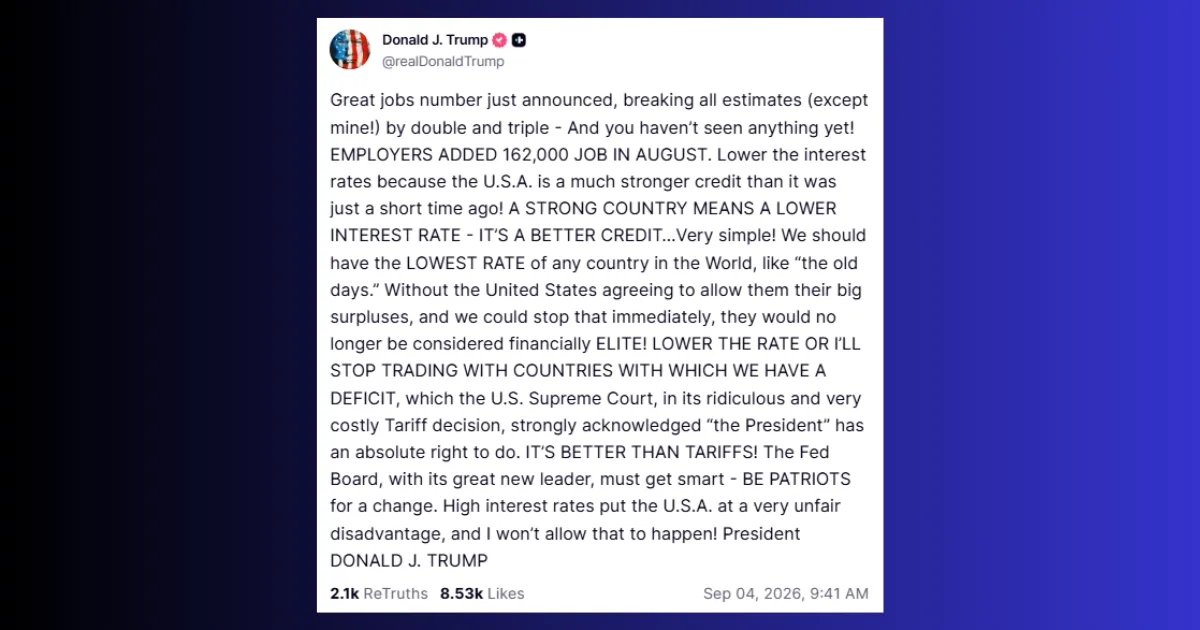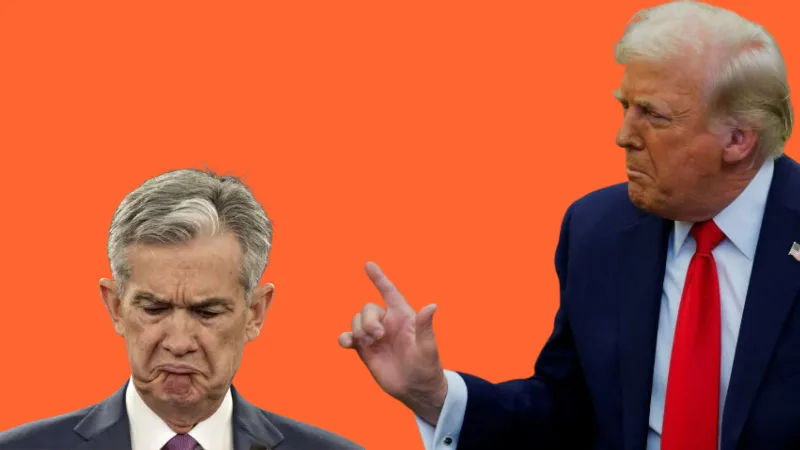
President Donald Trump reignited his ongoing feud with Federal Reserve Chairman Jerome Powell on Monday, publicly lambasting Powell for refusing to cut interest rates and slamming his leadership as costly and ineffective. Trump’s remarks have reignited concerns among investors and economists about political interference in central banking and raised new questions about the direction of U.S. monetary policy heading into a critical economic period.
“We have a bad Fed chairman, really bad,” Trump said during a press briefing at the White House. “If he would lower the rates… And I tried being nice to the guy. It doesn’t help. He’s like a knucklehead. Oh, he’s a knucklehead, a stupid guy. He really is.”
Trump went on to say that interest rates should be significantly lower, arguing, “We should be at 1%. We should be less than 1%.” This statement places him at direct odds with Powell’s more measured, data-driven approach to monetary policy.
A Long-Running Tension Boils Over
This is not the first time Trump has criticized Powell, whom he nominated to lead the Fed in 2017. Over the years, Trump has repeatedly pushed for aggressive rate cuts, arguing that higher rates slow economic growth and dampen investment. Powell, on the other hand, has consistently maintained that rate decisions should reflect a careful balancing of inflationary pressures, labor market conditions, and long-term economic stability.
Tensions escalated further last week when the Office of Management and Budget (OMB) Director Russell Vought, a close ally of Trump, sent a sharply worded letter to Powell accusing him of financial mismanagement. “President Trump is extremely troubled by your management of the Federal Reserve System,” Vought wrote.
The letter condemned the Fed’s ongoing $700 million renovation of its headquarters, calling it an “ostentatious overhaul” that includes extravagant design elements like VIP dining rooms, premium marble, rooftop gardens, and elaborate water features.
Powell Pushes Back Against Renovation Criticism
Fed Chair Powell responded to the criticisms during a Senate Banking Committee hearing, calling the media reports surrounding the renovations “misleading and inaccurate in many, many respects.”
“There’s no VIP dining room, there’s no new marble – we took down the old marble, we’re putting it back up,” Powell testified. “There are no special elevators, just the existing ones. There are no new water features, no beehives, no rooftop terrace gardens. All the sort of inflammatory things that the media carried are either not in the current plan or just inaccurate.”
Despite Powell’s rebuttals, the controversy has fanned the flames of political pressure on the central bank. Senator Tim Scott (R-S.C.), Chairman of the Banking Committee, echoed Vought’s sentiments, saying the plans “feel more like they belong in the Palace of Versailles than a public institution.”
Implications for Investors
For investors, the renewed clash between the White House and the Federal Reserve could increase market uncertainty in the months ahead. When political leaders openly pressure central banks, it can create doubt about the independence and objectivity of monetary policy decisions—factors critical to investor confidence and financial stability.
Moreover, Trump’s explicit call for interest rates below 1% could have profound effects on multiple asset classes. Lower interest rates typically drive up valuations in equities, especially in tech and growth stocks. However, if cuts are perceived as politically motivated rather than economically justified, they may trigger long-term volatility and erode trust in the dollar and U.S. Treasury bonds.
Renewed Speculation About Firing Powell
Trump has made no secret of his frustration with Powell’s leadership. Although the Federal Reserve was designed to be insulated from political interference, Trump has repeatedly floated the idea of removing Powell from his role—an act that, while legally murky, would undoubtedly send shockwaves through global markets.
The recent public insults and policy clashes have reignited speculation about whether Trump might attempt to replace Powell before the end of his term. While the law stipulates that a sitting Fed chair can only be removed “for cause,” Trump allies have previously explored ways to demote Powell or otherwise sideline his authority.
Political Pressure and Market Psychology
Political intervention in monetary policy historically makes markets nervous. The perception of central bank independence is a cornerstone of global financial stability. If investors believe that Fed decisions are driven by political agendas rather than economic fundamentals, they may begin to hedge more aggressively against inflation or pull capital out of dollar-denominated assets.
Gold prices, cryptocurrencies like Bitcoin, and defensive sectors such as utilities or consumer staples could see increased inflows if the Fed’s credibility continues to come under fire. Similarly, bond markets may begin pricing in greater risk premiums if they believe the central bank is being strong-armed into rate cuts.
What This Means for Investors Right Now
- Watch Fed Signals Closely: Expect increased market sensitivity to every Fed speech, dot plot, and FOMC statement. Even subtle language shifts could trigger large market reactions.
- Hedge Against Volatility: In an environment where political pressure influences economic policy, market swings become more pronounced. Consider portfolio diversification strategies, including exposure to gold, short-duration bonds, or sectors resilient to rate cuts.
- Monitor Dollar Strength: If political meddling weakens confidence in the Fed, the dollar could face downside pressure. This would impact importers, global companies, and international investors alike.
- Don’t Bet on Deep Cuts Yet: While Trump’s calls for sub-1% rates are loud, the Fed still retains its independence—for now. Investors should weigh real economic data rather than assuming Powell will cave to pressure.
The Bigger Picture
The feud between Trump and Powell is more than just political theater—it’s a clash over the future of U.S. monetary policy and the independence of one of the most powerful financial institutions in the world. Whether Powell can weather this storm or whether Trump escalates further remains to be seen. But what’s clear is that investors can’t afford to ignore the rhetoric or its implications.
Interest rates influence everything from mortgage payments to corporate borrowing costs to currency valuations. As this high-stakes battle continues to unfold, the market will be watching not just what the Fed does—but whether it can continue to act independently.
For now, Powell appears intent on staying the course, but the political heat is rising. And when the Fed chair is being called a “knucklehead” by the President of the United States, it’s a sure sign that investors should buckle up.
About Author