President Donald Trump just delivered one of the clearest signals yet that the White House believes it holds overwhelming leverage over Iran’s economic survival. Markets are now being forced to price in a dangerous possibility: this conflict may last far longer than traders originally expected, even if full-scale escalation is temporarily avoided.
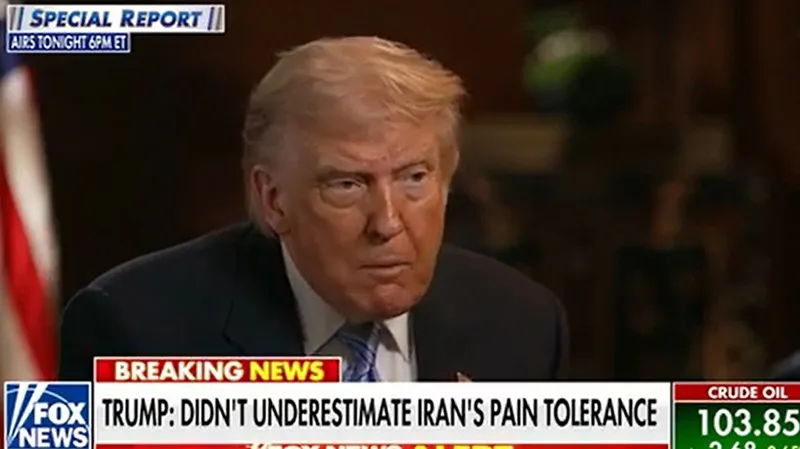
In an interview with Fox News’ Bret Baier, Trump rejected the idea that Iran’s resilience had been underestimated, arguing the U.S. deliberately spared key economic infrastructure despite its military capabilities. The comments arrive as tensions remain elevated around the Strait of Hormuz, one of the most important energy chokepoints on Earth, while Washington simultaneously attempts to negotiate a long-term peace arrangement with Tehran.
The message to markets was unmistakable: the administration believes it can escalate dramatically if needed, and oil traders, defense investors, shipping firms, and global central banks are all watching the same map.
Trump Signals Economic Pressure Campaign Could Intensify
When Baier asked Trump whether he underestimated Iran’s “pain tolerance,” Trump responded bluntly:
“I didn’t underestimate anything. We hit them unbelievably hard.”
Trump then revealed what may become the most market-moving part of the interview.
“We left their bridges. We left their electricity capacity. We can knock that all out in two days. Two days. Everything.”
That statement matters because it suggests the administration intentionally stopped short of fully dismantling Iran’s civilian and industrial infrastructure. Investors now have to consider what happens if that restraint disappears.
Trump also referenced Iran’s critical oil export infrastructure at Kharg Island, saying:
“We left Kharg Island, other than, I said ‘hit it except for the valves where the oil comes out.’”
Kharg Island handles the overwhelming majority of Iran’s crude exports. Any direct strike against those facilities could send oil markets into immediate shock, especially if Tehran retaliates in the Strait of Hormuz.
At the same time, Trump attempted to reassure Americans that rising U.S. oil activity could offset supply disruptions.
“Ships are floating up to Texas and Louisiana, and they’re going to Alaska, and they’re loading up with oil like we’ve never seen before.”
That line may sound political on the surface, but energy investors should pay attention. The administration appears increasingly comfortable framing U.S. energy dominance as a geopolitical weapon.
Energy Markets Are Quietly Entering a New Phase
The real story is not simply whether oil prices spike tomorrow.
The deeper shift is that global energy markets are beginning to adapt to the possibility of prolonged instability in the Middle East under a second Trump administration that appears far more willing to weaponize economic infrastructure than many investors anticipated.
The Strait of Hormuz remains central to that risk. Roughly a fifth of the world’s oil passes through the narrow shipping corridor. Any sustained disruption could rapidly push crude higher, reignite inflation concerns, and complicate Federal Reserve policy at a moment when markets are still hoping for eventual rate cuts.
That creates a difficult setup for equities.
Higher oil prices could initially benefit U.S. energy producers, LNG exporters, refiners, and pipeline operators. Defense stocks may also continue attracting inflows as investors position for sustained geopolitical instability.
But the broader market faces a more complicated equation. Rising energy costs could pressure transportation companies, industrial firms, airlines, retailers, and consumers already dealing with elevated living costs.
Bond markets are watching this closely because an oil-driven inflation resurgence could delay monetary easing expectations.
The Conflict Timeline Just Changed
One of the most important moments in the interview came when Baier asked Trump when Americans could expect the conflict to end.
Instead of signaling urgency for a quick resolution, Trump compared the current situation to some of America’s longest wars.
“Vietnam lasted 19 years. Iraq was like ten years. Korea was seven years.”
Then came the key line:
“We’re in there for two and a half months.”
That comparison may alter investor expectations more than any military headline.
Many traders initially treated the conflict as a contained geopolitical flare-up. Trump’s comments suggest the administration may be preparing the public for a drawn-out confrontation measured in years rather than weeks.
That changes how institutional capital positions itself.
Defense spending expectations rise under long-duration conflict assumptions. Energy security becomes a larger investment theme. Domestic manufacturing and strategic commodity supply chains gain importance. Inflation hedges regain attention.
Meanwhile, companies dependent on global stability, predictable shipping routes, or low fuel costs may face mounting pressure if volatility persists.
Beneath the Surface, Washington Is Sending a Message to China and Russia Too
There is another layer here many investors may be underestimating.
Trump’s remarks were aimed at Iran, but global powers were also listening carefully. By emphasizing that the U.S. intentionally spared infrastructure it could destroy rapidly, the administration was signaling the scale of American military and economic leverage.
That message matters for China’s energy security calculations and Russia’s positioning in global commodity markets.
If Middle East instability persists while the U.S. ramps domestic production, American energy exporters could gain geopolitical influence at a time when Europe and parts of Asia remain vulnerable to supply disruptions.
This is becoming bigger than Iran alone.
The market implications increasingly touch shipping lanes, global inflation expectations, defense procurement cycles, commodities, and international energy alliances.
Catalysts Investors Should Watch Next
- Any signs of military escalation around the Strait of Hormuz
- Changes in global shipping insurance costs
- U.S. crude export activity from Texas, Louisiana, and Alaska
- Iranian retaliation targeting oil infrastructure or maritime traffic
- Federal Reserve commentary tied to energy-driven inflation risks
- Defense contractor guidance and government procurement announcements
- Diplomatic developments tied to ceasefire or long-term negotiations
- Oil inventory and refinery capacity data over the coming weeks
One Clear Takeaway for Markets
Trump’s interview did more than defend the administration’s handling of Iran.
It signaled that the White House believes it can apply far more pressure than it has so far, while simultaneously preparing Americans for a potentially extended conflict timeline.
Markets now face a difficult balancing act between short-term optimism over contained escalation and the growing realization that geopolitical instability may remain a dominant macro force well into the future.
Investors betting that this situation fades quietly may be underestimating how quickly energy markets, inflation expectations, and defense spending trends can reshape the broader market narrative.
About Author