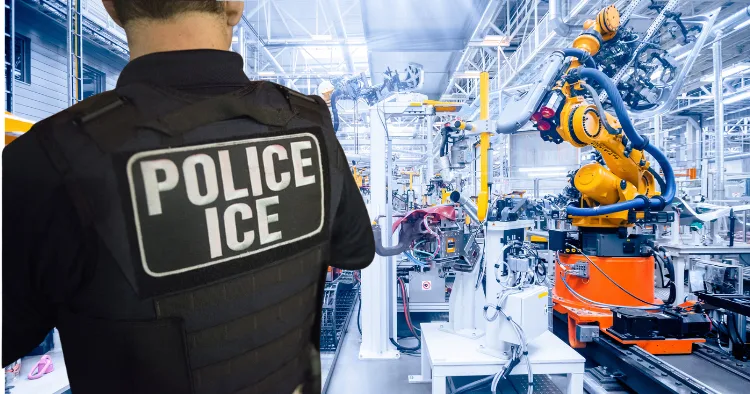
Earlier this month, U.S. immigration authorities carried out the largest single-site enforcement action in Department of Homeland Security history at Hyundai–LG Energy Solution’s electric vehicle (EV) battery plant construction site in Ellabell, Georgia. Nearly 475 foreign workers were detained in what officials called “Operation Low Voltage.” The majority of those detained were South Korean nationals, with some Mexican workers included as well.
This was not a small disruption. The project is a multi-billion-dollar investment meant to produce batteries for hundreds of thousands of EVs annually. Construction has now been paused, creating uncertainty not only for Hyundai and LG but also for the state of Georgia and U.S. industrial policy. For foreign governments and companies, the raid sends a troubling message. Washington has been urging global firms to invest in America’s supply chains, yet those same firms are now witnessing immigration crackdowns that threaten their operations.
What Happened in Georgia
On September 4, 2025, agents from Immigration and Customs Enforcement and Homeland Security Investigations detained hundreds of workers at the Georgia construction site. Many of those detained were in the United States on B-1 business visas or visa waiver entries. These visas allow for business meetings and training but not direct labor.
Hyundai and LG Energy Solution stated that the workers were hired by subcontractors and not directly employed by them. That detail may protect the parent companies legally, but it does not resolve the larger problem. The enforcement halted construction on a project valued between 4.3 billion and 7.6 billion dollars. This site was expected to play a central role in strengthening U.S. energy independence and reducing reliance on Chinese supply chains.
Diplomatic Fallout
The South Korean government reacted quickly. President Lee Jae-Myung called the raid a breach of trust and dispatched negotiators to Washington. Seoul secured an agreement to release the detained workers and arrange charter flights for their return.
The optics are troubling for allies. South Korea is one of the United States’ largest foreign investors, pledging more than 350 billion dollars in recent years for projects across EVs, semiconductors, and clean energy. The raid raises doubts about whether America is truly a stable and reliable partner for foreign direct investment.
Mixed Signals to Foreign Investors
For investors, the Hyundai raid highlights the risks of regulatory and political volatility in the United States. On one hand, Washington is offering billions of dollars in subsidies through the CHIPS Act, the Inflation Reduction Act, and state-level incentives to attract foreign capital. On the other hand, aggressive enforcement actions can freeze projects overnight and damage investor trust.
As one South Korean trade official noted, it makes little sense to invite billions in investment while penalizing foreign firms for immigration issues that often stem from subcontracting. That contradiction creates a higher risk premium for U.S. projects. Multinationals now face not only construction risk and supply chain delays but also unpredictable enforcement that can derail entire timelines.
Weaknesses in Oversight and Supply Chains
The raid also exposed governance gaps in the EV supply chain.
- Dependence on Foreign Expertise. Advanced manufacturing projects require specialized engineers and technicians. The U.S. workforce is not yet deep enough to provide all of these skills.
- Subcontractor Oversight. Hyundai insisted the detained workers were subcontractors, not direct employees. This highlights how foreign firms may lose visibility over their labor chains.
- Ripple Effects. A disruption at a single facility can spread quickly, delaying suppliers, logistics partners, and state economic plans.
For investors, the lesson is clear: supply chains are not only physical but also political and legal.
The Policy Contradiction
President Donald Trump defended the raid, saying that foreign companies must respect U.S. immigration law and prioritize training American workers. At the same time, he acknowledged the need for foreign experts to stay temporarily in order to transfer knowledge.
This dual message captures the tension in U.S. industrial strategy. Policymakers want foreign firms to build critical supply chains inside the country. Yet they also want to limit foreign labor, even in situations where American expertise is not yet sufficient. For global investors, that contradiction raises questions about whether America’s investment climate is as predictable as advertised.
Implications for Foreign Direct Investment
1. Higher Compliance Costs
Foreign firms will need to audit subcontractors, strengthen visa documentation, and maintain direct oversight of every worker on their sites. Investors should expect longer project timelines and higher overhead.
2. New Political Risk
The United States has traditionally been seen as one of the safest destinations for foreign direct investment. Sudden enforcement actions introduce political risk that investors normally associate with emerging markets.
3. Diversion of Capital
If the environment proves too unpredictable, some foreign investors may redirect future projects toward Canada, Mexico, or Southeast Asia. These regions often offer more flexible immigration policies and comparable supply chain access.
4. Local Hiring as a Strategy
Companies that can train and expand a domestic workforce will be better positioned to win U.S. contracts and avoid compliance disruptions. Investors should watch firms that are investing heavily in American workforce development.
Takeaways for Investors
The Hyundai ICE raid is more than a legal story. It is a warning about the complexity of foreign direct investment in the United States.
- U.S. projects remain attractive, but investors must now budget for compliance and potential enforcement delays.
- Visa policy will be a key driver. Tightening rules could slow project rollouts. Any reforms that expand access for skilled workers could ease investment flows.
- Companies with diversified global footprints will be more resilient to U.S. political shifts.
- Secondary industries such as compliance consulting, workforce training, and local staffing may benefit as global firms seek to mitigate risk.
Conclusion
The Hyundai ICE raid in Georgia underscores the fragility of America’s approach to foreign direct investment. Washington wants foreign capital and technology to build out EV supply chains. Yet without clear visa frameworks and consistent enforcement, even flagship projects can grind to a halt.
For investors, this incident should spark a reassessment of political and compliance risks in the U.S. market. The companies that thrive will be those that adapt quickly, balance global expertise with local hiring, and maintain airtight governance.
Foreign direct investment in America is not going away. However, the rules of the game are shifting, and investors cannot afford to ignore the signals.
About Author