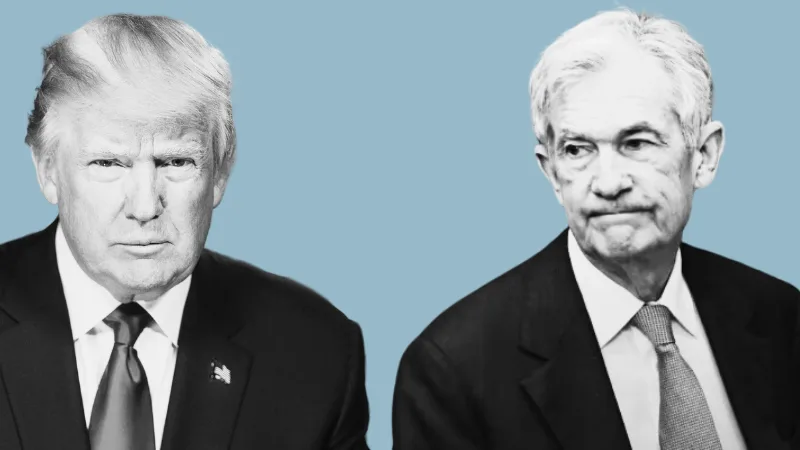
With Powell’s term as Fed chair nearing its end, Trump is signaling he may take aggressive action if Powell refuses to step aside. At the same time, a Justice Department investigation into Powell is raising new questions about the independence of the Federal Reserve and the future direction of U.S. monetary policy.
In a recent television interview, President Trump made it clear that he is prepared to act if Powell does not voluntarily step down at the end of his term.
“Well then I’ll have to fire him, OK?” Trump said during the interview.
The statement reinforces Trump’s long-standing frustration with Powell, whom he has repeatedly criticized over interest rate decisions and monetary policy direction.
While Powell’s term as Fed chair is set to expire soon, he is legally allowed to remain on the Federal Reserve Board as a voting member until 2028. That possibility appears to be a sticking point for the administration.
Powell himself has indicated he does not plan to leave quietly. He has stated he has “no intention of leaving” until the ongoing investigation concludes with what he described as transparency and finality.
The Justice Department Investigation Explained
At the center of the conflict is a Justice Department probe examining whether Powell misled Congress during testimony related to a Federal Reserve building renovation project.
According to reports, the investigation is active and ongoing. Prosecutors have even visited the construction site tied to the inquiry, signaling that the case has not been quietly shelved.
Powell has pushed back strongly against the investigation, suggesting it is politically motivated and part of a broader effort to pressure the Federal Reserve into changing its policy stance.
This raises a critical issue that markets care deeply about: central bank independence.
Why Fed Independence Matters to Investors
The Federal Reserve is designed to operate independently from political influence so it can make decisions based on economic data rather than political pressure.
If markets begin to believe that the Fed is being influenced or controlled by the White House, several consequences could follow:
- Increased volatility in bond markets
- Higher inflation expectations
- Weakening confidence in the U.S. dollar
- Risk premiums rising across equities
Historically, central bank independence has been one of the pillars supporting global confidence in U.S. financial markets. Any perceived erosion of that independence could have ripple effects across asset classes.
Legal Limits on Removing a Fed Chair
Trump’s comments about potentially firing Powell face a major legal hurdle.
Federal Reserve officials are protected under laws that restrict removal to specific causes such as misconduct or incapacity. Policy disagreements are not considered valid grounds for dismissal.
The issue is now even more complicated because the Supreme Court is currently reviewing a separate case involving the removal of a federal official. That ruling could redefine how much authority a president has over independent agencies like the Federal Reserve.
In other words, this situation could set a precedent that reshapes the balance of power between the White House and independent regulators for years to come.
Political Fallout and Senate Resistance
The situation is also creating friction within the Republican Party.
Trump’s preferred candidate to replace Powell, Kevin Warsh, is facing resistance in the Senate. Senator Thom Tillis has publicly stated that he will not support Warsh’s nomination until the investigation into Powell is resolved.
Trump dismissed concerns about Tillis’ position, saying, “He might not, but that’s why Tillis is no longer a senator.” While Tillis is retiring, he remains in office and retains voting power over the confirmation process.
Meanwhile, Senator Tim Scott, who chairs the Senate Banking Committee, has expressed confidence that the situation will resolve itself. However, he acknowledged that he does not have concrete evidence that the investigation will conclude quickly.
This political gridlock adds another layer of uncertainty for investors.
Market Implications: Why This Matters Right Now
This is not just a Washington story. It is a market-moving event.
Here are the key ways this standoff could impact investors:
1. Interest Rate Policy Uncertainty
If Powell remains in place, the Fed is likely to continue its current data-driven approach to rates. If Trump succeeds in replacing him, markets may anticipate a shift toward lower interest rates.
That expectation alone can move stocks, bonds, and currencies.
2. Volatility in Treasury Markets
Any perceived political interference in the Fed could lead investors to demand higher yields on U.S. Treasuries. That would increase borrowing costs across the economy, from mortgages to corporate debt.
3. Stock Market Rotation
Certain sectors are more sensitive to interest rate expectations:
- Growth stocks benefit from lower rates
- Financials often benefit from higher rates
- Utilities and real estate can swing sharply based on rate outlooks
A change in Fed leadership could trigger rapid sector rotations.
4. U.S. Dollar Pressure
If global investors begin to question the independence of the Fed, the U.S. dollar could weaken. That would have downstream effects on commodities, international trade, and multinational earnings.
Bigger Picture: A Long-Running Conflict
This clash did not happen overnight.
Trump has repeatedly criticized Powell dating back to his previous administration, often arguing that interest rates were too high and were holding back economic growth.
Powell, for his part, has maintained that the Fed’s decisions are based on economic data, not political pressure.
About Author