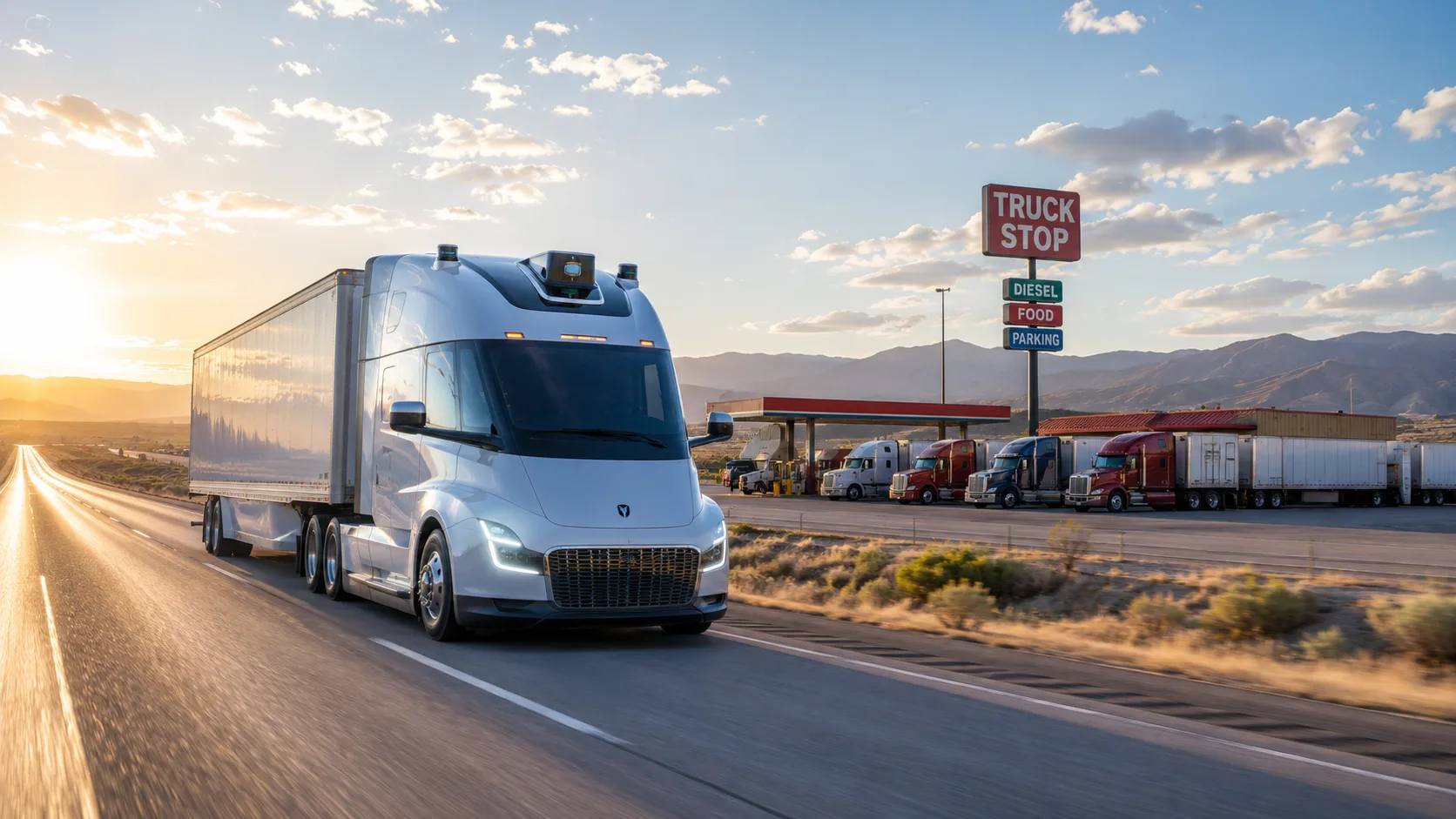
A silent economic shift is unfolding across American highways, and it could eventually impact millions of workers far beyond the trucking industry itself. Autonomous trucks are no longer trapped in the “future technology” category that investors have heard about for years. The industry is crossing into something much more disruptive: measurable economic superiority over human labor.
That changes the entire conversation.
When a driverless truck can move freight cheaper than a human driver, the debate stops being about futuristic innovation and starts becoming about corporate survival, labor replacement, and economic restructuring. Transportation companies operate on thin margins. Once automation becomes materially cheaper, pressure builds quickly across the entire system.
The implications stretch far beyond trucking companies and Silicon Valley startups. This could eventually reshape blue-collar employment, regional economies, supply chains, inflation, industrial real estate, and even political battles over the future of work in America.
Most investors still think autonomous trucking is a technology story.
It is becoming a labor economics story.
The Number That Finally Changed the Industry Conversation
For years, autonomous vehicle companies obsessed over software breakthroughs, sensor ranges, artificial intelligence models, and safety demonstrations. Investors heard endless promises about “millions of autonomous miles.”
The freight industry cared about something much simpler.
Can this truck move cargo cheaper than a human driver?
That question is finally getting a real answer.
According to Goldman Sachs Research, autonomous trucks are expected to become cheaper per mile than traditional human-driven trucks by 2028. Some companies claim they are already reaching that threshold on select routes.
One of them is Bot Auto.
The company recently completed a fully driverless commercial freight delivery between Houston and Dallas at a reported operating cost of $1.89 per mile. By comparison, the American Transportation Research Institute estimates human-driven trucking currently costs roughly $2.26 per mile.
That difference may appear small.
It is massive inside the freight industry.
Freight transportation is a scale business where even minor efficiency improvements can permanently alter competitive dynamics. When margins are tight, shaving costs across millions of miles can completely change who survives and who gets left behind.
There is another reason this story matters far beyond Wall Street and the technology sector: trucking remains one of the largest employment categories in America. Millions of people work directly or indirectly in freight transportation, from long-haul drivers and dispatchers to warehouse support staff, truck stop operators, maintenance businesses, and logistics coordinators.
If autonomous trucking scales nationally over the next decade, the economic consequences could spread far beyond freight companies themselves.
America’s Largest AI Labor Collision May Be on the Highway
For decades, trucking represented something increasingly rare in the modern U.S. economy: a middle-class career path that did not require a college degree.
That matters politically.
According to the U.S. Bureau of Labor Statistics, heavy and tractor-trailer truck driving remains one of the most common occupations in America. Entire towns, highway economies, and regional labor markets depend on the movement of freight.
Autonomous trucking threatens to pressure that ecosystem over time.
The first phase likely will not involve dramatic overnight layoffs. The shift could begin more quietly through reduced hiring, shrinking demand for long-haul routes, wage pressure, and gradual fleet restructuring as autonomous systems expand corridor by corridor across the Sunbelt.
That is how major labor disruptions often begin in America.
Slowly at first.
Then all at once.
Companies publicly frame autonomous trucking around safety improvements and supply chain efficiency. Beneath the surface, the race is increasingly about labor costs and operational leverage.
Driver wages continue climbing. Insurance expenses remain elevated. Healthcare costs keep rising. Recruiting younger drivers has become more difficult. Retention remains expensive for carriers already operating under margin pressure.
AI offers something executives have chased for decades: a truck that never requires overtime pay, never asks for benefits, never sleeps, and never walks away from the job market.
That reality will likely create one of the fiercest labor and political battles of the AI era.
Silicon Valley Is Selling Efficiency. Corporate America Sees Payroll Reduction
Most headlines around autonomous vehicles still revolve around robotaxis.
That may prove to be the smaller opportunity.
Goldman Sachs projects the global autonomous trucking market could reach $560 billion by 2035, eclipsing the projected $415 billion robotaxi market.
The reason is simple.
Freight companies make decisions based on economics, not emotion.
Consumers may hesitate to trust self-driving taxis. Shipping companies care about lowering operating costs, increasing asset utilization, and improving delivery speed.
Autonomous trucks potentially deliver all three.
That gives freight automation a much clearer commercial pathway than many consumer-facing AI technologies.
The Houston-to-Dallas corridor is a perfect example of why this transition may accelerate faster than many investors expect. Long highway stretches, predictable driving conditions, favorable weather, and heavy freight demand create an ideal testing environment for autonomous deployment.
The industry does not need to solve every difficult road condition in America immediately.
It only needs profitable deployment in key freight corridors to begin scaling commercially.
Once the economics work consistently in a handful of major routes, expansion capital and competitive pressure could accelerate rapidly.
Why the Trucking Labor Shortage Could Accelerate Automation Faster
The autonomous trucking race is quietly becoming one of the largest labor replacement bets in the American economy.
That is the hidden story sitting underneath the technology narrative.
Investors should understand that this shift is happening during a period of rising labor costs, demographic strain, and inflation pressure. The trucking industry has struggled for years to recruit younger drivers willing to spend long stretches away from home.
Ironically, the labor shortage itself may end up accelerating automation adoption.
Carriers facing demographic decline and operational strain may increasingly view autonomous systems as a financial necessity rather than a futuristic experiment.
In other words, the labor crisis and the automation wave may end up feeding each other.
That dynamic could create a self-reinforcing cycle where automation expands because labor is scarce, which then reduces future labor demand even further.
History shows that once industries cross an economic tipping point with automation, adoption curves can steepen very quickly.
The internet did this.
Cloud computing did this.
Artificial intelligence software is doing this right now.
Autonomous freight may be approaching its own inflection point.
The Five-Layer Freight Reset Investors Need to Understand
Investors need a framework for evaluating where value and disruption may emerge from this transition.
Layer 1: Autonomous Infrastructure
This includes the companies building autonomous driving systems, AI software stacks, sensors, compute platforms, and logistics intelligence systems.
This layer will attract the most investor attention early.
It will also likely experience heavy volatility.
Layer 2: Fleet Margin Expansion
Large freight operators that successfully integrate autonomous trucking could dramatically improve margins and asset productivity.
Trucks operating nearly around the clock create a completely different economic model compared to human-limited driving schedules.
That changes fleet economics permanently.
Layer 3: Industrial Real Estate Realignment
Warehouse demand patterns may evolve as freight movement becomes faster and more continuous.
Distribution hubs near autonomous freight corridors could become increasingly valuable.
Industrial real estate operators tied to logistics infrastructure deserve close investor attention.
Layer 4: Insurance and Risk Transformation
Commercial trucking insurance may eventually face significant disruption if autonomous systems reduce accident rates over time.
The transition period could remain volatile as insurers attempt to price both human-driven and autonomous risk simultaneously.
Layer 5: Political and Labor Resistance
This layer may ultimately become the most important.
Once labor displacement becomes visible at scale, pressure could build for new regulation, labor protections, autonomous trucking restrictions, or special taxation tied to automation.
The winners in this industry may not necessarily be the companies with the best technology.
The winners may be the firms best positioned politically.
The Roadside Economy May Become Collateral Damage
The disruption may eventually extend far beyond truck drivers themselves.
An entire roadside economy developed around human freight movement over the last century. Truck stops, diners, roadside motels, repair shops, logistics staffing firms, driver training schools, fuel stations, and service businesses all depend on the routines of human drivers moving across interstate corridors.
Autonomous fleets operating continuously with fewer overnight stops could gradually weaken parts of that ecosystem.
That does not mean those businesses disappear overnight.
It does mean certain regions could eventually face economic pressure if freight patterns change materially over time.
Investors should pay attention to which regional economies are heavily dependent on trucking activity and highway commerce.
The second-order effects may become larger than many analysts currently expect.
California Just Fired the Starting Gun
One recent development received far less attention than it deserved.
California approved new rules allowing autonomous trucks in the state despite heavy labor opposition.
That is significant because California remains one of the largest freight markets in the United States.
Once California begins opening regulatory pathways, pressure builds nationally.
Congress may also become more involved later this year during discussions surrounding major highway funding legislation. Federal standards could accelerate deployment timelines dramatically by creating clearer operating frameworks for autonomous freight operators.
Investors should watch Washington carefully.
Policy risk may eventually become just as important as technological capability.
The Next Inflation Battle Could Happen on America’s Highways
Transportation costs influence nearly every part of the economy.
If autonomous trucking materially lowers freight expenses over time, portions of the supply chain could become structurally cheaper and more efficient. Faster delivery cycles and lower operating costs may reduce friction across inventory systems and distribution networks.
That introduces a potential long-term deflationary force inside portions of the economy.
Friction reduction has historically created enormous economic value.
Railroads changed commerce.
Container shipping transformed global trade.
Cloud computing reshaped software infrastructure.
Autonomous freight could eventually become another major efficiency unlock.
The companies positioned between AI infrastructure and physical logistics may capture some of the largest long-term gains from this transition.
Where Capital Could Flow if Driverless Freight Scales Nationally
Investors chasing flashy autonomous startups may ultimately miss the broader opportunity set.
Some of the largest beneficiaries could include freight brokers integrating autonomous capacity early, industrial warehouse operators near autonomous corridors, semiconductor firms supplying AI compute systems, and infrastructure companies supporting freight digitization.
Insurance firms that successfully adapt to autonomous risk pricing could also gain an edge over slower-moving competitors.
Meanwhile, certain traditional trucking operators may struggle if they cannot modernize fleets fast enough to compete on cost.
This transition could eventually create a broad industrial reshuffling similar to what e-commerce did to retail logistics over the last two decades.
The companies positioned between physical infrastructure and AI automation may capture the most durable long-term value.
The Real Question Is No Longer Whether This Technology Works
Autonomous trucking is evolving into something far larger than a technology experiment.
It is becoming a referendum on the future value of human labor inside one of America’s most important industries.
The key development is no longer whether autonomous trucks can technically operate on highways. The key development is that the economics are rapidly improving while freight companies remain desperate for efficiency gains and labor stability.
Once the cost advantage becomes undeniable across major freight corridors, the pressure to automate may become extremely difficult to stop.
Investors focusing only on the technology may miss the much larger transformation unfolding underneath it: a potential restructuring of freight economics, blue-collar employment, regional commerce, and political power across the United States.
The market still views autonomous trucking as a futuristic concept.
The freight industry is beginning to view it as a balance-sheet necessity.
About Author