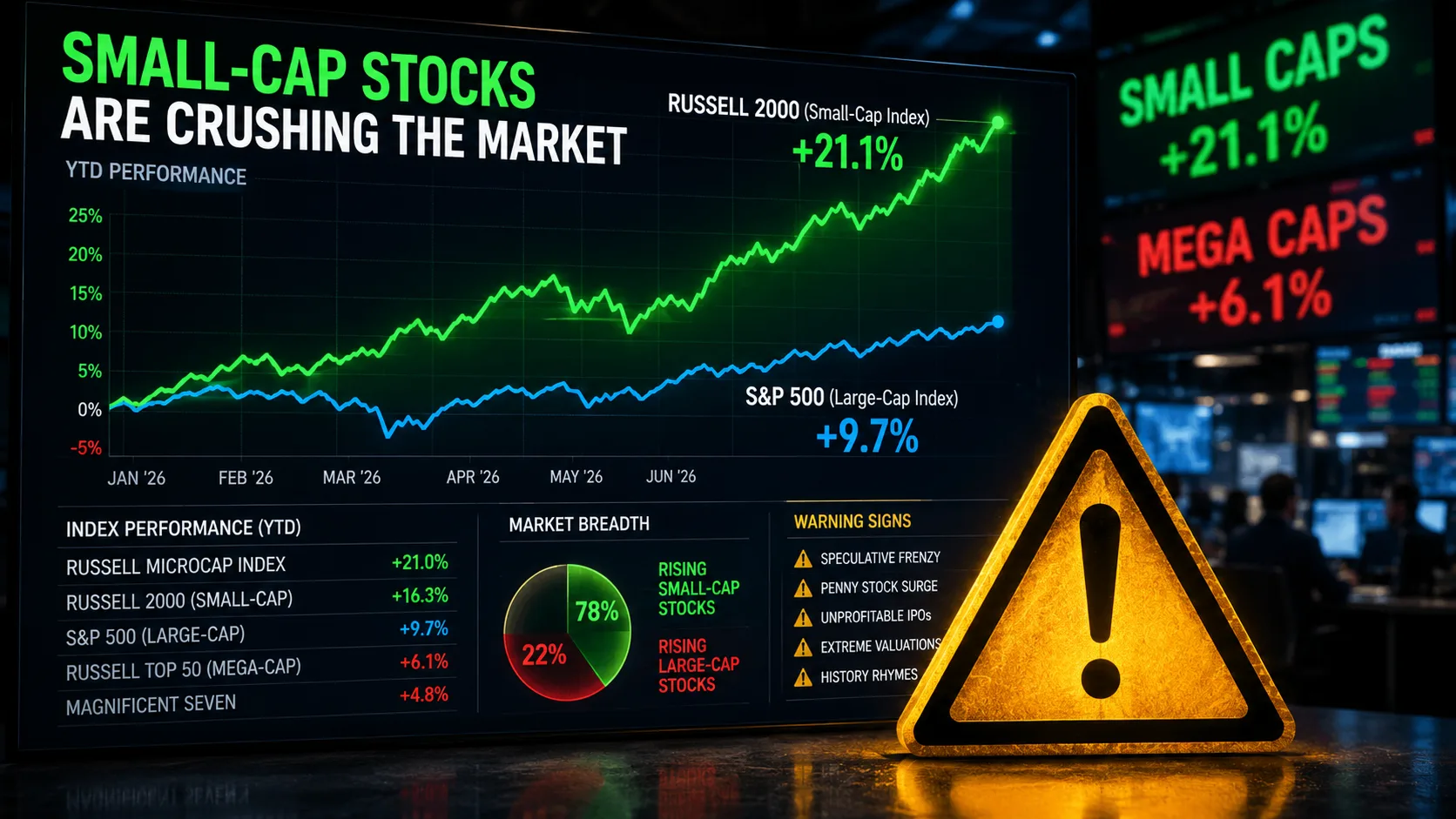
For years, investors have been told that the stock market revolves around the Magnificent Seven and other mega-cap giants. But 2026 has delivered a surprising twist.
America’s smallest publicly traded companies are dramatically outperforming the market’s largest names.
The Russell Microcap Index has surged roughly 21% this year, nearly doubling the gains of the S&P 500. Meanwhile, the Russell Top 50 Index, which tracks many of America’s largest corporations, has gained only about 6%.
At first glance, this looks like a healthy broadening of market participation. But beneath the surface, several warning signs suggest investors should be cautious about chasing the rally.
America’s Smallest Stocks Are Suddenly Beating the Market
The performance gap between small companies and market giants has become difficult to ignore.
While investors continue focusing on artificial intelligence leaders and trillion-dollar technology firms, many of the strongest returns this year have come from companies that receive little attention from Wall Street.
The Russell 2000 has posted strong gains, but the biggest surprise has been among microcap stocks, which have significantly outperformed both large-cap indexes and many household-name technology companies.
This shift represents one of the most dramatic reversals of market leadership in years.
The question is why.
Why Penny Stocks Are Suddenly Back in Favor
One of the biggest drivers behind the small-cap rally has been a resurgence in speculative trading.
Penny stocks, generally defined as shares trading below $5, have been among the market’s strongest performers. Since late March, they have gained roughly 28% on average, outperforming many larger small-cap companies and even the Magnificent Seven.
That may sound exciting, but history suggests investors should pay attention when speculative stocks start leading the market.
Many penny stocks receive little or no analyst coverage. Financial disclosures can be limited, trading volumes are often thin, and business fundamentals are frequently uncertain.
When large groups of these companies begin rising together, it often reflects investor enthusiasm rather than improving economic conditions.
The same behavior can be seen throughout the broader market. Investors continue pouring money into AI-related companies despite significant uncertainty about how many of these businesses will eventually generate meaningful profits.
Several companies have seen their valuations soar simply by announcing AI initiatives, while unprofitable IPOs have quickly become some of the most valuable newly listed companies in America.
The Unexpected Event That Changed Market Leadership
Geopolitics also played a major role in reshaping market leadership this year.
During the first quarter, concerns surrounding the U.S.-Israeli military action against Iran triggered widespread selling across global markets.
Large multinational companies were hit particularly hard as investors worried about higher energy prices, slowing international growth, and increased economic uncertainty.
The Magnificent Seven collectively fell roughly 16% during the first three months of the year, creating significant pressure on major indexes.
Meanwhile, smaller domestic-focused companies proved more resilient.
Because many small businesses generate most of their revenue inside the United States, investors viewed them as less vulnerable to global economic disruptions. The United States also remains a net exporter of petroleum products, helping cushion some of the economic impact from higher oil prices.
That combination encouraged investors to shift capital toward smaller companies while reducing exposure to multinational giants.
Why Money Is Flowing Out of Big Tech and Into Smaller Companies
The rally is not solely about speculation or geopolitics.
Smaller companies entered 2026 after years of underperformance. Following the AI-fueled surge in mega-cap technology stocks, many investors began searching for opportunities elsewhere.
That rotation started late last year and accelerated throughout 2026.
Compared with many large technology stocks trading at premium valuations, small-cap companies appeared relatively inexpensive. Investors looking for value naturally found more opportunities among overlooked businesses than among trillion-dollar market leaders.
As money flowed out of crowded trades and into neglected sectors, small-cap stocks received a significant boost.
Still, not all of the gains reflect broad-based strength across the entire small-cap universe.
Some of This Year’s Biggest Winners Aren’t Really Small Stocks
A strange quirk in index construction has amplified some of the performance numbers.
Several companies technically classified as small-cap or mid-cap stocks have become enormous businesses while remaining inside indexes designed for much smaller companies.
One example is Bloom Energy.
The fuel-cell producer remains a member of the Russell 2000 despite growing into one of the country’s largest publicly traded companies. Bloom Energy has surged more than 235% this year and more than fourteenfold over the past twelve months as investors embraced its role in powering AI-related data centers.
Another example is SanDisk.
The company has benefited from growing demand for AI-related storage solutions and now ranks among the most valuable corporations in America. Yet its classification within certain indexes continues to boost smaller-company benchmarks.
Because these companies have become significantly larger than many of their index peers, their extraordinary gains have had an outsized impact on small-cap performance figures.
The Last Two Times This Happened, Investors Regretted It
This is not the first time speculative enthusiasm has fueled a small-cap rally.
In 2021, investors rushed into SPACs, cannabis stocks, meme stocks, and unprofitable technology companies. The excitement eventually faded, leaving many investors with steep losses.
A similar pattern emerged during late 2022 and early 2023. Small-cap stocks initially surged as investors anticipated economic recovery, only to stall while large technology companies regained leadership through the AI boom.
Today’s environment is not identical, but the similarities are difficult to ignore.
When investors begin aggressively buying companies with uncertain earnings prospects simply because prices are rising, risks often build beneath the surface.
The Key Question Investors Need to Ask Right Now
Small-cap stocks are not automatically a bad investment.
Many smaller companies remain attractively valued and could benefit from lower interest rates, improving economic conditions, and stronger domestic growth.
The challenge is separating fundamentally strong businesses from stocks being driven primarily by momentum and speculation.
Investors should focus on earnings growth, cash flow generation, competitive advantages, and balance-sheet strength rather than simply chasing the strongest recent performers.
The companies that continue delivering results after speculative enthusiasm fades are often the ones that generate the best long-term returns.
What This Rally Could Mean for Your Money
The recent outperformance of small-cap stocks is encouraging because it suggests market gains are expanding beyond a handful of mega-cap technology companies.
A broader market rally is generally healthier than one driven by only a few dominant stocks.
At the same time, investors should remember that some of the strongest small-cap rallies in recent history have coincided with periods of excessive optimism and elevated speculation.
The opportunity today may not be chasing the hottest penny stock or the latest AI-themed microcap. It may be finding high-quality smaller businesses with sustainable growth prospects that can continue creating value long after market excitement fades.
Small-cap stocks may continue leading the market in the months ahead. The question investors need to answer is whether they are buying future winners or simply participating in the market’s latest speculative craze.
About Author