The great American summer vacation may be heading into its first real financial stress test since inflation exploded after the pandemic.
Flights are expensive. Gas prices are surging. Budget airlines are disappearing. Hotel costs remain elevated. And now one of the most important oil transit routes in the world is under pressure after the escalating Iran conflict pushed energy markets into panic mode.
Yet millions of Americans are still booking trips anyway.
That contradiction matters far beyond the travel industry. It may become one of the clearest real-time indicators of how much financial pain U.S. consumers can absorb before spending finally cracks.
And for investors, Memorial Day weekend could quietly become one of the most important consumer confidence signals of the entire summer.
The Summer Consumer Stress Test Has Arrived
For months, Wall Street has debated whether the U.S. consumer is finally weakening.
Credit card balances remain near record highs. Delinquencies have risen. Many Americans are struggling with higher grocery costs, insurance costs, housing costs, and interest rates.
But leisure spending has remained surprisingly resilient.
Travel has been one of the last major “I’m still doing okay” categories for consumers. Americans may cut back on furniture, electronics, or discretionary shopping before they cancel family vacations.
That is why this summer matters.
If consumers begin pulling back on travel despite strong emotional demand, investors may need to rethink assumptions about consumer strength heading into the second half of the year.
The problem is that travel costs are suddenly rising almost everywhere at once.
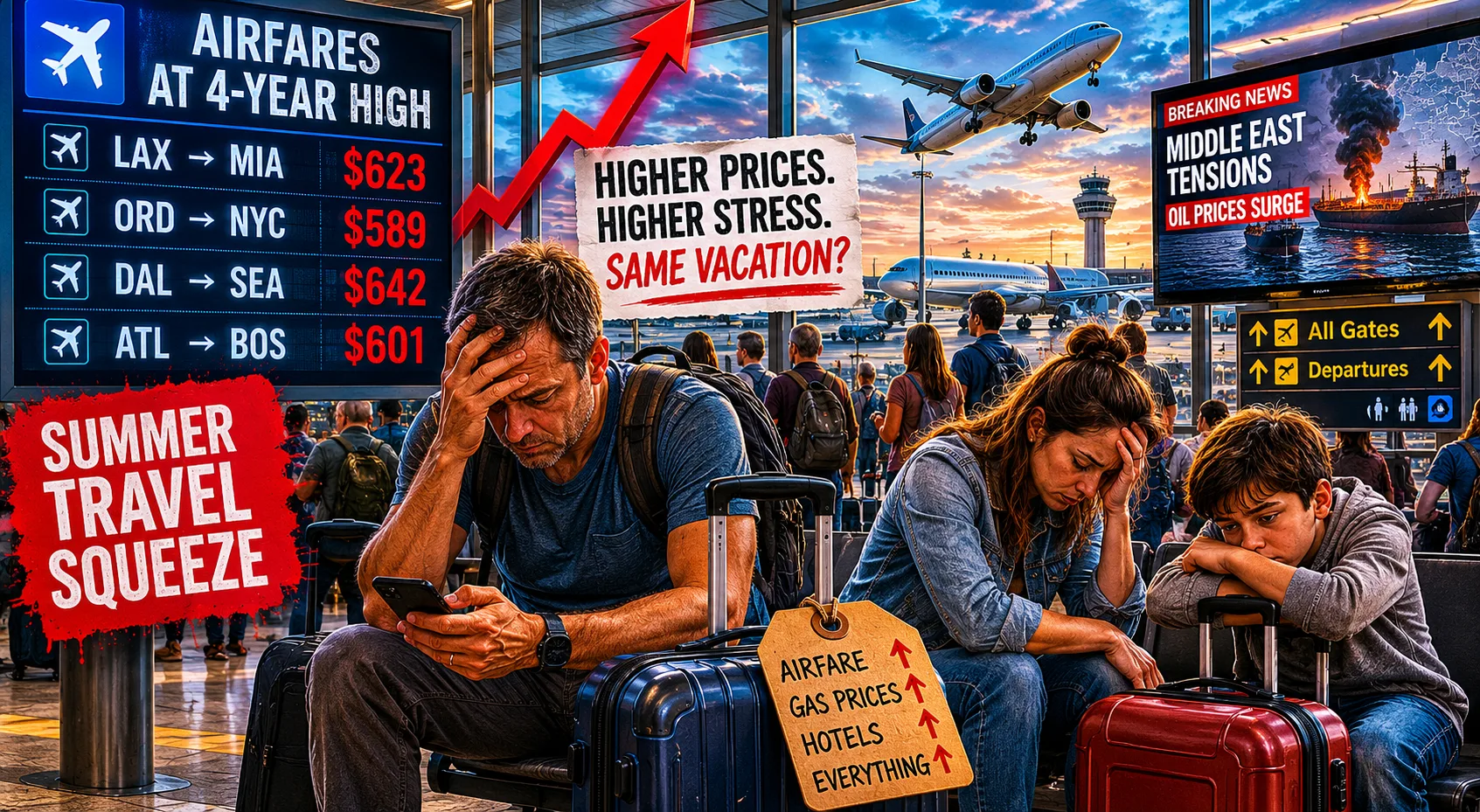
Domestic round-trip airfare averaged $623 in April, according to Airlines Reporting Corporation data. That is the highest level in nearly four years.
At the same time, gasoline prices are climbing sharply. GasBuddy forecasts average national gas prices could hit $4.48 during Memorial Day weekend and potentially rise toward $4.80 through Labor Day if tensions around the Strait of Hormuz continue disrupting energy markets.
That creates a dangerous combination for household budgets.
Families planning vacations are now getting squeezed on both ends:
- Higher transportation costs
- Higher overall living expenses
The consumer may still want to travel.
The bigger question is whether they can afford to keep doing it.
Why Oil Markets Suddenly Matter Again
This story is really about oil.
The conflict involving Iran has already triggered major disruptions across energy markets, especially around the Strait of Hormuz, one of the most strategically important shipping lanes on Earth.
A massive percentage of global oil exports pass through that narrow corridor.
Markets are increasingly pricing in the possibility that prolonged disruptions could keep fuel costs elevated well into the summer travel season.
That matters because jet fuel is one of the largest costs airlines face.
And airlines are now openly admitting they are pushing those higher costs directly onto consumers.
Jet fuel prices reportedly doubled in less than three months following the escalation involving Iran.
For investors, this creates ripple effects far beyond airlines:
- Higher airline ticket prices
- Higher shipping costs
- Potentially higher inflation readings
- Pressure on consumer discretionary spending
- Increased risk of stagflation fears returning
The market spent much of the past year celebrating falling inflation trends.
A sustained energy shock could reverse some of that progress surprisingly fast.
Spirit Airlines’ Collapse May Be More Important Than People Realize
One of the most overlooked developments in this story is the collapse of Spirit Airlines.
The airline partially blamed soaring fuel prices for its inability to recover after back-to-back bankruptcies.
Most headlines focused on the corporate collapse itself.
But the deeper issue is what Spirit represented.
Spirit was one of the largest suppressors of airfare pricing in the United States. Its ultra-low-cost model forced competitors to keep prices lower on many domestic routes.
Now that pricing pressure is disappearing.
That could quietly reshape airfare economics across the industry.
Even if major airlines add capacity to absorb former Spirit customers, the removal of a major discount player changes the competitive landscape significantly.
In practical terms:
- Fewer ultra-cheap fares
- Less pricing pressure on competitors
- Higher baseline ticket prices
- Potentially stronger airline profit margins
This is one reason airline stocks could become more complicated than many investors expect this summer.
Higher fares sound positive for carriers initially.
But if fares rise too aggressively, demand destruction becomes a real risk.
That balance becomes critical.
The Hidden Risk Wall Street Is Watching
The most important data point in this entire story may not be airline profits.
It may be road trip growth.
According to AAA, approximately 39.1 million Americans are expected to drive at least 50 miles over Memorial Day weekend.
That sounds strong until you examine the growth rate.
The increase versus last year is just 0.1%.
AAA reportedly noted this was the weakest Memorial Day driving growth in roughly a decade.
That is a major warning sign.
Road trips are usually the “budget alternative” during periods of economic strain. Families that cannot afford expensive flights often pivot toward driving vacations instead.
But if even road travel demand is flattening despite pent-up summer demand, investors should pay attention.
It suggests consumers may be approaching the upper limit of what they are willing or able to spend.
This becomes especially important because consumer spending drives roughly 70% of the U.S. economy.
Travel is emotional spending.
When emotional spending weakens, broader weakness often follows.
Why Airlines Still Sound Optimistic
Despite rising costs, airlines are not acting like demand is collapsing.
Far from it.
United Airlines expects to carry 53 million travelers between June and August, up roughly 3 million from last year.
American Airlines forecast approximately 75 million passengers between late May and early September, exceeding its previous record set before the pandemic.
That optimism matters.
It suggests airlines still see strong booking momentum despite higher prices.
But there is another layer investors should understand.
Airlines are simultaneously reducing capacity growth.
That means:
- Fewer flights
- Fewer available seats
- Potentially stronger pricing power
In other words, airlines may not need explosive passenger growth to maintain profitability.
If supply tightens while demand remains merely stable, ticket prices can remain elevated.
This is one reason airline executives are still sounding relatively confident.
The Consumer Divide Is Becoming More Obvious
This travel season may also reveal a widening economic divide inside the United States.
Higher-income consumers are still traveling aggressively.
Lower- and middle-income consumers appear increasingly pressured.
That distinction matters enormously for investors.
Luxury travel has remained surprisingly strong across much of the post-pandemic economy.
Budget-sensitive spending has weakened more noticeably.
The disappearance of Spirit Airlines may actually reinforce that divide further.
The ultra-budget traveler is becoming less economically viable inside the current fuel environment.
Meanwhile, premium travel demand remains resilient.
That dynamic could create winners and losers across the travel sector:
- Premium airlines may outperform discount carriers
- Luxury hotel operators may hold up better than economy chains
- Credit card travel ecosystems could benefit from points usage
- Oil producers may benefit if geopolitical tensions persist
The Miles and Points Boom Could Accelerate
Another hidden trend emerging here involves travel rewards programs.
Travel expert Kyle Potter urged consumers to start using miles and points now rather than hoarding them for future trips.
That advice reflects something important many consumers ignore:
travel rewards programs can quietly devalue over time.
As ticket prices rise, airlines often increase the number of miles required for redemption.
That could accelerate this summer if airfare inflation continues.
Investors should remember that loyalty programs have become enormously profitable for airlines and banks.
In some cases, those programs are more valuable than the airlines themselves.
Companies connected to travel rewards ecosystems may continue benefiting even if some consumers begin trading cash spending for points redemptions.
What Investors Should Watch Next
This summer travel season is becoming a live experiment in consumer endurance.
Several signals will matter enormously over the next 60 to 90 days:
1. Gas Prices
If national averages move toward the projected $4.80 level, consumer psychology could deteriorate rapidly.
2. Airline Booking Trends
Investors should watch for any weakening in July and August booking commentary during airline earnings calls.
3. Consumer Credit Stress
Rising vacation spending alongside rising debt burdens could pressure household balance sheets later this year.
4. Oil Market Stability
Everything changes if tensions involving Iran worsen or the Strait of Hormuz faces prolonged disruptions.
5. Inflation Data
Energy inflation filtering back into the economy could complicate Federal Reserve rate-cut expectations.
That last point may be the most important.
If higher fuel prices begin reigniting inflation concerns, markets may need to reprice expectations around interest rates entirely.
The Bigger Picture Investors May Be Missing
The real story here is not just expensive summer vacations.
It is the growing collision between emotional consumer behavior and economic reality.
Americans still want experiences.
They still want vacations.
They still want normalcy after years of economic anxiety and inflation fatigue.
But the financial buffer many households once had is shrinking.
This summer may reveal how much resilience remains.
And if travel demand finally begins to crack under pressure from fuel costs and inflation, it may become one of the clearest signals yet that the broader U.S. consumer is starting to hit a wall.
That is why Wall Street will be watching airports, highways, and gas stations much more closely than many investors realize.
About Author