The U.S. labor market delivered another surprise in May, adding far more jobs than economists expected and reinforcing the view that the economy remains far more resilient than many investors believed.
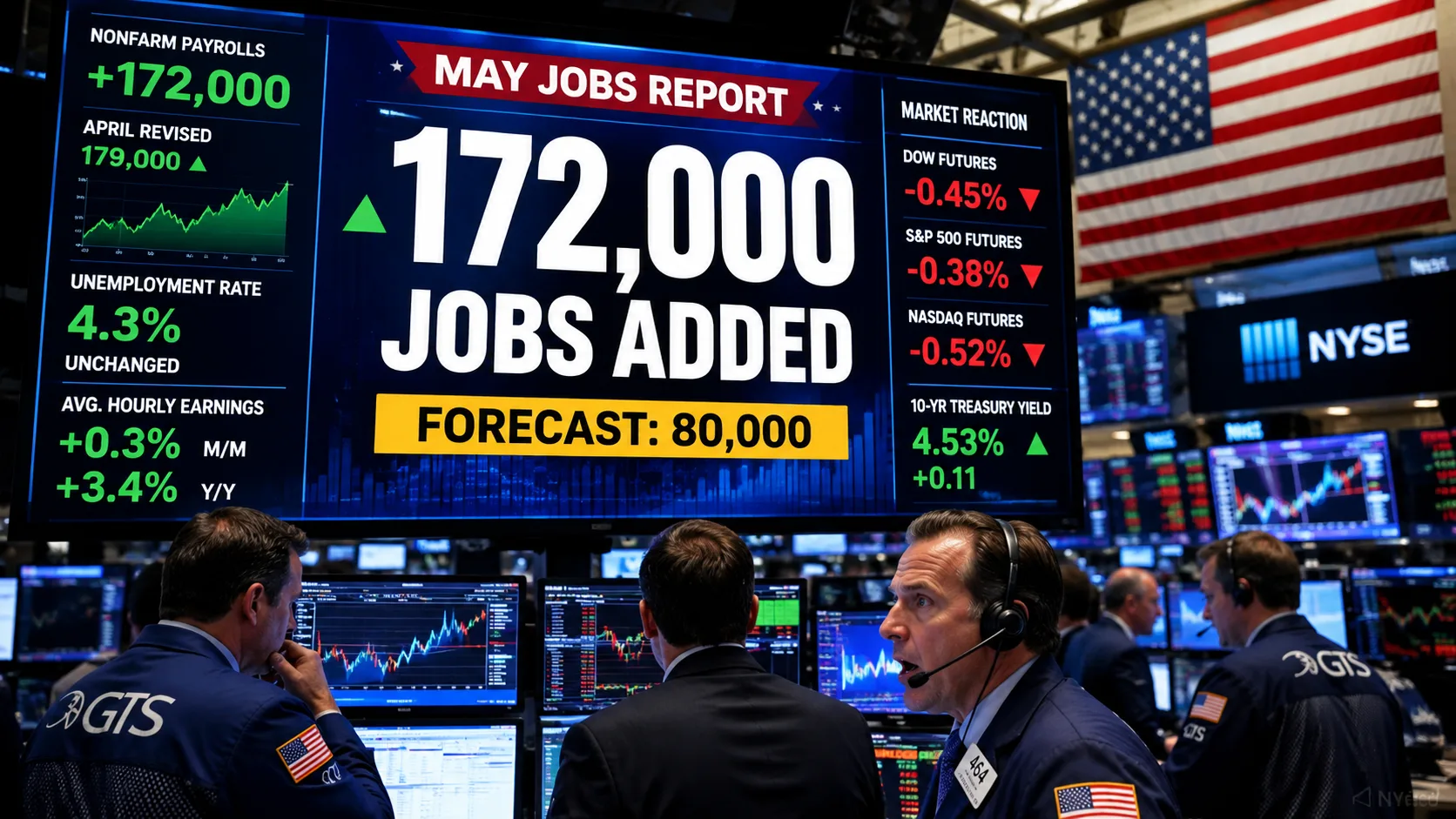
According to the latest Bureau of Labor Statistics report, nonfarm payrolls increased by 172,000 in May, handily beating forecasts for just 80,000 new jobs. The gain came after April payroll growth was revised higher to 179,000, while March was also revised upward to 214,000.
The unemployment rate remained steady at 4.3%, matching expectations and signaling continued stability in the labor market.
For investors hoping the Federal Reserve would soon begin cutting interest rates, the report may complicate that outlook.
The Labor Market Refuses to Slow Down
Despite concerns about higher inflation, elevated energy prices, and uncertainty surrounding artificial intelligence’s impact on employment, American businesses continued hiring at a healthy pace.
Economists had expected a much softer report amid signs of slowing job openings and cautious corporate hiring plans. Instead, the labor market once again exceeded expectations.
“This is a labor market that is stronger than it was last year and is looking pretty darn solid, despite high energy prices and higher inflation generally,” said Gus Faucher, chief economist at PNC. “There’s no indication that the labor market needs support.”
The strength was not isolated to a single industry either.
Several major sectors posted solid hiring gains, suggesting the labor market remains broadly healthy rather than dependent on one area of the economy.
Where the Jobs Are Being Created
Leisure and hospitality led all industries with 70,000 new jobs in May, significantly above its average pace over the past year.
Government hiring also accelerated, with local governments adding 55,000 positions.
Meanwhile, healthcare continued its steady expansion, creating another 35,000 jobs. Social assistance added 12,000 jobs.
The broader distribution of job growth marks a notable shift from recent months, when hiring was concentrated in a handful of industries.
For investors, broad-based hiring tends to be a stronger signal than gains coming from only one or two sectors.
It suggests economic demand remains healthy across multiple parts of the economy.
Wage Growth Remains Under Control
One of the most closely watched components of the report was wage growth.
Average hourly earnings rose 0.3% in May and were up 3.4% from a year ago, both matching economist expectations.
That figure is particularly important because wage growth can influence inflation.
If wages accelerate too quickly, businesses often pass higher labor costs to consumers through price increases. If wages remain moderate, inflation pressures are generally easier for the Federal Reserve to manage.
May’s report offered evidence that employers are still hiring while wage growth remains relatively contained.
That combination is often viewed as a positive outcome for policymakers seeking a soft landing.
Revisions Paint an Even Stronger Picture
The headline payroll number was impressive enough on its own.
However, revisions to prior months made the report even stronger.
April’s payroll total was revised higher by 64,000 jobs, while March gained an additional 29,000 jobs.
Together, those revisions added nearly 100,000 jobs to previously reported employment figures.
The updated data suggests the labor market has been performing better than initially believed throughout much of the spring.
Heather Long, chief economist at Navy Federal Credit Union, summed up the report bluntly.
“The hiring recession is over. American firms are hiring again,” Long said.
Why Investors Are Watching the Federal Reserve
While strong employment growth is generally positive for the economy, it creates a more complicated picture for interest rates.
The Federal Reserve has maintained a cautious stance throughout 2026 as officials continue monitoring inflation risks.
Many investors entered the year expecting multiple rate cuts. Those expectations have steadily diminished as economic data has remained surprisingly strong.
A labor market that continues generating more than 170,000 jobs per month makes it harder for the Fed to justify lowering rates in the near future.
“More solid jobs data leaves the Fed where it’s been for a while — watching and waiting, focused on the inflation side of its mandate,” said Ellen Zentner, chief economic strategist at Morgan Stanley Wealth Management.
“Rate cuts still aren’t on the near-term horizon, but the absence of inflationary threats in today’s report should quiet some of the chatter about a potential hike.”
In other words, investors may need to adjust expectations for lower borrowing costs.
Markets React to the Jobs Surprise
Financial markets quickly responded following the release.
Treasury yields moved sharply higher as traders reduced expectations for future rate cuts.
Stock futures were mostly negative immediately after the report, reflecting concerns that stronger economic growth could keep interest rates elevated for longer.
Higher rates typically pressure growth stocks and other rate-sensitive sectors because future earnings become less valuable when discounted at higher interest rates.
However, strong employment growth also supports consumer spending and corporate earnings, creating a balancing act for investors.
The Bigger Economic Picture
The jobs report aligns with several other indicators suggesting the U.S. economy remains on solid footing.
The household survey showed employment rising by 149,000 workers during May.
The labor force participation rate held steady at 61.8%.
Meanwhile, a broader measure of unemployment that includes discouraged workers and individuals working part-time for economic reasons fell to 8.1%.
Economic growth has also remained surprisingly resilient.
Gross domestic product expanded at a 1.6% annualized pace during the first quarter, while the Atlanta Fed’s GDPNow model currently projects growth near 3% for the second quarter.
Those figures hardly resemble an economy headed toward recession.
What Investors Should Watch Next
The May jobs report delivered a clear message: the labor market remains one of the strongest pillars supporting the U.S. economy.
Hiring continues to outpace expectations, unemployment remains low, wage growth is stable, and prior months’ data is being revised higher rather than lower.
For investors, the biggest takeaway may be what this means for the Federal Reserve.
A stronger labor market reduces the urgency for rate cuts and increases the likelihood that policymakers remain on hold for longer than Wall Street previously expected.
That may create short-term volatility as markets adjust to shifting rate expectations.
However, it also reinforces a more important reality: the U.S. economy continues to generate jobs, support consumer spending, and expand despite persistent concerns about inflation, energy prices, and global uncertainty.
For now, America’s labor market remains one of the strongest arguments against the growing recession fears that have repeatedly surfaced over the past year.
About Author