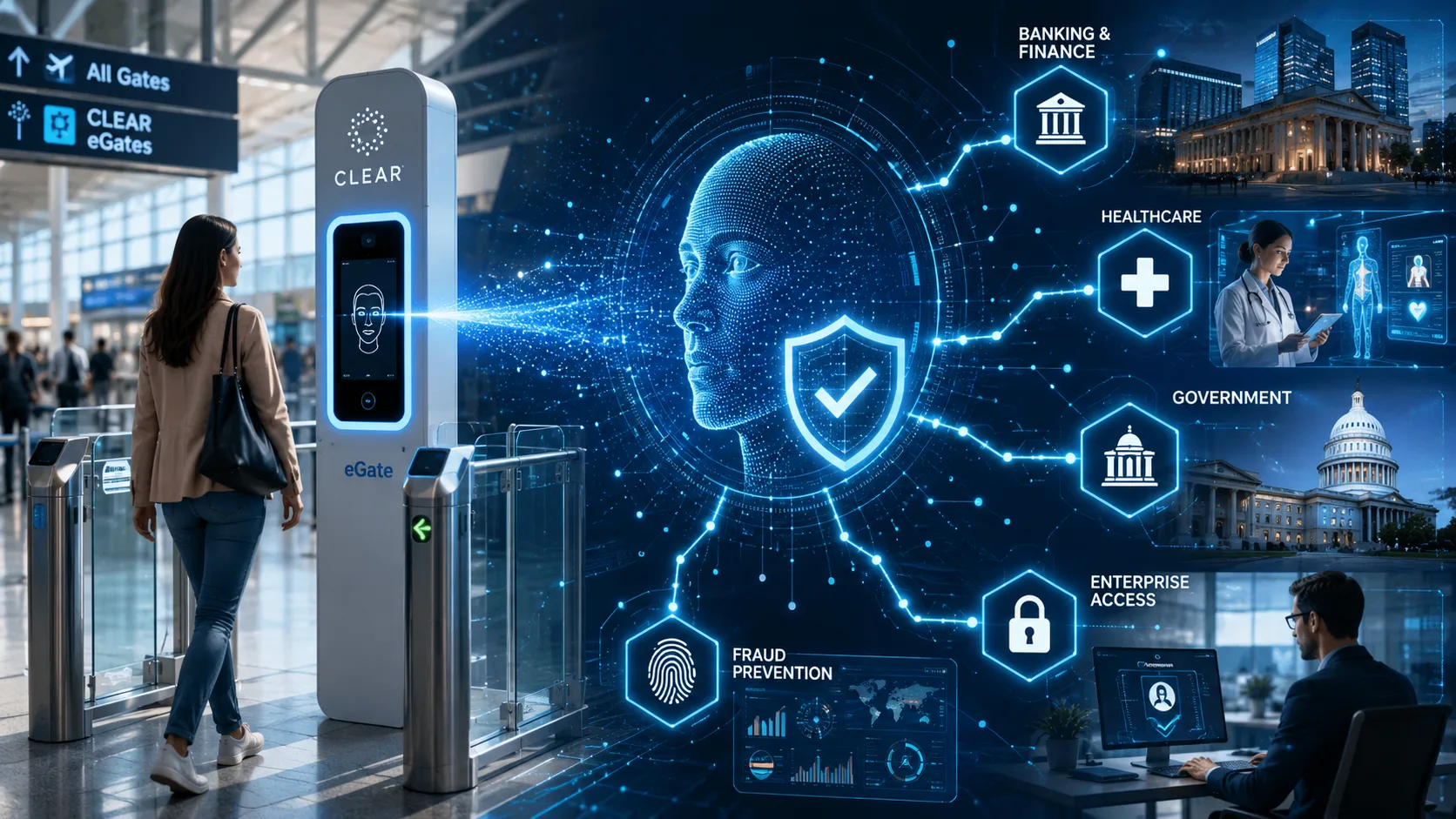
Clear Secure (NYSE: YOU) is best known for helping travelers skip long airport security lines. But that business may soon become the least interesting part of the company.
As artificial intelligence spreads across banking, healthcare, government services, and the workplace, one question is becoming increasingly important: How do you prove you’re really you?
Clear believes it already has the answer.
The company is quietly transforming itself from an airport security business into a digital identity platform that could verify users dozens of times every day instead of just a handful of times each year. If management executes on that vision, today’s valuation may significantly underestimate the company’s long-term opportunity.
From Airport Lines to Digital Identity
Most consumers know Clear through its Clear+ airport membership, which allows travelers to move through dedicated security lanes using biometric verification.
That business has become far more valuable than simply generating subscription revenue.
Instead, it serves as an enormous customer acquisition engine.
Clear now has more than 41 million verified members in its identity database, up more than 31% from a year ago. Every new member expands the company’s network while making future identity verification faster, cheaper, and more profitable.
CEO Caryn Seidman Becker recently summed up the company’s strategy with a simple goal:
“We want to go from verifying someone 12 times a year to 12 times a day.”
That shift could fundamentally change Clear’s business model.
AI Is Creating a Massive New Market
Artificial intelligence is making digital trust far more valuable.
Today, companies typically verify users with passwords, text-message codes, or one-time authentication methods that are increasingly vulnerable to fraud, deepfakes, and stolen credentials.
Clear’s enterprise platform, Clear1, approaches identity differently.
Instead of relying on a single credential, it combines:
- Government-issued IDs
- Live facial verification
- Liveness detection
- Device intelligence
- Trusted third-party data sources
The result is a continuously verified digital identity that’s significantly harder to impersonate.
That technology is already finding customers across several industries.
Healthcare providers use it for patient registration and medical record access.
Financial institutions use it for account openings, compliance, and high-value transactions.
Businesses use it for employee authentication, password resets, and secure remote access.
As AI-generated fraud becomes more sophisticated, demand for trusted identity verification could increase substantially.
The Best Part? Margins Improve Over Time
Perhaps the most attractive aspect of Clear’s model is how profitability improves as its database grows.
The expensive part is initially verifying someone’s identity.
Once that individual is already inside the system, future verification requires far less work.
Management refers to this as “reverification,” and those transactions carry significantly higher margins.
Needham analyst Joshua Reilly believes this creates a powerful economic advantage.
Every additional verified customer makes future identity checks cheaper while increasing the value of the overall platform.
That’s exactly the type of network effect investors like to see.
The Airport Business Is Still Getting Stronger
Even as investors focus on AI opportunities, Clear’s legacy business continues to perform well.
The company recently introduced eGates, which allow travelers to verify their identity in under five seconds using facial recognition without employee assistance.
Besides improving the customer experience, the technology should reduce labor costs while increasing airport throughput.
Clear has also expanded into premium concierge services that escort travelers from curbside through security, targeting customers willing to pay for convenience and reduced travel stress.
Meanwhile, partnerships with Delta Air Lines, United Airlines, and American Express continue driving new member growth.
According to JPMorgan, American Express cardholders alone account for roughly 30% of Clear’s active user base, demonstrating how valuable those strategic partnerships have become.
Financial Results Continue Improving
The business transformation is beginning to show up in the numbers.
During the first quarter:
- Revenue increased nearly 20% year over year
- Clear1 bookings surged fivefold
- Free cash flow more than doubled to $185.5 million
- Membership climbed to 41 million users
Management expects revenue growth to accelerate further during the second quarter.
Even more importantly, operating leverage continues improving as the platform scales.
With a growing cash position and expanding margins, Clear has significant flexibility to continue investing in new products and acquisitions.
Could Clear Become an Acquisition Target?
There’s no indication the company is currently exploring a sale.
However, Clear possesses several characteristics that strategic buyers often seek:
- Large verified identity database
- Strong recurring revenue
- High free cash flow generation
- Expanding enterprise business
- Attractive unit economics
Potential buyers could theoretically include payment companies like Visa or Mastercard, technology giants looking to strengthen digital identity offerings, or cybersecurity firms seeking verified identity capabilities.
In June, Clear also removed certain supermajority voting requirements from its corporate charter, eliminating one potential obstacle to a future transaction.
Any acquisition would still require approval from CEO Caryn Seidman Becker, who maintains majority voting control through the company’s dual-class share structure.
Valuation Still Looks Reasonable
Despite the stock’s strong performance since its IPO, valuation hasn’t become excessive.
Shares recently traded around:
- 18x forward EBITDA
- 27x forward earnings
Needham believes Clear can sustain 25%+ annual revenue growth for several years while maintaining attractive profitability.
For a company positioned at the intersection of AI, cybersecurity, digital identity, and enterprise software, many investors would argue those multiples remain reasonable.
About Author