For years, the Tesla Semi has largely existed on the sidelines of the Tesla growth story.
That may finally be changing.
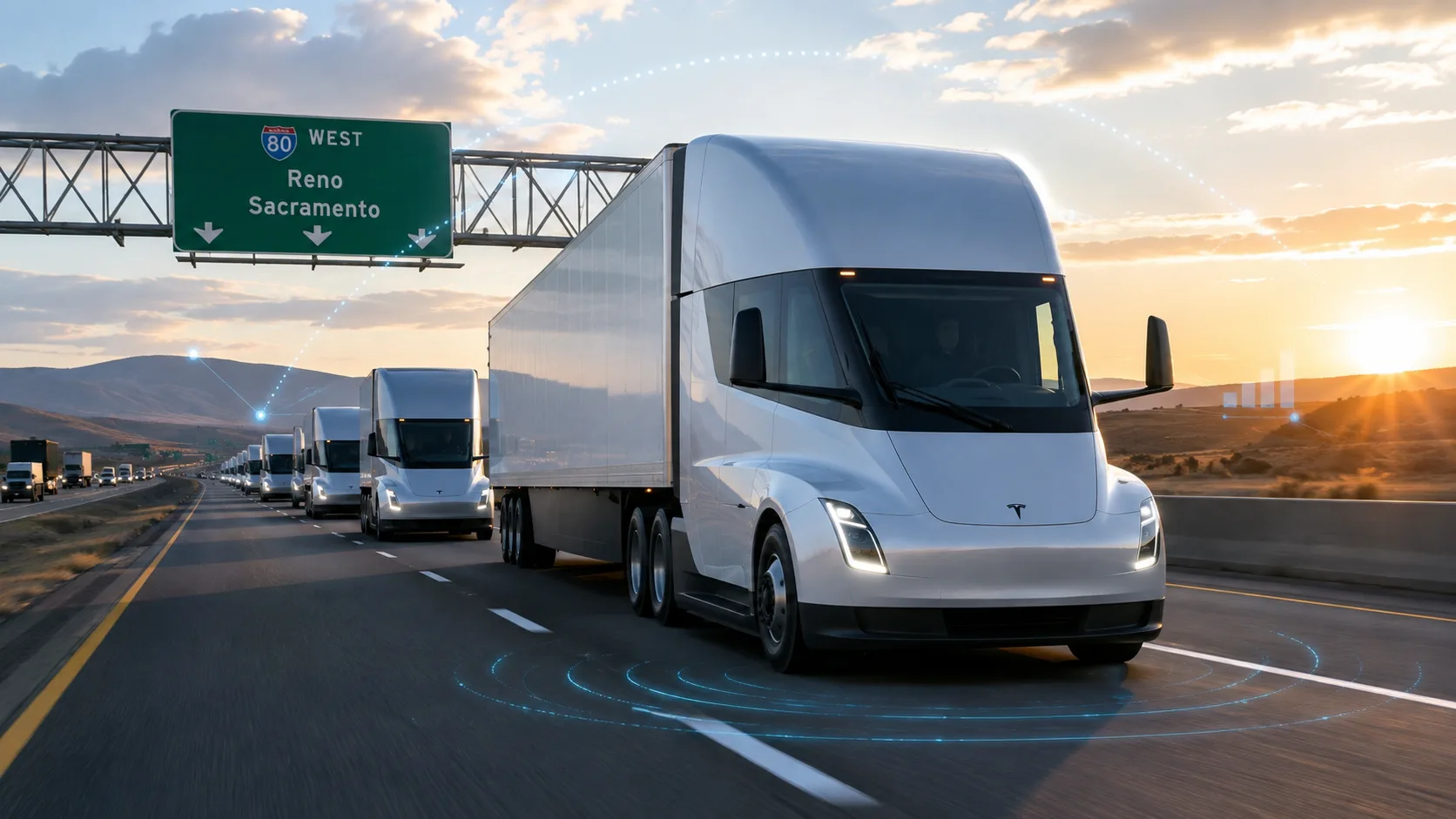
Swedish electric and autonomous trucking company Einride (NASDAQ: ENRD) announced plans Tuesday to deploy 500 Tesla Semi trucks across North America, beginning in September and continuing in phases over the following 24 months. Einride customers include major companies such as Amazon.
The deployment is significant enough to triple Einride’s deployed electric-truck fleet, according to the company.
The market immediately noticed.
Einride shares surged in premarket trading following the announcement before giving back part of those gains after the opening bell. Tesla shares, meanwhile, traded lower Tuesday morning.
The diverging stock reactions make sense in the short term. Five hundred trucks could materially change Einride’s business, while the immediate financial impact on a company Tesla’s size is much smaller.
But investors shouldn’t dismiss the announcement.
For Tesla, this could represent something much more important: commercial validation of a product that has taken nearly a decade to reach meaningful production.
And if Tesla eventually combines Semi with its autonomous-driving technology, the long-term opportunity could extend far beyond selling electric trucks.
The Tesla Semi Finally Gets a Major Commercial Deployment
Einride plans to integrate the 500 Tesla Semis into its Saga AI platform, the company’s digital freight-management system designed to coordinate electric and autonomous freight operations.
The trucks are expected to serve Einride’s customers across North America.
Einride CEO Roozbeh Charli described the deployment as evidence that the company can execute at the scale demanded by large customers.
The announcement also suggests something important about the evolution of electric trucking.
Rather than viewing electric trucks simply as replacements for diesel vehicles, Einride is integrating the vehicles into a broader software-controlled logistics network.
That could become increasingly important as freight transportation becomes more automated.
For Tesla, meanwhile, the deal gives the Semi something it desperately needs:
Scale and real-world operating data.
A few dozen demonstration vehicles can prove that a truck works.
Hundreds of vehicles operating across commercial freight networks can begin proving whether the economics work.
That’s a much more important test.
Tesla Semi’s Nearly Decade-Long Journey
Investors could be forgiven for being skeptical about the Tesla Semi.
Tesla first unveiled the vehicle in 2017, originally targeting production years earlier than what ultimately occurred.
The first production Semis weren’t delivered until 2022, when PepsiCo became one of the earliest commercial operators.
Other major corporations, including Walmart, UPS and Anheuser-Busch, have also been associated with orders or testing programs.
But the Semi remained a relatively small part of Tesla’s overall business.
That changed materially this year.
On April 29, Tesla announced that the first Semi had rolled off its new high-volume production line in Nevada, marking a major milestone for the program.
The dedicated facility near Tesla’s Nevada operations has reportedly been designed for eventual annual capacity of as many as 50,000 trucks, although reaching anything close to that level will require a gradual production ramp.
Tesla CEO Elon Musk has warned investors not to expect production to explode immediately.
During Tesla’s first-quarter earnings call, Musk explained that products with entirely new supply chains typically experience a slow initial production curve before accelerating.
He said Tesla expected early Cybercab and Semi production to be slow before ramping substantially toward the end of 2026 and into 2027.
That makes the Einride announcement particularly interesting.
Tesla now has a customer prepared to absorb hundreds of vehicles as production expands.
Why 500 Tesla Semis Matter More Than the Number Suggests
Tesla investors shouldn’t evaluate this announcement by simply asking how much revenue 500 trucks could generate.
That’s too narrow.
The more important question is whether this deployment can help validate Tesla Semi’s economics at commercial scale.
Large freight operators care about very different things than passenger-car buyers.
A trucking fleet isn’t purchasing a vehicle because it looks futuristic.
Fleet operators care about:
- total cost per mile,
- reliability,
- vehicle utilization,
- charging downtime,
- maintenance expenses,
- driver productivity,
- payload capability,
- energy costs, and
- return on invested capital.
That creates a much tougher proving ground.
Tesla advertises the long-range Semi at roughly 500 miles of estimated range, putting the truck within reach of a meaningful portion of regional and long-haul freight applications.
But advertised specifications aren’t enough.
Large-scale deployments can provide real-world evidence about whether electric Class 8 trucks can compete economically against diesel fleets.
If Einride demonstrates attractive economics across hundreds of Tesla Semis, other fleet operators will notice.
And that could be far more valuable to Tesla than the initial 500-vehicle deployment itself.
Amazon Makes the Story Even More Interesting
One detail investors shouldn’t overlook is Einride’s relationship with Amazon.
Einride’s freight network serves major corporate customers, including the e-commerce giant, and reporting surrounding the Tesla deployment specifically highlights Amazon freight operations.
Amazon operates one of the largest logistics ecosystems in the world.
That means Tesla Semis could receive exposure within a sophisticated freight network where efficiency is measured obsessively.
This doesn’t mean Amazon has suddenly ordered 500 Tesla Semis directly.
That distinction matters.
The deployment is being made through Einride.
But successful performance in freight operations serving companies of Amazon’s scale could become a powerful reference case for Tesla.
Corporate fleets tend to be conservative about adopting new equipment because vehicle failures can directly disrupt supply chains.
Demonstrating reliability at scale could therefore help Tesla overcome one of the biggest obstacles facing any new commercial vehicle manufacturer: convincing fleet managers that the technology is ready for mission-critical operations.
The Bigger Opportunity: Autonomous Trucking
Electric trucks alone could become a meaningful business.
Autonomous electric trucks could potentially be much more disruptive.
During Tesla’s second-quarter earnings call in July, Musk said Tesla expects to get self-driving technology working on the Semi around the end of 2026 or early 2027.
Musk told investors:
“We expect to get self-driving working on the Tesla Semi probably around the end of this year or early next year.”
He added that Semi autonomy is temporarily taking a back seat to Tesla’s work on Model 3, Model Y and Cybercab autonomy.
That distinction is crucial.
Tesla isn’t currently pitching Semi simply as an electric replacement for diesel trucks.
The company’s longer-term ambition is potentially to create an autonomous electric freight platform.
If successful, the economics could look dramatically different.
Why Autonomous Trucks Could Transform Freight Economics
Labor represents one of the biggest expenses in commercial trucking.
Drivers also face federally regulated hours-of-service limits, meaning a truck cannot simply operate continuously with a single human driver.
Autonomous technology could eventually change that equation.
A sufficiently capable autonomous freight vehicle could theoretically:
- operate for significantly longer periods,
- reduce labor costs,
- increase vehicle utilization,
- improve routing efficiency,
- reduce downtime,
- optimize energy consumption, and
- potentially improve safety.
Musk specifically pointed to the truck-driver shortage when discussing autonomous Semi technology during Tesla’s Q2 earnings call.
He argued that autonomous trucks could help address labor shortages while improving safety and driver comfort.
Investors should still treat Tesla’s autonomy timelines cautiously.
Tesla has repeatedly pushed back ambitious autonomy forecasts over the years, and regulatory approval for autonomous commercial trucking could represent an entirely separate challenge.
But the potential economics explain why Tesla continues pursuing the technology.
A truck that saves money on fuel is valuable.
A truck that saves money on fuel and dramatically increases utilization while reducing labor requirements could potentially reshape freight transportation.
Tesla Is Becoming More Than an EV Company
The Semi announcement also fits into a much broader transformation underway at Tesla.
Tesla’s growth strategy increasingly extends beyond selling Model 3 and Model Y passenger vehicles.
The company is simultaneously investing in:
Tesla Semi: commercial freight.
Cybercab: autonomous passenger transportation.
Optimus: humanoid robotics.
Energy storage: Megapack and Powerwall systems.
Artificial intelligence: autonomous-driving infrastructure and AI training.
Tesla said earlier this year that it planned to spend more than $20 billion in capital expenditures during 2026, with investments directed toward Semi, Cybercab, Optimus, battery manufacturing and other initiatives.
The strategy is extraordinarily capital intensive.
But it also illustrates why Tesla’s valuation cannot be understood solely through passenger-vehicle deliveries.
Tesla is attempting to build multiple technology businesses simultaneously.
Semi is one piece of that puzzle.
Electric Trucking Meets AI
Einride’s involvement adds another dimension.
The 500 Tesla trucks will operate through Einride’s Saga AI fleet-management platform.
That means the trucks will become part of a digitally coordinated freight network rather than operating as isolated vehicles.
This could point toward where transportation is ultimately heading.
Imagine a freight network where software determines:
- which truck handles each load,
- optimal departure times,
- charging schedules,
- routing,
- energy usage,
- maintenance schedules,
- vehicle positioning, and eventually
- autonomous dispatch.
That begins looking less like traditional trucking and more like a physical logistics network controlled by software.
Tesla brings the vehicle.
Einride brings fleet orchestration.
And major customers bring freight demand.
That combination could become an interesting test of what next-generation logistics networks look like.
The Bull Case for Tesla Investors
For Tesla shareholders, there are several reasons to watch Semi closely.
1. Tesla gains another potentially large addressable market
Commercial trucking represents an enormous global industry.
Tesla doesn’t need to dominate it for Semi to become meaningful.
Even a relatively modest share of Class 8 truck sales could create billions of dollars in potential annual revenue if production eventually reaches tens of thousands of units.
2. Commercial customers could validate Tesla’s technology
Fleet operators make purchasing decisions based heavily on economics.
If companies operating Tesla Semis report lower total ownership costs, competitors may feel pressure to electrify their own fleets.
That could create a powerful adoption cycle.
3. Semi expands Tesla beyond consumer EV demand
Passenger EV demand can be affected by consumer confidence, financing costs, incentives and competition.
Commercial trucking operates under different purchasing cycles and economic incentives.
Semi therefore gives Tesla another potential revenue stream.
4. Autonomy could dramatically increase the opportunity
Tesla selling electric trucks is one business model.
Tesla providing autonomous freight technology could potentially become another.
Software revenue, autonomous services and fleet-management opportunities could theoretically carry higher margins than manufacturing alone.
5. Tesla’s charging ecosystem could gain another market
Electric commercial trucks require enormous amounts of power.
If Tesla can build charging infrastructure around Semi deployments, the company could create additional ecosystem opportunities around electricity, batteries and charging.
But Investors Shouldn’t Ignore the Risks
There is still plenty that could go wrong.
Production remains the biggest immediate test
Building prototypes is very different from manufacturing tens of thousands of heavy trucks reliably.
Tesla only recently began high-volume Semi production.
Manufacturing efficiency, component availability and supply-chain execution will determine whether Tesla can actually deliver trucks at meaningful scale.
Charging infrastructure is complicated
Commercial electric trucks require significantly more electricity than passenger vehicles.
Fleet operators need high-capacity charging infrastructure at depots and along freight corridors.
Building that network will require substantial capital investment and utility coordination.
Competition isn’t standing still
Tesla isn’t entering an empty market.
Traditional truck manufacturers and electric-vehicle startups are also pursuing battery-electric and autonomous commercial trucks.
Tesla’s brand gives it visibility, but commercial buyers ultimately care about economics and reliability.
Autonomy remains uncertain
Musk’s late-2026 or early-2027 target should be viewed as a development objective—not a guarantee of widespread autonomous commercial operation.
Technical capability is only one hurdle.
Regulators, insurers, state governments and federal transportation agencies will also influence how quickly autonomous trucks can operate without drivers.
What Investors Should Watch Next
The Einride announcement creates several milestones Tesla investors should monitor over the next 12 to 24 months.
Semi production numbers
Tesla needs to demonstrate that its Nevada facility can ramp efficiently.
Einride deployment progress
The rollout begins in September and is expected to continue over two years. Investors should watch whether those deployments stay on schedule.
Major fleet customers
Additional commitments from major logistics companies could signal broader commercial acceptance.
Operating economics
Real-world data on charging costs, maintenance, range and utilization will matter enormously.
Autonomous Semi development
Tesla’s targeted late-2026 to early-2027 timeframe will become an important technology milestone.
Margins
Ultimately, investors need to know whether Semi can become a profitable business rather than merely a technological achievement.
The GMN Investor Takeaway
The most important number in this story isn’t 500.
It’s what comes after 500.
Tesla has spent nearly a decade turning Semi from a stage presentation into a mass-produced commercial truck. The Einride deployment provides one of the company’s biggest opportunities yet to demonstrate that the product can work across a large, sophisticated freight network.
If the rollout succeeds, Tesla could gain something more valuable than the revenue from several hundred trucks.
It could gain credibility.
That credibility could encourage other fleet operators to place larger orders just as Tesla’s Nevada production capacity expands.
Then comes the potentially transformative piece: autonomy.
Tesla is attempting to connect several technologies it has spent years developing—electric drivetrains, batteries, artificial intelligence, autonomous driving and large-scale manufacturing—inside one commercial vehicle.
That makes Semi an unusually important experiment.
The bullish scenario isn’t simply that Tesla becomes another truck manufacturer.
It’s that Tesla helps create a new model for freight transportation in which electric vehicles, AI software and autonomous driving operate as one integrated logistics platform.
That outcome remains far from guaranteed.
Tesla still needs to prove manufacturing scale, commercial reliability, charging economics and autonomous-driving capability. Investors should be particularly cautious about assuming Musk’s autonomy timeline will automatically translate into regulatory approval or driverless freight operations.
But Einride’s 500-truck deployment provides something Tesla Semi has lacked for years:
A credible path toward scale.
For long-term Tesla investors, that makes Semi worth watching much more closely.
About Author