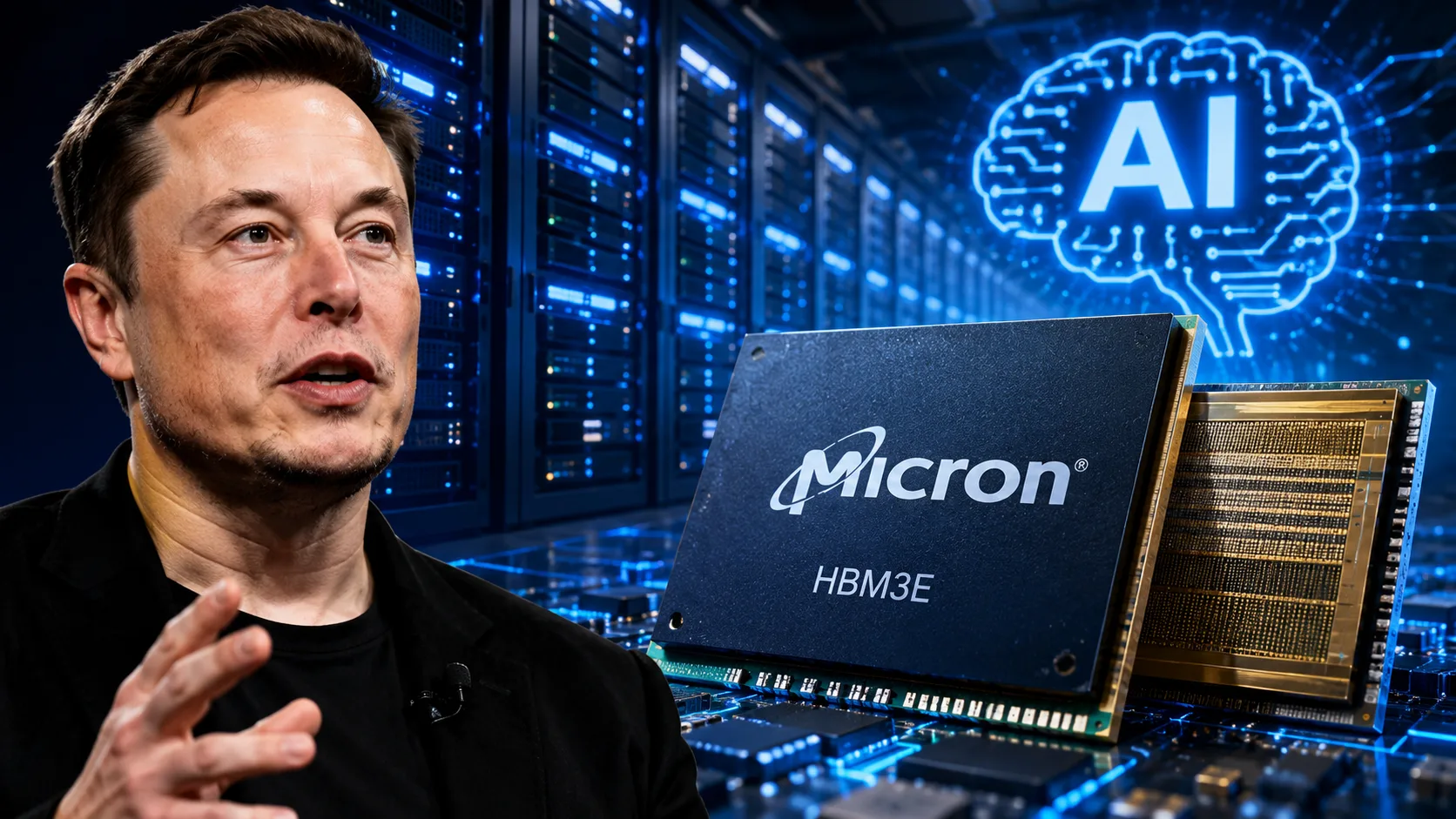
Elon Musk just identified what he sees as one of the biggest constraints on the AI boom, and his answer could have major implications for Micron Technology investors.
During SpaceX’s second-quarter earnings call, Musk summed up the problem in five words:
“Limiting factor currently is memory.”
That statement puts a spotlight on Micron Technology (NASDAQ: MU), the only U.S.-based producer of high-bandwidth memory, or HBM, and one of only three major global suppliers alongside Samsung Electronics and SK Hynix.
Musk’s warning comes as AI companies race to build increasingly powerful data centers, creating enormous demand for the specialized memory required to keep advanced GPUs operating at full capacity.
And according to Musk, supply simply isn’t keeping up.
Musk Says Memory Demand Is Growing Far Faster Than Supply
Musk laid out the problem using remarkably simple math.
He estimated that memory production is increasing by roughly 20% annually, which would normally represent extremely strong growth for a mature semiconductor industry.
Demand, however, is moving at an entirely different speed.
According to Musk, memory demand could be increasing by roughly 200% per year or more as companies aggressively expand AI computing capacity.
If those estimates are even directionally correct, the implications are significant.
When demand grows dramatically faster than supply, prices typically rise until either new supply enters the market or demand begins to weaken.
Musk argued that this basic supply-demand imbalance means memory prices are more likely to increase than decrease.
It is important to note that Musk’s 20% supply-growth and 200% demand-growth figures were his characterization during the earnings call, rather than independently verified industry forecasts.
Still, his comments provide an unusually direct look at how one of the world’s most aggressive buyers of computing infrastructure views the memory market.
Why Micron Could Be One of the Biggest Beneficiaries
Micron sits at the center of this increasingly important part of the AI supply chain.
High-bandwidth memory is designed to move enormous quantities of data between processors and memory at extremely high speeds. That makes it particularly important for AI accelerators, where conventional memory can become a bottleneck.
As AI models become larger and more sophisticated, the amount of memory attached to each generation of GPUs has also increased substantially.
HBM content per GPU has reportedly increased roughly 3.6 times from Nvidia’s H100 generation to Blackwell Ultra, while the context windows used by frontier AI models have expanded dramatically over the past several years.
That means AI infrastructure doesn’t simply require more GPUs.
It increasingly requires much more memory alongside those GPUs.
For Micron, that creates an opportunity to benefit from AI spending even if the investment frenzy eventually shifts away from processors themselves.
Musk Says Power Isn’t the Biggest Problem
Musk’s memory comment becomes even more interesting when viewed alongside what he said about electricity and cooling.
AI data centers consume enormous amounts of power, leading many investors to assume electricity generation will become the ultimate constraint on AI expansion.
Musk appears to see things differently, at least for his own infrastructure plans.
SpaceX is targeting roughly 20 gigawatts of power and cooling capacity by the end of next year, although Musk acknowledged that reaching the full target may be difficult and suggested something closer to 15 gigawatts could be achievable.
More importantly, Musk said the company intends to maintain substantially more power, cooling and electrical infrastructure than it has GPUs available to use.
The reasoning is straightforward. GPUs are extremely expensive, so Musk wants the supporting infrastructure ready before additional processors arrive.
Nvidia supply could still create another constraint. Musk said SpaceX expects to receive only a relatively small percentage of Nvidia’s GPU production next year.
Yet when identifying the current limiting factor, Musk specifically pointed to memory.
For Micron investors, that distinction matters.
Musk Had Already Singled Out Micron
The SpaceX comments weren’t Musk’s first warning about memory.
During Tesla’s second-quarter earnings call roughly two weeks earlier, Musk reportedly thanked Micron by name twice for providing Tesla with a significant memory allocation on what he described as reasonable terms.
He also characterized the increase in memory prices as the “biggest price jump in anything I’ve ever seen.”
That makes his latest comments harder to dismiss as an offhand observation.
Across two major companies operating at the forefront of AI, autonomous vehicles and robotics, Musk has repeatedly highlighted memory availability and pricing as major concerns.
If other large technology companies are experiencing similar constraints, the implications could extend well beyond Tesla and SpaceX.
The AI Memory Supply Crunch
The broader industry numbers help explain why investors are paying attention.
Nearly 100 gigawatts of additional AI data-center capacity could reportedly be built globally over the next four years, while new DRAM production capacity is expected to grow much more slowly.
Meanwhile, the three major HBM producers, Micron, Samsung and SK Hynix, have reportedly committed much of their available 2026 HBM production.
Meaningful additional supply could take years to develop because expanding semiconductor manufacturing capacity requires enormous capital expenditures, specialized equipment and long construction timelines.
That creates a potentially powerful setup for memory manufacturers.
Unlike software, semiconductor production cannot simply be doubled overnight because demand suddenly increases.
If AI infrastructure spending continues growing rapidly while new memory capacity comes online gradually, suppliers could retain substantial pricing power.
Micron Shares Have Already Exploded Higher
There is one major complication for investors considering Micron today: the market has already noticed.
Micron shares closed at $971.66 on August 14, representing a staggering gain of roughly 241% in 2026 and nearly 677% over the previous 12 months.
Even after that extraordinary rally, Micron has traded at roughly six times forward earnings, a valuation that can appear surprisingly inexpensive relative to many other companies benefiting from the AI boom.
CEO Sanjay Mehrotra has also indicated that Micron expects tight industry conditions to persist beyond calendar 2027.
The company has backed some of that optimism with long-term Strategic Customer Agreements designed to provide greater revenue visibility.
But investors need to be careful when interpreting Micron’s seemingly low earnings multiple.
Memory stocks have historically looked cheapest near the top of their earnings cycles.
The Biggest Risk for Micron Investors
The bear case revolves around one question: What happens if memory prices stop rising so quickly?
TrendForce forecasts cited in an August analysis projected third-quarter 2026 DRAM contract prices increasing approximately 13% to 18%, while NAND prices could increase roughly 10% to 15%.
Those would still be significant increases.
But they would represent a sharp slowdown from the enormous sequential price gains seen during the previous quarter.
That matters because Micron’s profitability is highly sensitive to memory pricing.
Wall Street’s fiscal 2027 earnings estimates have also reportedly begun leveling off after increasing rapidly earlier in the year.
If supply catches up with demand faster than expected, AI infrastructure spending slows, or customers begin resisting higher prices, Micron’s earnings growth could cool quickly.
And memory has historically been one of the semiconductor industry’s most cyclical businesses.
Periods of shortages and rapidly rising prices have repeatedly encouraged manufacturers to expand production, eventually creating excess capacity and sending prices in the opposite direction.
Is AI Permanently Changing the Memory Business?
That may be the biggest question facing Micron investors.
The bullish argument is that AI represents something fundamentally different from previous memory cycles.
Modern AI systems consume enormous quantities of memory, and each new generation of accelerators can require significantly more HBM than the generation before it.
AI inference could eventually become an even larger driver as artificial intelligence moves from training massive models to serving billions of everyday requests across businesses, autonomous vehicles, robotics and consumer devices.
If that happens, memory demand could remain structurally higher for years.
The bearish argument is much more familiar.
Memory shortages push prices higher. Higher prices encourage manufacturers to expand capacity. New factories eventually begin producing chips, supply catches up, prices fall and margins collapse.
That cycle has played out repeatedly.
The question is whether AI has finally changed the equation.
Why Musk’s Five Words Matter
Elon Musk isn’t predicting Micron’s stock price.
But he is describing the physical constraints facing some of the world’s most ambitious AI infrastructure projects.
And right now, he says the constraint is memory.
That puts Micron in an unusual position. The company is one of only three major global HBM suppliers, the only U.S.-based producer, and a critical supplier to an AI industry whose appetite for computing capacity continues to grow.
The opportunity is enormous, but expectations are already high. Micron’s stock has climbed hundreds of percent, and any meaningful slowdown in memory pricing could quickly challenge today’s earnings forecasts.
Investors therefore have two very different signals to watch.
Musk is warning that AI’s appetite for memory is overwhelming supply.
TrendForce is warning that memory price growth could already be starting to decelerate.
Which one ultimately matters more could determine whether Micron’s extraordinary rally still has room to run, or whether investors are looking at another peak in one of technology’s most famously cyclical industries.
About Author