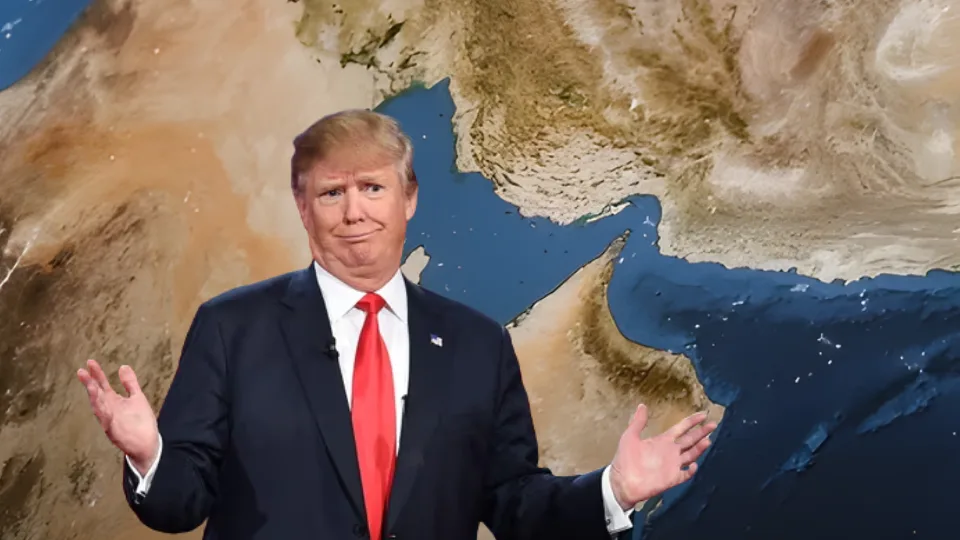
President Donald Trump issued a stunning warning to Oman on Monday, saying the United States would “bomb” the Gulf nation if it interfered with Washington’s dealings with Iran.
The threat comes as the fragile 60-day U.S.-Iran ceasefire reaches its expiration with no formal agreement in place, negotiations stalled and commercial shipping through the Strait of Hormuz slowing to a fraction of its prewar level.
The combination is raising fresh concerns that the conflict could be entering another dangerous phase, with one of the world’s most important energy corridors caught in the middle.
Trump Warns Oman: Don’t ‘Get in the Way’
Speaking with Fox News on Monday, Trump discussed the state of negotiations with Iran and claimed informal discussions were taking place with Iran’s Islamic Revolutionary Guard Corps.
Iran has repeatedly denied that direct negotiations with Washington are underway.
Trump suggested he was in no rush to reach an agreement.
“They’re good poker players, but they’re dying,” Trump said of the Revolutionary Guard. “I have no time schedule. I’m not in a hurry.”
He then turned his attention to Oman, which has been engaged with Tehran over efforts to reopen the Strait of Hormuz to commercial shipping.
“If Oman gets in the way, we’ll bomb the s— out of them,” Trump said.
The remark is particularly significant because Oman has traditionally served as an intermediary in regional disputes, including between the United States and Iran.
Rather than threatening an adversary, Trump’s comments appeared to warn a Gulf nation attempting to play a diplomatic role in the crisis.
U.S.-Iran Ceasefire Reaches Its Deadline
Trump’s comments come as the 60-day ceasefire between Washington and Tehran is set to expire Monday without an announced extension or broader agreement.
The situation is complicated by disagreement over whether a formal ceasefire even exists.
Iranian Foreign Minister Abbas Araghchi said over the weekend that the two countries do “not have anything like a ceasefire” and denied that negotiations with Washington were taking place.
“No negotiations have been held between the United States and us at this time,” Araghchi said, according to comments reported by Iranian media.
He acknowledged that Qatar and Pakistan have been exchanging messages between the two sides but said those communications should not be considered negotiations.
Trump, meanwhile, has continued to suggest that discussions are taking place behind the scenes.
That leaves the status of the conflict increasingly uncertain just as the 60-day period established by Washington comes to an end.
Trump Says Iran Cannot Be Allowed to Obtain a Nuclear Weapon
One issue where the administration’s position remains clear is Iran’s nuclear program.
Trump reiterated Monday that preventing Tehran from acquiring nuclear weapons remains Washington’s top objective.
“The number one Goal is, and always will be, that Iran cannot have, in any way, shape, or form, a Nuclear Weapon,” Trump wrote on Truth Social.
Iran’s nuclear ambitions have been at the center of the confrontation, but the conflict has increasingly expanded into a broader struggle involving sanctions, military pressure, Iranian ports and control of the Strait of Hormuz.
And developments inside the strait could have consequences far beyond the Middle East.
Ship Traffic Through Hormuz Nearly Grinds to a Halt
Commercial shipping through the Strait of Hormuz slowed dramatically over the weekend.
Only three ships passed through the strait on Sunday, according to Kpler data reported by Reuters.
The five-day average was approximately 12 transits per day.
Before the war began on Feb. 28, roughly 130 vessels crossed the Strait of Hormuz each day.
That means Sunday’s traffic represented only a tiny fraction of normal activity.
The slowdown follows tanker attacks and growing uncertainty over whether vessels can safely navigate the waterway as tensions between Washington and Tehran remain unresolved.
HSBC shipping analyst Parash Jain warned Monday that investors may need to become accustomed to instability across the shipping industry.
“Chaos is the norm,” Jain told CNBC, arguing that investors should increasingly factor disruption into their baseline assumptions.
Iran Says Hormuz Will Remain Under Its Control
Iranian Deputy Foreign Minister Kazem Gharibabadi declared Friday that the Strait of Hormuz would remain “Iranian.”
He also said decisions about whether the waterway is opened or closed would be made “under Iran’s command.”
That position directly clashes with Washington’s efforts to keep international shipping moving through the strategic passage while maintaining pressure on Tehran.
Oman’s involvement adds another layer of complexity.
The country has been attempting to work with Iran over reopening the waterway to commercial traffic. Trump’s threat now raises questions about whether Oman can continue playing that intermediary role without becoming entangled in the confrontation itself.
Markets Face Another Critical Moment
The expiration of the 60-day ceasefire comes at an especially sensitive moment.
There is no publicly announced U.S.-Iran agreement. Tehran denies direct negotiations are taking place. Washington continues demanding that Iran abandon any path toward a nuclear weapon, while Iran insists it controls when the Strait of Hormuz can be opened or closed.
Meanwhile, commercial traffic through one of the world’s most important shipping routes has fallen dramatically.
The immediate question is whether the ceasefire deadline passes without a renewed military confrontation.
For global markets, however, the larger issue may be how long shipping disruptions can continue before the consequences spread through energy prices, transportation costs and global supply chains.
With Trump now openly threatening Oman while pressure on Iran continues, the geopolitical risk surrounding the Strait of Hormuz appears far from resolved.
About Author