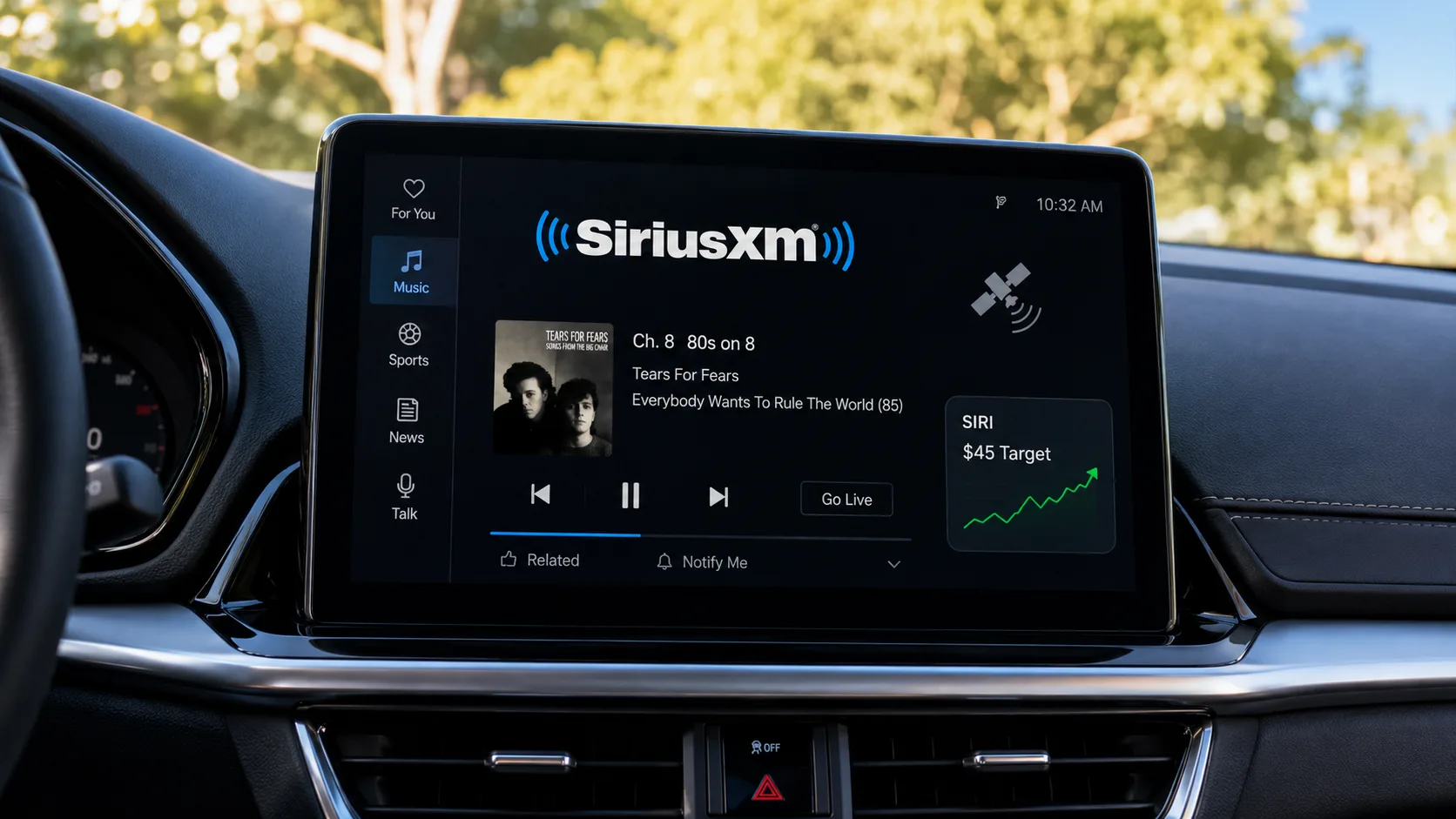
SiriusXM has already climbed 38% this year, yet Deutsche Bank believes Wall Street is still overlooking the company’s biggest growth opportunity. A new partnership with YouTube could turn the satellite radio operator into a much larger digital advertising business and push its stock toward $45.
Deutsche Bank Sees 63% Upside
Deutsche Bank upgraded SiriusXM Holdings from hold to buy and raised its price target from $31 to $45. That target represents approximately 63% upside from Tuesday’s closing price.
Analyst Bryan Kraft believes Wall Street’s forecasts substantially underestimate what SiriusXM could achieve in 2027 and 2028.
“We believe SIRI is mispriced based on a large disconnect between consensus estimates and what we believe the company can achieve in 2027 and 2028,” Kraft wrote in a note to clients.
The disagreement centers on digital audio advertising, a business that could become increasingly important as SiriusXM expands beyond its traditional satellite subscription model.
According to Deutsche Bank, consensus forecasts imply SiriusXM’s total revenue will grow by only about $250 million between 2026 and 2028. Kraft expects approximately $1.5 billion of growth over that period.
That is a major forecasting gap. If Deutsche Bank is even directionally correct, analysts may eventually need to raise their revenue, earnings and free cash flow estimates.
YouTube Could Change the SiriusXM Story
The centerpiece of the bullish case is SiriusXM Media’s agreement to become YouTube’s exclusive U.S. audio advertising representative.
The partnership gives advertisers access to YouTube’s audio inventory through SiriusXM Media and its AdsWizz advertising technology. YouTube audio ads can reach consumers listening to podcasts, music, talk shows and other audio-focused content.
This is a large and relatively untapped market. SiriusXM said more than 212 million people in the United States engage with audio-first content or listening environments on YouTube each month.
Deutsche Bank estimates that the relationship could eventually produce $2 billion in annual incremental revenue by 2029. At a high-teens EBITDA margin, that could translate into approximately $350 million to $400 million in additional annual EBITDA.
Those projections are not company guidance. They are Deutsche Bank’s estimates, and investors should treat them accordingly. Still, the size of the opportunity helps explain why Kraft believes the current consensus is too conservative.
“Consensus estimates seem to be completely disregarding that SiriusXM will become YouTube’s exclusive US audio advertising representative,” he wrote.
The agreement is particularly valuable because SiriusXM does not need to create another major consumer platform from scratch. YouTube supplies the enormous audience and inventory. SiriusXM provides the advertising sales operation, advertiser relationships and audio technology needed to monetize it.
That creates a potentially attractive capital-light growth channel.
SiriusXM Is Becoming an Audio Advertising Platform
Many investors still view SiriusXM primarily as a subscription radio company tied to automobile sales.
That legacy business remains important. Subscription revenue gives SiriusXM recurring cash flow and a large installed customer base. However, the company now operates across satellite radio, streaming music, podcasts and advertising technology.
Its portfolio includes Pandora, the SiriusXM Podcast Network and AdsWizz. The YouTube partnership adds another major source of inventory to that ecosystem.
The result is a broader business model with three valuable components:
1. Recurring Subscription Revenue
SiriusXM’s self-pay subscribers provide a relatively predictable revenue base. The company reported a record-low monthly self-pay churn rate of 1.4% during the second quarter of 2026 and added 22,000 self-pay subscribers.
Stable subscription performance could give management time to develop the digital advertising opportunity without relying entirely on rapid growth in the traditional satellite radio business.
2. Advertising Scale
The YouTube deal dramatically expands the amount of digital audio inventory SiriusXM can offer advertisers.
Greater scale could help SiriusXM win larger advertising budgets, especially from brands that want to run campaigns across streaming music, podcasts and creator-driven content through a single sales platform.
3. Advertising Technology
AdsWizz gives SiriusXM the infrastructure to sell, target and measure digital audio advertising. That capability matters because advertisers increasingly expect audio campaigns to provide the same audience targeting and performance measurement available in digital video and display advertising.
If SiriusXM can make audio easier to purchase and measure, it may capture a greater share of overall advertising budgets.
The Amazon Partnership Adds Another Distribution Channel
SiriusXM is also working more closely with Amazon.
Through an integration with Amazon’s demand-side advertising platform, marketers can buy inventory from SiriusXM Media’s portfolio, including Pandora and SoundCloud in the United States. The partnership combines SiriusXM’s audio inventory with Amazon’s shopping, streaming and browsing data.
That could make audio advertising more measurable and useful for performance-focused marketers.
The YouTube and Amazon relationships serve different purposes. YouTube provides SiriusXM with additional audio inventory to represent, while Amazon gives advertisers another powerful route for purchasing SiriusXM’s inventory.
Together, the agreements position SiriusXM between major technology platforms, advertisers and audio audiences.
The Case for a Higher Valuation
Deutsche Bank’s argument extends beyond revenue growth. The bank also believes stronger digital advertising results could lead investors to place a higher valuation multiple on SiriusXM.
That distinction matters.
A company with a mature subscription business and limited growth will usually trade at a lower multiple. A company with expanding digital advertising revenue, improved margins and rising cash flow can command a higher one.
SiriusXM could benefit from both forces at once:
- Analysts may raise their earnings and cash flow estimates.
- Investors may become willing to pay more for each dollar of those earnings.
This combination is what Kraft means by “multiple expansion and positive estimate revisions.”
Deutsche Bank’s $45 target applies an 8 times multiple to estimated 2027 EBITDA. The bank said SiriusXM was trading around 6.7 times estimated 2026 EBITDA when it issued the upgrade.
A successful YouTube launch could therefore change both the company’s results and the way the market values those results.
Berkshire Hathaway Creates an Unusual Capital-Allocation Question
Berkshire Hathaway owns approximately 37% of SiriusXM’s outstanding shares, according to Deutsche Bank. That large position adds credibility to the investment story, but it also creates an unusual complication.
Kraft estimates that roughly $2.5 billion of share repurchases at the stock’s recent price could push Berkshire’s ownership above 50%, even if Berkshire purchased no additional shares. That could happen because buybacks would reduce the total number of shares held by everyone else.
The company’s board could eventually face several options:
- Continue repurchasing shares and allow Berkshire’s percentage ownership to rise.
- Ask Berkshire to participate proportionally in the buybacks by selling shares.
- Shift more capital toward recurring dividends.
- Use special dividends to return excess cash without reducing the public share count.
- Direct more capital toward debt reduction or strategic investments.
“Time will tell, but we don’t view this as a concern for the investment case,” Kraft wrote.
The issue could still influence shareholder returns. SiriusXM’s capital-allocation strategy has historically been an important part of its appeal, and any limit on future buybacks would change how cash reaches investors.
The Market’s Skepticism May Be Useful
Deutsche Bank’s bullish position sits well outside the Wall Street consensus.
Among the 16 analysts covering SiriusXM, eight rate the stock a hold and only four have buy or strong-buy ratings, according to LSEG data cited in the original report.
That skepticism reflects real concerns. SiriusXM operates a mature satellite radio business, faces intense competition for consumer attention and must prove that new advertising partnerships can become financially meaningful.
Yet cautious analyst sentiment also creates the possibility of positive revisions.
A stock with universally optimistic forecasts has little room for additional enthusiasm. SiriusXM enters the YouTube rollout with modest consensus expectations and a large disagreement over future revenue.
If Deutsche Bank’s projections prove accurate, the market may be forced to revalue the company gradually as quarterly results provide evidence.
The Biggest Risk Is Execution
The $2 billion figure is compelling, but it depends on several assumptions.
SiriusXM must convince advertisers to allocate meaningful budgets to YouTube’s audio inventory. The company must also deliver targeting, measurement and campaign performance that compete effectively with other digital advertising channels.
YouTube’s enormous reach does not guarantee that advertisers will value every audio impression equally. Pricing, listener engagement, ad formats and measurement quality will all influence the economics.
There is also a timing risk. A multiyear opportunity can take longer to develop than analysts expect. If revenue builds slowly, investors may lose patience before the full earnings contribution appears.
Finally, the traditional subscription business still matters. Significant subscriber losses or deteriorating pricing power could offset some of the growth generated by advertising.
About Author