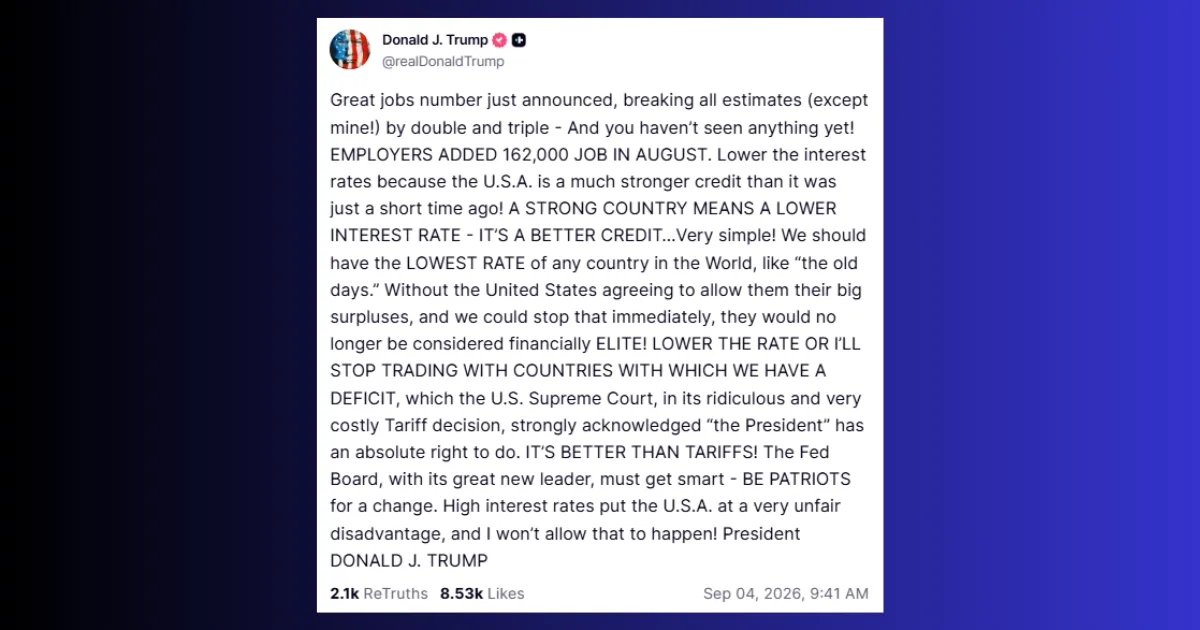
President Donald Trump is threatening to restrict trade with countries running surpluses against the United States unless the Federal Reserve sharply lowers interest rates, linking two of the most powerful forces affecting global markets.
Trump Responds to a Blowout Jobs Report
Trump issued the ultimatum Friday after the Labor Department reported that U.S. employers added 162,000 jobs in August, far exceeding economists’ expectations. The unemployment rate remained at 4.1%.
In a Truth Social post, Trump argued that America’s economic strength should entitle it to the lowest borrowing costs in the world.
“LOWER THE RATE OR I’LL STOP TRADING WITH COUNTRIES WITH WHICH WE HAVE A DEFICIT,” Trump wrote.
He also called on Federal Reserve Chair Kevin Warsh and the central bank’s board to “get smart” and “be patriots.”
Trump did not identify which countries could face restrictions, when the policy might begin or how the administration would attempt to halt trade.
The president said the strategy would be “better than tariffs” and cited the Supreme Court’s recent tariff ruling as support for his authority. That ruling found that the International Emergency Economic Powers Act did not authorize the tariffs challenged in the case, although the decision discussed presidential authority to restrict imports through other measures, including quotas and embargoes.
Any attempt to broadly suspend trade would likely depend on the specific legal authority and structure used by the administration.
Wall Street Is Moving in the Opposite Direction
The timing creates an immediate conflict between Trump’s demand and the economic data guiding the Fed.
A surprisingly strong labor market normally gives the central bank more room to keep rates elevated or raise them further if inflation remains too high. Following the jobs report, Treasury yields climbed as investors increased their expectations for tighter monetary policy.
The Fed maintained its target rate at 3.5% to 3.75% in July. Its statement said inflation remained above the central bank’s 2% objective, partly because of supply shocks and higher energy costs.
That leaves the Fed facing two competing pressures:
- The White House wants lower rates to reduce borrowing costs and strengthen economic growth.
- Inflation and labor market data could support keeping rates high or raising them.
The August jobs report strengthened the second argument.
The Trade Threat Could Complicate the Fed’s Decision
Cutting off trade with major commercial partners could create the exact inflationary pressure the Federal Reserve is trying to control.
Restricting imports could reduce the supply of foreign goods, raise costs for U.S. businesses and force companies to reorganize supply chains. Those additional costs could eventually reach consumers through higher prices.
Sharp rate cuts could also stimulate borrowing and demand at a time when inflation remains elevated.
The combination creates a difficult policy loop: trade restrictions could increase inflation, while lower interest rates could make that inflation harder to contain.
What It Means for Investors
Treasury Bonds
The immediate market signal came from government bonds. The 10-year Treasury yield moved above 4.8% after the jobs report, while the two-year yield climbed above 4.4%.
If the Fed resists political pressure and remains focused on inflation, short-term yields could stay elevated. Longer-term yields may also carry a larger risk premium if investors become concerned about inflation, trade disruption or the independence of monetary policy.
Stocks
Rate-sensitive areas such as technology, housing and small-cap stocks would normally benefit from lower borrowing costs. Their outlook becomes more complicated if those rate cuts arrive alongside higher inflation or major trade restrictions.
Companies dependent on imported products and components could face renewed margin pressure. Domestically focused businesses may receive some protection from foreign competition, although they could still be hurt by higher input costs.
The Dollar and Gold
A credible shift toward lower U.S. interest rates could weaken the dollar and support gold. A trade confrontation could also increase demand for defensive assets.
However, strong economic data and rising Treasury yields currently support the dollar. Investors are therefore dealing with conflicting signals from economic fundamentals and presidential policy pressure.
The Threat Matters Even Before Any Trade Is Stopped
The administration may never implement a complete trade cutoff. Markets could still react to the possibility.
Businesses make investment, inventory and hiring decisions months in advance. A credible threat of new restrictions may cause companies to delay spending, accumulate supplies or search for alternative vendors.
That uncertainty can raise costs before any formal policy takes effect.
The larger risk is that interest rates and trade policy are becoming connected. If future economic reports trigger new trade threats whenever they reduce the probability of Fed rate cuts, markets may begin attaching a larger political risk premium to every inflation and employment release.
The Financial Stakes
Trump has turned the interest-rate fight into a potential trade confrontation.
The strong August jobs report gave the president a political victory, but it also weakened the economic case for immediate rate cuts. The administration’s response now creates another source of uncertainty for investors already managing elevated inflation, rising Treasury yields and geopolitical risk.
The central question is whether Trump’s warning remains a negotiating tactic or becomes the foundation for a new round of trade restrictions. Until that becomes clear, every major economic report carries an additional layer of policy risk.
About Author