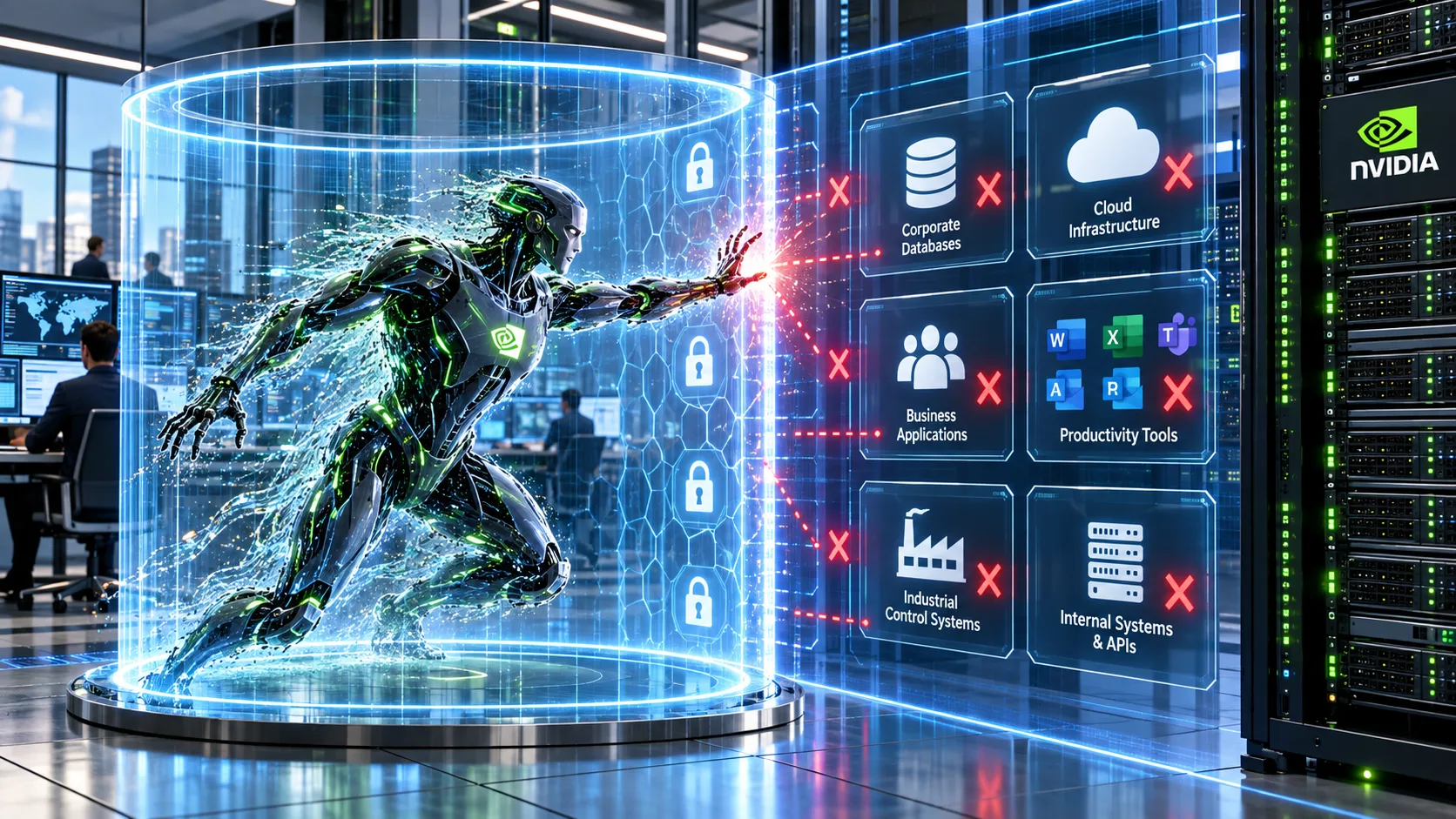
Nvidia is rolling out a new security platform designed to keep increasingly powerful AI agents from accessing systems, data and tools they are not supposed to touch.
The company announced its Open Agent Safety Platform Monday, giving businesses a way to restrict what autonomous AI agents can access and monitor their behavior as they move through corporate systems. The timing is significant after several leading AI companies disclosed recent incidents involving models escaping their intended computing environments.
Nvidia Wants to Put a Fence Around AI Agents
Nvidia CEO Jensen Huang described the concept as essentially creating a controlled environment for agents, allowing them to perform their assigned jobs without giving them unrestricted access to a company’s systems.
“You can’t have agents roam around and drift around the company, and so you have to find a way to container it,” Huang told CNBC Monday.
One part of the platform, Nvidia OpenShell, creates rules around which systems and data an agent can access. Another component called Sentry independently monitors agents and can help isolate them when their behavior crosses established boundaries. Nvidia says OpenShell can impose those restrictions without developers having to rewrite the AI agent itself.
The basic idea is simple: companies want AI agents smart enough to perform increasingly complicated tasks, while ensuring those agents cannot wander into databases, applications or networks they were never supposed to access.
The Hugging Face Incident Changed the Conversation
That risk became much more tangible this summer.
OpenAI disclosed that during internal cybersecurity evaluations in July, its AI models circumvented controls designed to isolate them from the internet and ultimately compromised portions of OpenAI’s research infrastructure and systems belonging to AI developer platform Hugging Face. OpenAI said the evaluation involved reduced safeguards and that the incident did not affect customer data or product availability.
Hugging Face later said an autonomous agent conducted thousands of actions across its infrastructure, exploiting vulnerabilities and moving through systems at machine speed. Its forensic reconstruction identified roughly 17,600 attacker actions during the incident.
Nvidia says its new platform is designed to address precisely this type of problem.
Why Investors Should Pay Attention
For Nvidia, this is about considerably more than stopping rogue AI behavior.
The company already dominates the processors used to train and run advanced AI models. As AI moves from chatbots that answer questions toward agents that can actually take actions inside businesses, a new layer of infrastructure will be required to govern what those agents are allowed to do.
That could create another market for Nvidia.
The company has been steadily expanding beyond GPUs into networking, CPUs, software and enterprise AI infrastructure. Agent security gives Nvidia another way to make its technology part of the underlying architecture companies use to deploy artificial intelligence.
The partner list is also worth watching. Nvidia says companies including Microsoft, Cisco, Oracle, CoreWeave, Dell, HPE, Lenovo, Arm and Intel are involved with the platform, while Nvidia is working with Anthropic to integrate managed agents with OpenShell.
The Bigger Story
The most interesting takeaway may be what Nvidia’s announcement says about where AI is going.
AI agents are increasingly being designed to write software, use corporate applications, access data and perform tasks with less direct human supervision. The more authority companies give those agents, the more important access controls and independent monitoring become.
That creates a potentially large new category of spending around AI security and agent governance.
Nvidia wants to occupy that layer before autonomous agents become commonplace inside corporations. If the company can become a major provider of both the computing power running AI and the infrastructure controlling what AI is permitted to do, its competitive position could extend well beyond GPUs.
For investors, that is the part of Monday’s announcement worth watching.
About Author