A popular trading platform used by millions of investors is facing an explosive accusation from Congress: its connections to China could expose American financial data and billions of dollars in customer assets to Beijing.
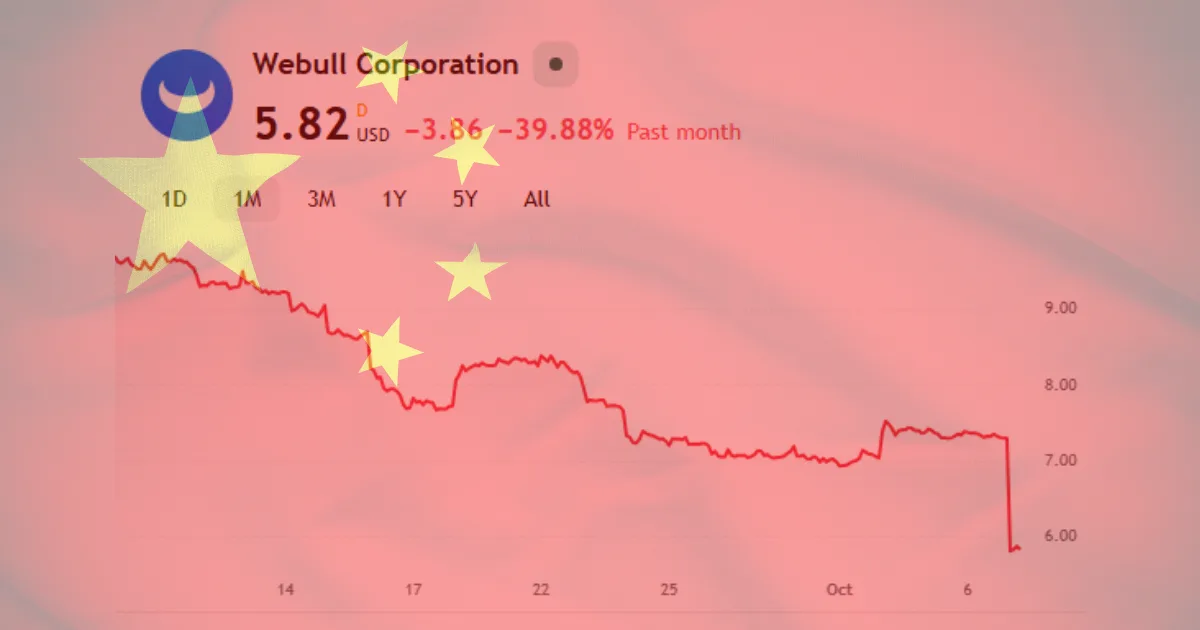
Webull, the Nasdaq-listed brokerage that competes with Robinhood, Charles Schwab and E-Trade, plunged roughly 20% Wednesday after a bipartisan congressional panel raised serious national security concerns about the company’s ownership, technology operations and China-based workforce.
The warning goes far beyond another Washington dispute over a Chinese-linked company.
The House Select Committee on China says Webull’s critical technology, engineering operations and data infrastructure remain deeply connected to the People’s Republic of China, potentially placing parts of a major U.S. trading platform within reach of Chinese laws that can require companies to cooperate with government authorities.
For Americans using Webull to trade stocks, ETFs, options, futures and digital assets, that creates a much bigger question:
Exactly who has potential access to the machinery behind their brokerage account?
Congress Says Webull’s China Connections Run Deep
Webull presents its American business as headquartered in St. Petersburg, Florida, with an additional office in New York.
Congressional investigators say the picture behind the scenes is considerably more complicated.
According to the House committee, Webull’s “ownership architecture, technical workforce, technology infrastructure, cross-border data routing, corporate financing, and compliance frameworks” remain structurally connected to China.
That includes technology operations supported by a subsidiary based in mainland China.
Perhaps the most striking number comes directly from Webull’s own regulatory filings.
As of the end of 2025, Webull’s mainland subsidiary, Hunan Weibu Information Technology Co., employed 863 people, representing 62% of Webull’s global workforce.
Webull founder and CEO Anquan Wang is also a Chinese citizen. According to Webull’s 2025 annual filing with the Securities and Exchange Commission, Wang beneficially owned 16.4% of Webull’s outstanding ordinary shares as of March 31, 2026, but controlled approximately 79.2% of the company’s voting power.
Those disclosures have become particularly important as lawmakers examine how much operational control and technical infrastructure remains connected to China.
The National Security Concern Is Bigger Than Who Owns the Stock
For Washington, the central issue is not simply that Webull employs people in China.
It is where critical systems are developed, who can access them and which government’s laws ultimately apply to the people and infrastructure supporting those systems.
The congressional committee says Webull’s software development, data pipelines and core engineering operations rely on infrastructure exposed to Chinese jurisdiction.
Chinese national security and intelligence laws have long concerned U.S. policymakers because companies operating there can face requirements to assist state authorities.
For a social media application, that debate centers largely on personal information.
For a brokerage, the potential stakes are different.
A trading platform can contain customers’ identities, financial profiles, investing behavior, account information, transaction histories and potentially large amounts of cash and securities.
That transforms a data-security concern into a financial-infrastructure concern.
Committee Chairman Rep. John Moolenaar warned that Webull’s China-based operations put American investors and their data at risk, arguing that reliance on mainland Chinese technology providers and a China-linked ownership structure could expose information to America’s primary geopolitical competitor.
The committee’s findings do not establish that Chinese authorities have accessed Webull customers’ financial information. The concern is about potential access and structural exposure.
That distinction matters.
So does the underlying risk.
Billions in American Capital Raise the Stakes
Congress says the situation became more serious in October 2025, when Webull began directly carrying customer cash.
The committee argues that this created what it calls a “structural exposure of billions of dollars in American capital.”
Webull Corporation reported approximately $24.6 billion in customer assets, making this far more than a theoretical debate about a small financial technology startup.
Webull also says it has approximately 28 million users globally.
That scale helps explain why Congress appears to view the company differently from an ordinary China-linked technology business.
A brokerage sits directly between investors and their money.
If Washington determines that critical financial platforms with large American customer bases cannot depend heavily on Chinese technology operations, the Webull investigation could eventually become a test case for how far national security restrictions extend into financial services.
Webull Strongly Disputes Congress’ Conclusions
Webull is pushing back.
The company said the committee’s report contains “significant inaccuracies” and reaches “unsupported conclusions,” while criticizing the panel for allegedly failing to seek clarification before publishing its findings.
Webull says its U.S. operations are conducted from its headquarters in St. Petersburg and its New York office. The company also says American customer data is stored inside the United States and that access to sensitive U.S. customer information is controlled by its American operations.
That position is consistent with disclosures Webull has previously made to investors.
In SEC filings, the company has said personally identifiable information belonging to U.S. brokerage customers is stored on servers located in the United States and cannot be transmitted overseas or accessed by foreign employees without permission and oversight from U.S. personnel.
Webull has also described its mainland Chinese operations as primarily research, development and technical support.
Congress is effectively challenging whether those safeguards eliminate the broader structural risks created by Webull’s workforce, technology and corporate organization.
The 62% Figure Could Be Particularly Difficult to Ignore
One detail may attract more attention in Washington than almost anything else in the report.
Congress says Webull previously told the committee that it did not have offices or employees based in China and that its employees were located in the United States.
Yet Webull’s regulatory filing states that its mainland Chinese subsidiary employed 863 workers at the end of 2025.
That represented nearly two-thirds of the company’s worldwide workforce.
For investors, that discrepancy could become significant because congressional investigations often evolve from questions about underlying risks into questions about disclosure, governance and management credibility.
Webull’s own SEC filing already acknowledges that its Chinese subsidiary is subject to Chinese jurisdiction and warns that future Chinese-related laws or regulations could materially affect the company.
Those statements now face considerably more scrutiny.
This Could Become a Regulatory Problem, Not Just a Political One
The immediate market reaction has been brutal.
Webull shares dropped sharply Wednesday as traders attempted to calculate what congressional scrutiny could ultimately mean for the company’s American business.
The largest risk is uncertainty.
Congressional criticism alone does not mean Webull will face restrictions. But investors now have to consider several possible outcomes, including additional congressional hearings, demands for more disclosures, scrutiny from U.S. financial regulators or pressure for changes to Webull’s technology and corporate structure.
More aggressive action could create an even bigger problem.
The United States has already shown a willingness to treat Chinese access to American data and critical technology as a national security issue. Expanding that philosophy deeper into financial infrastructure would have implications well beyond Webull.
Brokerages are especially sensitive because Americans are entrusting them with both information and assets.
If Washington begins applying the same national security framework used for telecommunications, semiconductors and social media to financial platforms, companies with China-based engineering and technology operations could face an entirely new regulatory risk.
There Is Another Side to the Selloff
The sharp decline in Webull shares does not prove that Congress’ worst concerns will materialize.
Webull is regulated in the United States, says American customer information remains stored domestically and disputes the committee’s conclusions.
There is also a large difference between a company operating technology teams in China and evidence that Beijing has actually obtained American customer information. The congressional findings raise concerns about vulnerability and jurisdiction rather than documenting an actual breach of U.S. customer accounts.
That makes the next stage critical.
If Webull can demonstrate strong technical separation between its Chinese operations and sensitive U.S. systems, today’s selloff could eventually look excessive.
If investigators uncover deeper operational dependencies or regulators begin demanding structural changes, investors may decide that the company’s China exposure deserves a permanent discount.
What Investors Should Watch Now
Three developments could determine whether this story grows substantially larger.
Regulatory involvement: Watch whether the SEC, FINRA, Treasury Department or other federal agencies respond to the congressional findings. A political report can damage a stock. Formal regulatory action can change a company’s business model.
Webull’s technical response: General assurances about where customer data is stored may no longer be enough. Investors should watch for detailed explanations about who develops Webull’s critical systems, who can access them and how its U.S. infrastructure is isolated from operations in mainland China.
Congressional escalation: Hearings, subpoenas, proposed legislation or demands for restructuring would signal that lawmakers see Webull as part of a broader national security campaign rather than an isolated investigation.
The last possibility may be the most important for markets.
Washington has spent years tightening restrictions around Chinese access to American technology. Financial infrastructure could be emerging as another front.
The Bottom Line
Webull’s problem is suddenly much larger than a bad day for its stock.
A bipartisan congressional committee is questioning whether a brokerage entrusted with billions of dollars in customer assets has technology, personnel and corporate structures that leave American investors exposed to Chinese jurisdiction.
Webull strongly disputes that conclusion and says sensitive U.S. customer information remains protected inside the United States.
But the numbers behind the company’s structure will be difficult for investors to ignore: 62% of Webull’s workforce was employed by its mainland Chinese subsidiary at the end of 2025, while its Chinese founder controlled nearly 80% of the company’s voting power as of March 2026.
Congress is now asking whether those connections create an unacceptable vulnerability inside America’s financial system.
For Webull shareholders and customers, what Washington does with that answer could matter far more than Wednesday’s stock plunge.
About Author