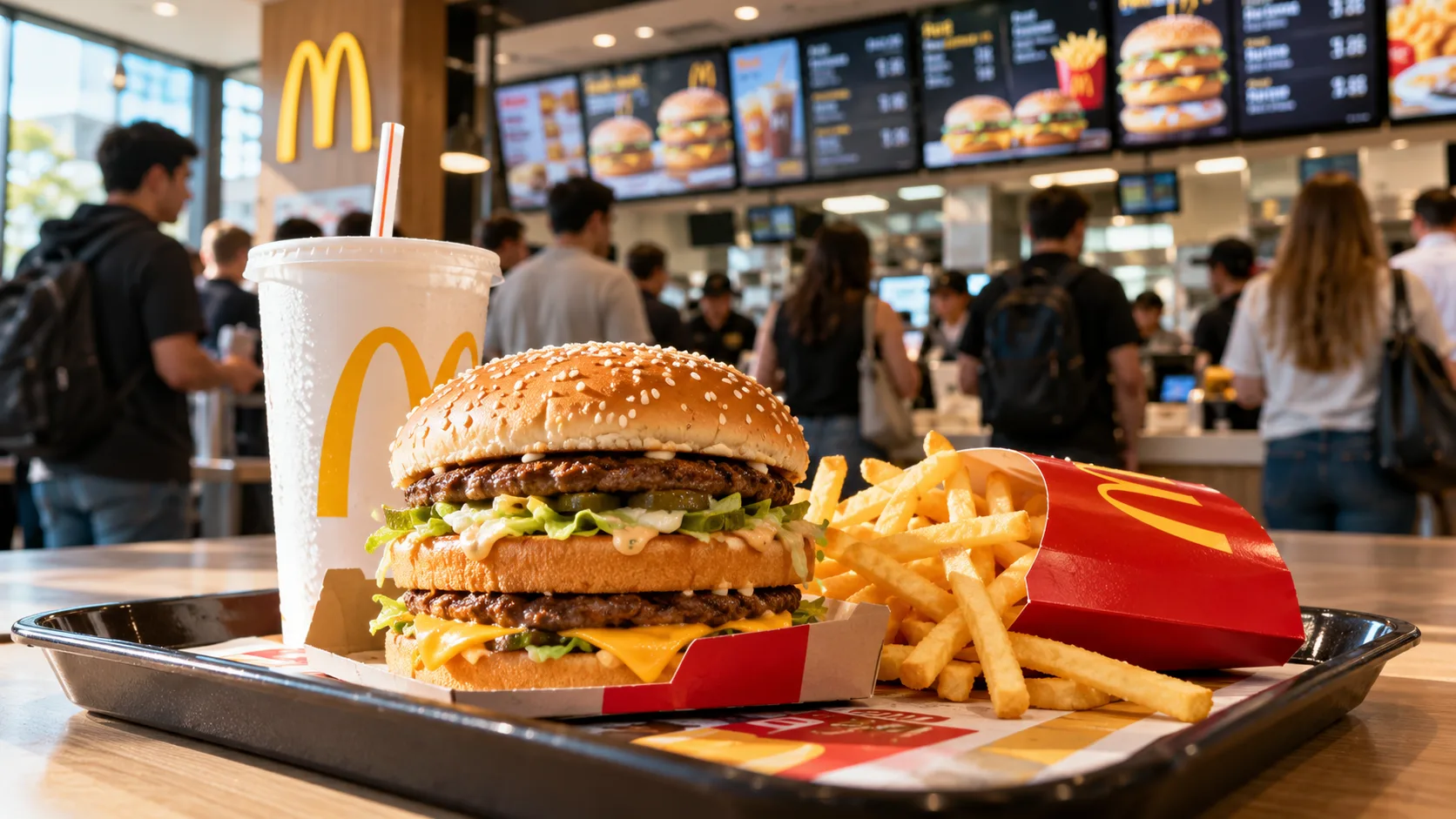
Artificial intelligence may already be helping companies decide how much consumers are willing to pay, and a new lawsuit against McDonald’s could test how far businesses can go when using AI to recommend prices.
McDonald’s is facing a proposed nationwide class action accusing the fast-food giant of using an AI-powered pricing system to illegally coordinate menu prices across thousands of independently owned franchises and company-operated restaurants. McDonald’s strongly denies the allegations, but the case raises a much bigger question for consumers: Could AI eventually help determine when prices rise during busy periods, such as the lunch rush?
What McDonald’s Is Accused of Doing
The lawsuit, filed in federal court in Chicago, alleges McDonald’s violated U.S. antitrust laws by coordinating pricing recommendations among restaurants that are supposed to make their own independent pricing decisions.
At the center of the case is a pricing system that uses machine-learning algorithms and data collected from millions of daily transactions across McDonald’s nearly 14,000 U.S. restaurants. According to the allegations, that system can analyze information from restaurants and recommend prices based on local demand and other market conditions.
The lawsuit argues that sharing data and generating centralized pricing recommendations could reduce competition among independently owned McDonald’s locations. The basic argument is that if separately owned businesses are supposed to compete with one another, their prices should be determined independently.
McDonald’s disputes that characterization. “AI does not set the price of a Big Mac or any other menu item,” the company said in response to the controversy. McDonald’s says franchisees remain responsible for their own prices and can decide whether to follow recommendations provided by its pricing tools.
The company has also said that pricing analytics and recommendation systems are common across many industries. The lawsuit remains an allegation, and no court has determined that McDonald’s violated antitrust law.
Could Prices Rise During Peak Times?
This is where the story becomes much more relevant to the average consumer.
Businesses have always tried to determine how much customers are willing to pay. Airlines adjust fares constantly. Hotels raise prices when rooms are in high demand. Ride-sharing companies can charge more during busy periods. Retailers regularly change prices based on inventory, demand and competition.
AI can make those decisions far more sophisticated.
Instead of relying on broad pricing rules, an AI-powered system could potentially analyze millions of transactions, local traffic patterns, demand, costs and customer behavior in real time. That could allow a company to make much more precise pricing recommendations based on when and where demand is strongest.
For a fast-food restaurant, that naturally raises questions about peak periods. Could a burger eventually cost more at noon than at 3 p.m.? Could prices differ when a restaurant is packed, when there is a major event nearby or when local demand suddenly increases?
The lawsuit against McDonald’s does not prove that the company is currently using AI to raise prices during lunch or other busy periods. McDonald’s specifically says AI does not set menu prices. Still, the technology behind algorithmic pricing makes that possibility an increasingly important issue for consumers and regulators.
The Bigger Story Goes Far Beyond McDonald’s
The real significance of this case has little to do with hamburgers.
AI is rapidly changing how companies analyze pricing. A sophisticated system can process enormous amounts of information and potentially determine what price is most likely to maximize revenue at a particular location or time.
For businesses, that can be extremely valuable. Even small pricing improvements can translate into substantial profits when applied across millions of transactions.
For consumers, the same technology creates a more uncomfortable question: How much does a company know about what you are willing to pay, and how quickly can it use that information to change the price?
That issue could eventually affect restaurants, hotels, airlines, retailers, entertainment companies and online marketplaces. Any industry with large amounts of customer and transaction data could potentially use AI to make pricing more dynamic.
Algorithmic Pricing Is Already Creating Legal Problems
McDonald’s is entering a legal battle that has already begun elsewhere.
Plaintiffs have brought lawsuits in recent years alleging that algorithmic pricing tools were used to improperly coordinate prices in industries including apartment rentals and hotel rooms. The central concern is whether technology can effectively accomplish something businesses would traditionally be prohibited from doing directly.
Imagine several competitors sharing confidential sales information and agreeing on what customers should pay. That would immediately attract antitrust scrutiny. The legal question becomes more complicated when companies feed their information into a common algorithm that generates pricing recommendations.
There may never be a meeting or an explicit agreement between competitors. Regulators and courts still have to determine whether the technology reduces genuine competition or simply provides businesses with better information.
The McDonald’s case could become another important test of where that line is drawn.
Why Investors Should Care
For McDonald’s investors, the immediate financial impact of a single lawsuit may be limited. The larger issue is what the case could mean for the company’s ability to use data and technology to optimize prices across its enormous restaurant network.
Pricing is one of the most powerful tools available to restaurant companies. Raise prices too little and margins can suffer. Raise them too aggressively and customers may visit less frequently or move to competitors.
AI promises to make that balancing act more precise by helping companies understand demand at a very detailed level. If courts or regulators eventually restrict how companies can pool information or generate pricing recommendations, some of those advantages could become harder to capture.
There is also a reputational risk. Few customers care about the technical distinction between an algorithm setting a price and an algorithm recommending one. They care about what lunch costs.
That matters especially for McDonald’s, which has spent decades competing heavily on value. If consumers begin to believe that prices could rise simply because a restaurant is busy, the backlash could become more damaging than the technology itself.
This Could Become a Much Larger Corporate Issue
The biggest investment implication may have little to do with McDonald’s stock.
AI-powered pricing can potentially improve margins because companies can respond faster to demand and make more precise decisions. That makes the technology attractive across nearly every consumer-facing industry.
Restaurants, retailers, hotels, airlines and entertainment companies all have enormous amounts of customer data that can be analyzed to improve pricing. As those systems become more valuable, regulators and plaintiffs’ attorneys are likely to examine them more closely.
Investors evaluating companies with aggressive AI strategies may eventually need to consider a new category of risk alongside cybersecurity, privacy and automation: algorithmic antitrust risk.
There Is Another Side to the Argument
There is an important distinction between using AI to analyze prices and using AI to illegally coordinate them.
Companies have used software, market research and competitive intelligence to help determine prices for decades. A restaurant charging more in Manhattan than in rural Iowa is hardly unusual because wages, rent, competition and customer demand can differ dramatically from one market to another.
AI makes those calculations faster and more sophisticated. That alone does not mean a company has violated antitrust law.
This distinction could ultimately become crucial in the McDonald’s case. If individual franchisees genuinely retain control over their prices and independently decide whether to accept recommendations, McDonald’s could argue that the system is simply another analytical tool.
The plaintiffs, meanwhile, will have to convince the court that the system crosses the line from providing information into improperly coordinating prices.
What Happens Next Could Matter Far Beyond Fast Food
The McDonald’s lawsuit is still in its early stages. Before consumers receive anything from a class action, plaintiffs would have to overcome numerous legal hurdles, including obtaining class certification and ultimately proving their allegations.
Investors should watch for something larger. Pay attention to whether regulators become more interested in algorithmic pricing, whether other companies change how they describe or operate their pricing systems, and whether similar lawsuits begin appearing in other consumer industries.
Most importantly, watch how courts begin defining the difference between an AI tool that helps a company price its products and one that may reduce competition.
That distinction could become increasingly important as artificial intelligence spreads throughout corporate America.
The Bottom Line
McDonald’s says AI does not determine what customers pay for a Big Mac and that individual franchisees retain control of their prices. A new lawsuit argues the company’s centralized pricing system goes too far by using private data and algorithms to coordinate recommendations across thousands of restaurants.
The courts will decide whether those allegations have merit. The broader pricing issue, however, is already taking shape.
AI is giving companies increasingly powerful tools to understand demand and determine what consumers may be willing to pay. In theory, that could eventually mean more prices changing by location, demand or even time of day.
For consumers, the question is simple: Could the same meal eventually cost more just because you showed up during the lunch rush?
For investors, the answer could affect far more companies than McDonald’s.
About Author