

The S&P 500 has delivered impressive gains, but a growing concentration in a handful of technology giants is raising an important question for investors: Is your portfolio as diversified as you think?
With artificial intelligence spending accelerating and Wall Street increasingly sensitive to the enormous costs of building AI infrastructure, some investors are looking beyond U.S. stocks for opportunities.
Six established international companies are attracting attention for a combination of dividend income, relatively reasonable valuations, and businesses that operate far from the center of the AI spending boom.
Their dividend yields range from approximately 2.3% to 3.9%, and several have already delivered substantial gains in 2026.
For investors approaching retirement or seeking to reduce their dependence on a handful of American technology companies, these stocks offer an alternative worth examining.
The Hidden Risk Inside the S&P 500
The S&P 500 contains roughly 500 of America’s largest publicly traded companies. That sounds like substantial diversification, but the index has become increasingly dependent on a relatively small group of stocks.
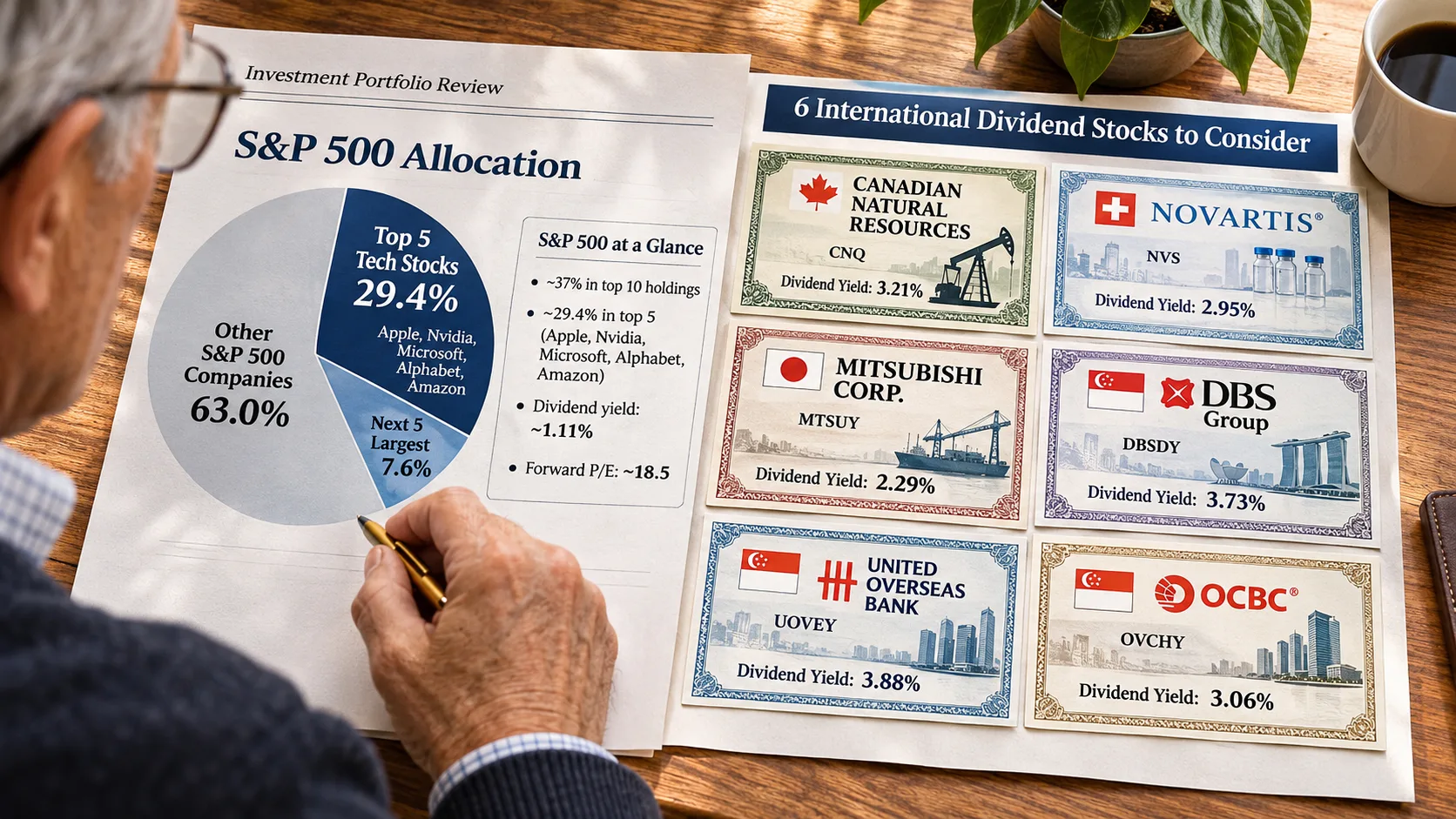
As of late October, its 10 largest holdings accounted for approximately 37% of the SPDR S&P 500 ETF Trust (SPY).
Apple, Nvidia, Microsoft, Amazon, and Alphabet alone represented nearly 30% of the fund.
That concentration has rewarded investors as technology companies have driven much of the market’s growth. However, it also means that disappointing earnings, slowing AI investment, or falling valuations among these companies could have an outsized impact on the broader index.
Consider an investor with $500,000 in an S&P 500 index fund. Based on those weightings, roughly $185,000 is effectively concentrated in the fund’s 10 largest stock positions.
Even investors who believe they are broadly diversified may have much more exposure to the technology trade than they realize.
The concern is especially relevant for retirees and investors approaching retirement, when large portfolio declines can become harder to recover from, particularly if withdrawals are already underway.
International Stocks Are Trading at a Substantial Discount
One reason international dividend stocks are receiving renewed attention is valuation.
According to FactSet figures cited in recent market analysis, the S&P 500 traded at approximately 18.5 times expected earnings, compared with 14.4 times for the iShares MSCI EAFE ETF (EFA), which tracks developed markets outside the United States and Canada.
That means the international fund traded at roughly a 22% discount to its U.S. counterpart based on forward earnings multiples.
The valuation gap creates an interesting opportunity. Investors can potentially purchase established companies at lower earnings multiples while collecting larger dividend payments.
International stocks have also demonstrated that investors do not necessarily need to sacrifice performance by looking beyond American markets.
Through the first 10 months of 2026, the S&P 500 generated a total return of approximately 11.8%, while the MSCI EAFE Index returned 12.4%, with dividends reinvested.
One particularly interesting investment vehicle is the Franklin International Low Volatility High Dividend Index ETF (LVHI).
The fund focuses on dividend-paying companies in developed international markets while emphasizing more stable earnings and stock-price behavior.
According to the supplied market figures, LVHI returned approximately 20.6% during the first 10 months of 2026, with a forward price-to-earnings ratio of 12.4 and a 30-day yield of approximately 3.13%.
The fund’s dividend yield was nearly three times the S&P 500’s indicated yield of approximately 1.11%.
Those figures illustrate why investors seeking income and greater geographic diversification are taking another look at international markets.
Six Dividend Stocks Worth a Closer Look
The following six companies were identified by Franklin Templeton investment executive Jeff Silverman as examples of international dividend opportunities combining income potential with relatively attractive business characteristics.
Each is accessible to U.S. investors through a U.S.-listed share or American depositary receipt (ADR).
| Company | U.S. Ticker | Dividend Yield | 2026 Return |
|---|---|---|---|
| Canadian Natural Resources | CNQ | 3.21% | +70.6% |
| Novartis | NVS | 2.95% | +20.2% |
| Mitsubishi Corp. | MTSUY | 2.29% | +34.7% |
| DBS Group | DBSDY | 3.73% | +34.8% |
| United Overseas Bank | UOVEY | 3.88% | +23.3% |
| Oversea-Chinese Banking Corp. | OVCHY | 3.06% | +53.8% |
Source: LSEG figures supplied for the article. Dividend yields and total returns are based on the U.S. listings through the referenced 2026 reporting period. Yields fluctuate with share prices and distributions. Past performance does not guarantee future results.
1. Canadian Natural Resources (CNQ): A 3.21% Yield With Energy Exposure
Canadian Natural Resources offers investors exposure to oil and natural gas production outside the United States.
The company operates a diversified collection of energy assets, including Canadian oil sands and conventional oil and gas operations.
Its appeal extends beyond the dividend. Energy producers can provide a different source of earnings from technology companies, with profitability driven more directly by commodity prices, production volumes, and operating costs.
Canadian Natural Resources has already produced substantial gains in 2026, with the supplied data showing a total return of 70.6%.
Its forward price-to-earnings ratio of 13.2 suggests investors are paying a lower multiple of expected profits than they would for the average S&P 500 company.
What investors should watch: Oil prices remain the biggest variable. A prolonged decline in crude prices could pressure cash flow, reduce dividend growth opportunities, and reverse some of the stock’s recent gains.
For investors with limited energy exposure, CNQ offers an opportunity to diversify earnings sources while collecting income.
2. Novartis (NVS): A Defensive Healthcare Business With a 2.95% Yield
Swiss pharmaceutical giant Novartis represents a different approach to portfolio diversification.
Rather than depending on consumer spending, advertising, or artificial intelligence investment, Novartis generates revenue through prescription medications.
Demand for healthcare products can remain relatively resilient during economic slowdowns, although individual pharmaceutical companies face significant risks from patent expirations, competition, and drug-development outcomes.
Novartis trades at approximately 16.2 times forward earnings and offers a dividend yield of 2.95%, according to the supplied figures.
Its 2026 total return of 20.2% demonstrates that dividend-paying pharmaceutical companies can participate in market gains while providing exposure to a fundamentally different industry.
What investors should watch: New drug approvals, major clinical trial results, and the company’s ability to replace revenue lost when blockbuster medications face generic competition.
For income investors, Novartis provides exposure to healthcare innovation without relying on the spending plans of America’s largest technology companies.
3. Mitsubishi Corp. (MTSUY): A Japanese Dividend Stock With Multiple Sources of Profit
Mitsubishi Corp. is one of Japan’s major trading and investment companies, with businesses spanning energy, metals, industrial materials, consumer products, and other sectors.
That diversified structure gives investors access to several parts of the global economy through a single company.
The stock offers a dividend yield of approximately 2.29% and trades at 14.5 times expected earnings.
It has also generated a 34.7% total return in 2026, according to the supplied data.
Japan has become increasingly interesting to international investors as corporate governance reforms encourage companies to improve capital efficiency and deliver stronger shareholder returns.
For Mitsubishi, that can translate into opportunities for greater dividend distributions, share repurchases, and more disciplined capital allocation.
What investors should watch: Commodity demand, Japanese corporate governance developments, the yen’s exchange rate, and management’s commitment to shareholder returns.
Although its dividend yield is the lowest among these six companies, Mitsubishi offers a combination of geographic diversification and exposure to multiple industries.
4. DBS Group (DBSDY): A 3.73% Yield From One of Asia’s Major Banks
Singapore-based DBS Group is a leading financial services company with operations across major Asian markets.
Its business provides exposure to banking, wealth management, lending, and financial activity in the region.
DBS offers a dividend yield of approximately 3.73%, with a forward price-to-earnings ratio of 15.7.
The stock has returned 34.8% in 2026, according to the supplied figures.
An important attraction is the company’s emphasis on distributing capital to shareholders. DBS has established a policy of progressively growing ordinary dividends alongside earnings and has outlined additional capital-return distributions through 2027.
That framework can appeal to investors who prioritize income.
What investors should watch: Interest-rate changes, credit quality, regional economic growth, and whether the bank can sustain strong profitability as lending conditions evolve.
Lower interest rates can sometimes support loan demand while simultaneously pressuring banks’ net interest margins.
5. United Overseas Bank (UOVEY): The Highest Dividend Yield of the Six
United Overseas Bank, commonly known as UOB, offers the highest indicated dividend yield on this list at approximately 3.88%.
The Singapore-headquartered banking group serves customers across Southeast Asia and other major financial markets.
Its forward price-to-earnings ratio of 12.2 is also the lowest among the six stocks, based on the supplied figures.
That combination of a relatively low earnings multiple and above-average dividend yield may appeal to investors seeking income at a reasonable valuation.
UOB has generated a 23.3% total return in 2026, suggesting investors have benefited from both capital appreciation and shareholder distributions.
However, bank dividends depend on earnings, capital requirements, and the health of loan portfolios.
What investors should watch: Regional property markets, credit losses, interest margins, and capital levels.
A lower valuation can represent an opportunity, but investors should determine whether the discount adequately compensates them for banking-sector risks.
6. Oversea-Chinese Banking Corp. (OVCHY): A 3.06% Yield and Strong 2026 Performance
Oversea-Chinese Banking Corp., better known as OCBC, rounds out the list.
The Singapore banking group operates across commercial banking, wealth management, and other financial services.
OCBC has delivered a 53.8% total return in 2026, according to the supplied data, making it one of the strongest performers among these six companies.
The stock carries an indicated dividend yield of approximately 3.06% and trades at 16.1 times forward earnings.
Its combination of financial services operations and exposure to Asian economic activity offers an alternative to U.S. technology and consumer-related investments.
However, its strong recent share-price performance also raises an important valuation question: How much future growth is already reflected in the stock?
What investors should watch: Loan growth, wealth management performance, credit quality, and the sustainability of dividends following a substantial share-price advance.
The Dividend Advantage: What Higher Yields Could Mean for Your Income
For investors approaching retirement, the difference between a 1% yield and a 3% or 4% yield can be meaningful.
Consider a hypothetical $100,000 investment.
| Annual Dividend Yield | Annual Income |
|---|---|
| 1.11% | $1,110 |
| 2.50% | $2,500 |
| 3.00% | $3,000 |
| 3.50% | $3,500 |
| 3.88% | $3,880 |
Illustrative annual income before taxes and fees, assuming yields remain unchanged. Actual dividends and exchange rates can fluctuate.
At a 3.5% yield, an investor could generate $3,500 in annual dividends, compared with $1,110 at the S&P 500’s cited 1.11% yield.
That is an additional $2,390 annually for every $100,000 invested.
For a $500,000 portfolio, the same yield difference would represent approximately $11,950 in additional annual dividend income.
Of course, higher yields do not automatically translate into better investments. Share prices can decline enough to overwhelm years of dividend income, and companies can reduce their payouts.
Investors must consider total returns, taxes, and dividend sustainability alongside current income.
One Important Risk Investors Shouldn’t Overlook
International dividend investing introduces several risks that may be less familiar to investors accustomed to U.S. stocks.
The first is currency exposure.
A company may increase its dividend in Japanese yen, Swiss francs, or Singapore dollars, yet a U.S. investor could receive less income after currency conversion if the dollar strengthens.
Foreign dividend withholding taxes can also reduce the amount investors actually receive. Tax treatment varies by country, account type, and applicable tax agreements.
Liquidity presents another consideration. Some international ADRs trade less frequently than major U.S. stocks, resulting in wider bid-ask spreads and potentially higher transaction costs.
There is also a concentration issue within this particular group of six stocks.
Three are Singapore banks. Buying all three would provide international exposure, but it would also create substantial exposure to the same country, industry, and regional economic risks.
This is why geographic diversification should be evaluated alongside sector diversification.
Could International Dividend Stocks Hold Up Better During an AI Selloff?
One of the strongest arguments for international dividend investing involves the different factors driving corporate profits.
Many leading American technology companies are committing enormous amounts of capital to data centers, chips, computing infrastructure, and other AI-related projects.
Investors are increasingly focused on whether those expenditures will produce sufficient returns.
If markets become more skeptical of AI profitability, companies trading at premium valuations could experience substantial pressure.
A Swiss pharmaceutical company, a Canadian energy producer, or a Singapore bank may respond differently because its earnings depend on different business conditions.
That creates potential diversification benefits.
However, there is an important distinction between lower volatility and protection from losses.
International dividend stocks can still decline sharply during a global recession, financial crisis, or broad market selloff. Energy companies are sensitive to commodity prices, while banks face credit and interest-rate risks.
The strongest case for these investments is that their returns may be driven by different factors, potentially reducing reliance on one dominant market theme.
A Simpler Way to Invest Internationally
Investors who find researching individual foreign stocks complicated have another option.
The Franklin International Low Volatility High Dividend Index ETF (LVHI) packages an international dividend strategy into a single exchange-traded fund.
The portfolio holds nearly 200 stocks, according to the supplied fund data, and emphasizes companies with relatively high dividends and more stable earnings and share-price behavior.
The fund distributes dividends quarterly.
Unlike purchasing a few individual stocks, an ETF can spread company-specific exposure across numerous holdings, countries, and industries.
Still, investors should evaluate the fund’s expense ratio, underlying sector allocations, currency exposure, dividend history, and historical drawdowns before investing.
The iShares MSCI EAFE ETF (EFA) offers another approach through broader exposure to developed markets outside the United States and Canada, although it does not specifically target high-dividend, low-volatility companies.
Investors should also remember that an ETF’s 30-day SEC yield, trailing distribution yield, and individual-stock indicated dividend yields are different measurements and should be compared carefully.
What Investors Should Watch Through the End of 2026
Several developments could influence whether international dividend stocks continue attracting capital.
AI spending and technology earnings: If investors become more concerned about technology valuations and capital expenditures, demand for less technology-dependent investments could increase.
Federal Reserve policy: Changes in interest rates can influence the value of dividend-paying stocks, the U.S. dollar, and the profitability of financial companies.
The U.S. dollar: A weaker dollar can benefit unhedged international investments when their foreign-currency returns are translated into dollars. A stronger dollar can create the opposite effect.
Dividend announcements: Investors should monitor whether companies increase payouts in line with earnings or begin using more debt and capital reserves to maintain distributions.
International valuations: If global investors increasingly favor cheaper markets, some of today’s valuation discounts could narrow. However, strong recent returns also mean future upside may be more limited for individual stocks that have already rallied sharply.
The Takeaway for Investors
The S&P 500 remains a powerful long-term investment vehicle, and its technology-heavy composition has helped deliver exceptional gains.
However, investors who own multiple U.S. index funds may discover that their portfolios depend on many of the same companies.
International dividend stocks offer an opportunity to broaden that exposure while potentially increasing portfolio income.
Canadian Natural Resources, Novartis, Mitsubishi, DBS, United Overseas Bank, and OCBC demonstrate how investors can access different industries, currencies, and economic regions through established dividend-paying businesses.
The attraction is straightforward: relatively attractive valuations, meaningful dividend yields, and earnings streams with less direct dependence on the American AI boom.
For investors concerned about excessive concentration in Big Tech, the most important opportunity may be finding additional sources of returns before the next period of market volatility arrives.
About Author