
The leaders of the United States, China and Russia have gathered in China for an extraordinary diplomatic summit that could influence everything from global trade and artificial intelligence to energy prices and the future of international security.
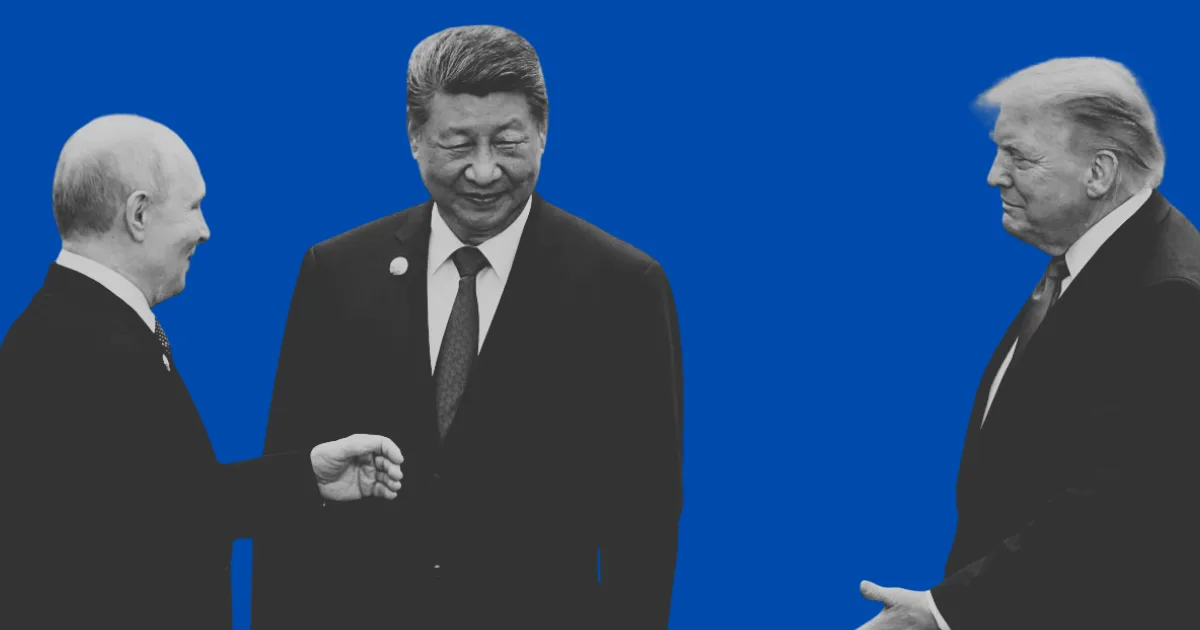
President Donald Trump, Chinese President Xi Jinping and Russian President Vladimir Putin came together Wednesday in Shenzhen, where a carefully orchestrated display of diplomacy offered an early glimpse into the shifting relationships among the world’s most powerful nations.
The three leaders are scheduled to hold formal talks Thursday, November 19, with trade restrictions, nuclear weapons, regional conflicts and technological competition among the issues potentially shaping discussions. But even before those negotiations begin, several developments are already revealing how the balance of global economic power may be changing.
Here are seven things investors need to know.
1. Trump, Xi and Putin Are Attempting Something Rarely Seen in Modern Diplomacy
The gathering brings together the leaders of three countries whose decisions influence global trade, military security, energy supplies and many of the world’s largest financial markets.
Trump arrived in Shenzhen on Wednesday, joining other international officials for APEC events. Later, Trump and Putin exchanged a handshake as Xi looked on, a moment that attracted considerable attention given the tensions between Washington and Moscow.
The public interactions were cordial, despite considerable disagreements involving U.S. technology restrictions, Russia’s military activities and competing international alliances. The contrast between the friendly atmosphere and the difficult issues awaiting the leaders illustrates the complicated nature of their relationships.
The more consequential discussions are scheduled for Thursday, when the three presidents are expected to participate in formal talks. While a major diplomatic breakthrough remains uncertain, the meeting itself provides an opportunity to address disputes that have increasingly shaped the global economic outlook.
Why it matters: Direct communication among Washington, Beijing and Moscow could reduce uncertainty surrounding major geopolitical disputes, even without immediate agreements. For investors, the most important question is whether that communication produces measurable changes in trade policy, sanctions or military tensions.
2. China Is Sending a Message About Trade, and America Is the Intended Audience
Xi used Wednesday’s APEC CEO Summit to make a sweeping argument for reducing barriers to international commerce. The Chinese president pledged to lower tariffs, expand market access and reform regulations to encourage foreign investment and manufacturing.
His remarks came against the backdrop of American restrictions on advanced technology exports and continued disagreements over trade practices. China has a strong economic incentive to promote greater international commerce, particularly as its manufacturers depend heavily on overseas demand.
Meanwhile, the country’s domestic economy continues to struggle with weak consumer spending and a prolonged property downturn. These challenges have increased the importance of exports and foreign investment as sources of economic growth.
Xi’s message also appeared designed to appeal to other Asia-Pacific countries seeking more predictable trading relationships. By positioning China as a supporter of international commerce, Beijing is attempting to strengthen its relationships with economies that have become increasingly concerned about tariffs and trade restrictions.
The contrast with Washington’s tariff-focused approach was difficult to miss, particularly as Trump prepared for direct discussions with Xi.
Why it matters: Reduced trade friction could benefit multinational manufacturers, industrial companies, retailers and technology businesses with international supply chains. However, investors should distinguish between diplomatic commitments and enforceable policy changes, since the details of any agreement will ultimately determine which businesses benefit.
3. The Choice of Shenzhen Was No Accident
China could have hosted the gathering in Beijing, its political capital, or Shanghai, its international financial center. Instead, the summit is taking place in Shenzhen, one of the country’s most important technology and advanced manufacturing hubs.
Once a relatively small city near Hong Kong, Shenzhen has developed into a center of Chinese innovation, home to major companies including Huawei, electric-vehicle manufacturer BYD and drone producer DJI.
Its manufacturing ecosystem brings together electronics suppliers, engineers, factories and technology startups in unusually close proximity. That concentration allows companies to move rapidly from product development to large-scale production, giving Shenzhen an important competitive advantage.
According to figures cited in reporting on the city, Shenzhen’s economy expanded 6% during the first three quarters of 2026, outperforming China’s overall growth rate. The city has become a showcase for China’s most successful industries at a time when other parts of the national economy continue to struggle.
By bringing Trump and Putin to Shenzhen, Xi is showcasing the part of China’s economy that Beijing wants the world to notice. The symbolic message is powerful: China increasingly wants to be recognized as a global leader in advanced technology, rather than primarily as a low-cost manufacturing center.
Why it matters: Competition between the United States and China is expanding across artificial intelligence, semiconductors, electric vehicles, robotics and advanced manufacturing. Companies exposed to these industries could face significant opportunities alongside growing regulatory and competitive risks as both countries increase their investments in strategically important technologies.
4. Artificial Intelligence May Be One of the Biggest Issues Behind the Scenes
Although trade and international security dominate the summit’s public agenda, artificial intelligence is becoming an increasingly important component of the U.S.-China relationship.
Washington has restricted China’s access to some of the most advanced American semiconductor technology, particularly the chips used to develop and operate powerful AI systems. Those restrictions have encouraged Beijing to accelerate efforts to build a domestic semiconductor industry and reduce dependence on American suppliers.
Huawei has become central to that effort, developing its own AI processors and expanding the technology infrastructure supporting Chinese businesses. The company’s ambitions reflect a broader push by Beijing to establish greater control over the technologies that will drive future economic growth.
The summit also comes amid uncertainty surrounding Nvidia’s leadership following Jensen Huang’s departure, a development that has intensified attention on the global AI industry. While the leadership controversy has attracted considerable publicity, the more enduring geopolitical question concerns which countries and companies will control the next generation of computing infrastructure.
Xi specifically highlighted artificial intelligence and the digital economy as engines of future growth during his Wednesday remarks. His comments reinforce how technological leadership has become a central economic and national security priority for China.
Why it matters: Investors should pay attention to semiconductor export restrictions, Chinese chip development and any changes to technology trade rules. A loosening of restrictions could open additional opportunities for some American chipmakers, while continued restrictions could accelerate China’s investment in competing products and create long-term challenges for established technology leaders.
The outcome could influence where billions of dollars in AI infrastructure investment ultimately flow, affecting semiconductor manufacturers, cloud computing companies and businesses throughout the technology supply chain.
5. Putin Is Using the Summit to Challenge Western Sanctions
Russian President Vladimir Putin arrived in China with a message of his own, criticizing Western sanctions and restrictions on international trade. Speaking at the APEC CEO Summit, Putin emphasized Russia’s economic resilience and argued that the Asia-Pacific region offers opportunities for future cooperation.
His remarks come as Moscow continues to navigate the economic consequences of its confrontation with Western countries. China has become an increasingly important economic partner for Russia, particularly in energy, manufacturing and other industries affected by Western restrictions.
The relationship between Beijing and Moscow has attracted increasing attention from Western governments concerned about the economic and strategic implications of closer cooperation. For Russia, expanding relationships with Asian economies offers an opportunity to reduce some of the pressure created by sanctions.
The meeting also arrives amid uncertainty surrounding Russia’s war in Ukraine, the conflict involving Iran and broader questions about nuclear weapons agreements. These issues remain important sources of geopolitical risk, and meaningful progress on any of them could have consequences extending well beyond the countries directly involved.
Why it matters: Any meaningful reduction in geopolitical tensions could influence oil prices, shipping costs and global inflation expectations. Energy markets are particularly sensitive to developments involving Russia and Iran, where changes in sanctions, diplomatic relations or military conflict could alter expectations for crude oil supplies.
For investors, lower geopolitical risk could support broader financial markets, while renewed confrontation could increase volatility across energy, currencies and commodities.
6. China’s Technological Ambitions Are Becoming Impossible to Ignore
One of the most important developments surrounding the summit is China’s effort to demonstrate that it can compete directly with the United States in emerging technologies.
Shenzhen provides a visible example. Its streets have become testing grounds for autonomous vehicles, commercial delivery drones and other advanced technologies, while local manufacturers develop everything from sophisticated robotics to components used in artificial intelligence systems.
The city’s transformation reflects a broader Chinese strategy to achieve technological independence while increasing its influence over global manufacturing. That ambition creates a complicated situation for American businesses, particularly those operating in industries where China is both a major customer and an emerging competitor.
China remains an enormous potential market for U.S. technology companies. At the same time, Chinese manufacturers are increasingly challenging businesses in industries historically dominated by American, European and Japanese firms.
Huawei’s efforts to develop domestic AI chips illustrate the challenge. Even if Chinese processors do not immediately match the performance of leading American products, continued progress could eventually reduce China’s reliance on foreign suppliers.
There is another important consideration: China’s domestic economic weaknesses may actually accelerate its commitment to advanced manufacturing. With its property sector struggling and consumer demand subdued, Beijing has powerful incentives to support industries capable of generating exports, employment and long-term productivity growth.
For Chinese policymakers, advanced manufacturing increasingly represents a potential solution to several economic challenges simultaneously. Investments in robotics, semiconductors and artificial intelligence could strengthen industrial competitiveness while supporting the country’s broader ambitions for technological independence.
Why it matters: Investors should consider both sides of China’s technological expansion. American technology companies could benefit from stronger Chinese demand if trade relationships improve, but increased Chinese competition could also pressure pricing, market share and profit margins.
Industries worth monitoring include semiconductors, industrial automation, robotics, electric vehicles and the infrastructure supporting AI development.
7. The Biggest Market-Moving Developments May Come After the Cameras Leave
Wednesday’s public appearances were filled with handshakes, ceremonial welcomes and diplomatic speeches. But Thursday’s negotiations will be considerably more important for determining whether the summit produces lasting economic consequences.
A major agreement involving trade or technology restrictions could influence financial markets well beyond Asia. Likewise, unexpected developments involving Russia, Ukraine, Iran or nuclear security could quickly alter investors’ expectations for energy prices and international stability.
There is also a more complicated possibility. The three leaders could leave China without announcing any major agreement, while continuing private negotiations that eventually reshape international economic relationships.
That scenario would make the summit an opening chapter in a much longer geopolitical process. Major international agreements frequently require months of negotiations, and the willingness of leaders to maintain communication can sometimes become important even when immediate results are limited.
Why it matters: Investors should watch for specific policy decisions rather than interpreting friendly public appearances as evidence that major disputes have been resolved. The difference between a diplomatic commitment and an implemented agreement can be substantial, especially when trade restrictions, national security and advanced technology are involved.
What Investors Should Watch Next
Three developments could determine whether the Shenzhen summit becomes a meaningful turning point for financial markets.
First, watch for changes to U.S.-China trade policy. Any concrete tariff reductions, export-control adjustments or market-access agreements could affect multinational businesses and global supply chains. Companies with significant exposure to Chinese manufacturing or consumers may be particularly sensitive to announcements that alter the cost of international commerce.
Second, watch for agreements involving Russia and international security. Progress on nuclear weapons, Ukraine or other regional conflicts could influence energy prices and investors’ appetite for risk. Any indication that sanctions could eventually be adjusted would also deserve attention from energy producers, shipping companies and commodity investors.
Third, watch for technology-related announcements. Artificial intelligence and semiconductor policy could have consequences extending well beyond the companies directly involved. Changes in technology export rules, market access or restrictions on advanced equipment could influence investment decisions throughout the global technology industry.
The most meaningful signals will be written agreements, implementation schedules and subsequent policy actions. Investors should also monitor how financial markets respond once the summit concludes, particularly in sectors most exposed to international trade and geopolitical uncertainty.
The Bigger Picture
The gathering in Shenzhen highlights a broader transformation in the global economy.
China is trying to establish itself as a leader in advanced technology and international commerce. Russia is seeking to preserve its global influence despite Western economic pressure, while the United States is attempting to protect its strategic interests and manage increasingly complicated relationships with both countries.
Each leader arrived with different priorities, and their competing interests will make major agreements difficult. Nevertheless, the gathering underscores the importance of maintaining diplomatic relationships at a time when economic competition and international security concerns are becoming more closely connected.
For investors, the summit offers an unusually concentrated look at the forces likely to shape global markets in the coming years: technological competition, changing trade relationships, geopolitical risk and the continuing struggle for economic influence.
The biggest takeaway may be that the world’s economic balance is shifting, and decisions made in Shenzhen could help determine which countries, industries and companies benefit from what comes next.
About Author