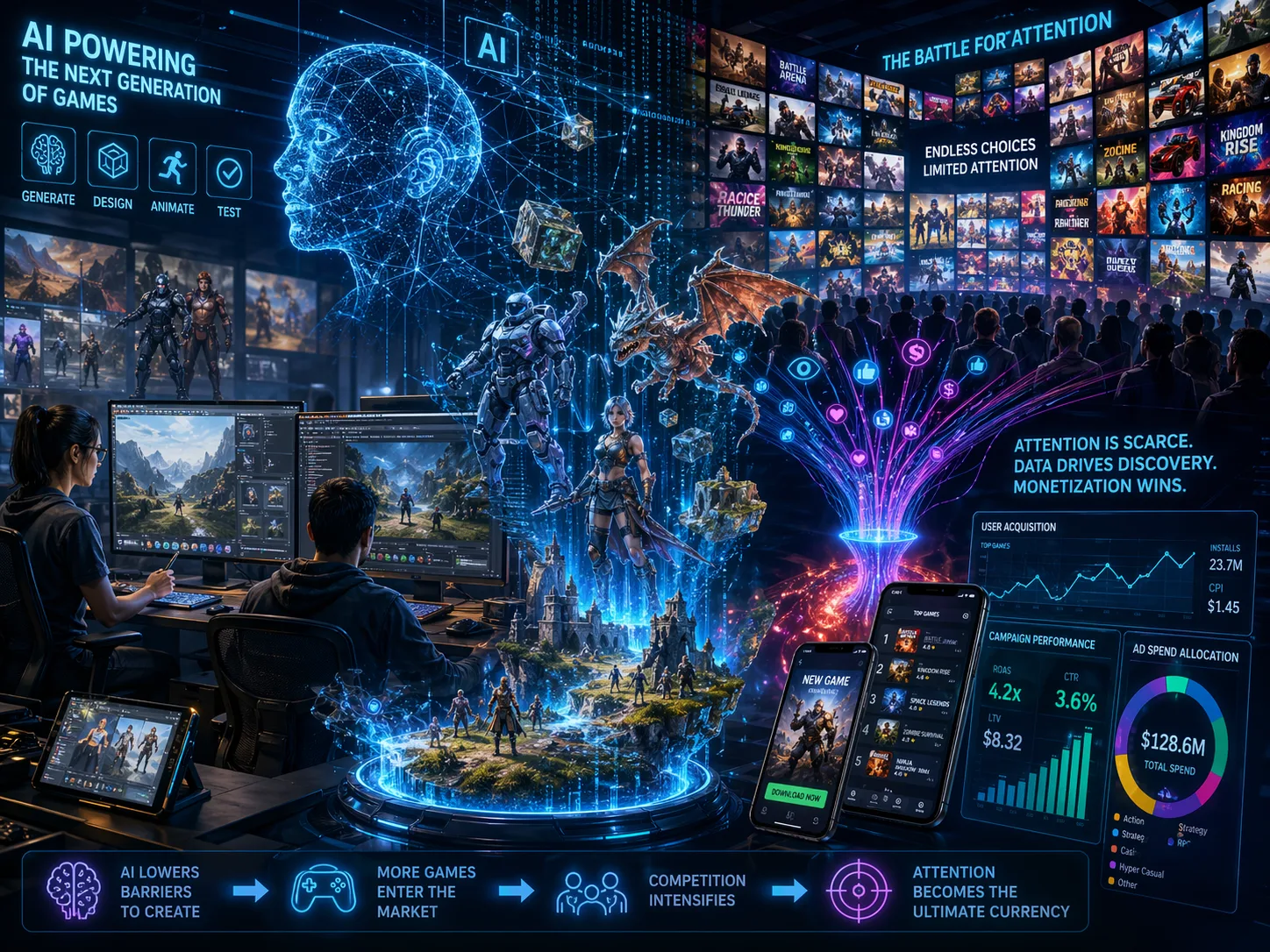
Artificial intelligence is not just another upgrade cycle for gaming. It is a structural reset that will reshape who makes money, how games are built, and where investor capital flows next. According to Morgan Stanley, generative AI could cut game development costs in half, unlocking an estimated $22 billion profit opportunity across the industry.
That headline number sounds bullish. It is. But it is also incomplete.
Because when costs collapse, supply explodes. And when supply explodes, attention becomes the real constraint.
This is not just a growth story. It is a power shift.
The Hidden Story: AI Is Expanding Supply Faster Than Demand
Most coverage focuses on cost savings. That is the easy takeaway.
The deeper issue is what happens when the number of games grows faster than the number of players willing to spend time and money on them.
AI does not just make development cheaper. It makes creation faster, easier, and more accessible. That leads to:
- More studios entering the market
- Faster release cycles
- A surge in total content
This creates a new reality:
- More titles competing for the same audience
- Shorter lifespans for individual games
- Increased reliance on visibility and discovery
This is not just efficiency. It is saturation.
For investors, that changes the equation. When supply overwhelms attention, value moves away from creators and toward companies that control distribution, discovery, and monetization.
A New Way to Understand This: The Gaming Power Shift Model
To understand where the money goes next, you need to rethink how the industry is structured.
The Gaming Power Shift Model
AI is redistributing control across three key zones:
1. Creation Zone (Pressure Building)
This is where traditional developers operate.
AI lowers costs and speeds up production. But it also intensifies competition. That means:
- More games fighting for visibility
- Less pricing power per title
- Higher dependence on standout success
Output increases. Control decreases.
2. Control Zone (Leverage Expanding)
This includes platforms where players discover and engage with games.
As content volume rises, these platforms decide:
- What gets surfaced
- What gains traction
- What generates revenue
Control shifts away from creators and toward distribution ecosystems.
3. Attention Zone (Where Profits Concentrate)
This is where the real battle takes place.
When supply surges, attention becomes scarce. Companies that can:
- Acquire users efficiently
- Retain engagement
- Match content with the right audience
…gain disproportionate power.
This is where margins expand.
The Core Insight
AI is shifting gaming from a creation-driven business to an attention-driven economy.
That is the lens investors need to adopt.
The Companies Positioned to Win
Morgan Stanley highlights four U.S.-traded companies that could benefit. Through this model, their positioning becomes clearer.
Sony: The Ecosystem Operator
Sony operates across multiple layers of the gaming economy:
- Game development through its studios
- Platform control via PlayStation
- Recurring revenue through subscriptions and live services
This diversification gives it flexibility.
As AI accelerates content creation, Sony can:
- Produce more efficiently
- Leverage existing franchises
- Capture value through its ecosystem
Morgan Stanley points to its strong intellectual property and recurring revenue streams as key advantages.
Investor takeaway: Sony is not dependent on a single outcome. It benefits from both increased content and sustained engagement within its platform.
Roblox: The Creator Engine
Roblox is built for this moment.
Its platform thrives on user-generated content. AI amplifies that model:
- Lower barriers for creators
- Faster content development
- More experiences for users
This drives a powerful cycle:
More creators lead to more content, which drives engagement, which fuels monetization.
Non-obvious insight:
While some investors worry about oversupply reducing quality, Roblox benefits from volume. More content increases engagement and keeps users inside the ecosystem longer.
AppLovin: The Attention Gatekeeper
AppLovin sits in a different part of the value chain.
It does not make games. It helps games find users.
As competition intensifies:
- More companies compete for attention
- User acquisition becomes more expensive
- Efficient targeting becomes critical
Morgan Stanley highlights that platforms capable of matching demand with users become more valuable in this environment.
Investor takeaway: When attention is scarce, companies that control discovery gain pricing power.
NetEase: The Execution Advantage
NetEase stands out for its technical capabilities.
Morgan Stanley describes it as a leading AI expert in gaming, with a strong talent base.
In an AI-driven environment, execution matters:
- Faster adoption of new tools
- Better integration of AI workflows
- Higher-quality output at lower cost
Investor takeaway: AI does not level the playing field completely. It rewards companies that can implement it effectively.
The Contrarian Reality: More Innovation Doesn’t Guarantee More Profit
The dominant narrative is straightforward. AI reduces costs, so profits should rise.
That is only half the story.
At the same time:
- Competition increases
- Differentiation becomes harder
- Success becomes less predictable
The result is a paradox:
The industry expands, but the average participant captures less value.
Investors expecting broad gains across gaming stocks may be disappointed. The upside will concentrate among companies with structural advantages in distribution, data, and monetization.
Where Capital Is Likely to Move
Instead of viewing gaming as a single sector, focus on positioning within the ecosystem.
Platforms Gain Strategic Importance
As content volume rises, platforms become the primary filter for what users see.
Watch:
- User growth
- Engagement metrics
- Revenue per user
Discovery Becomes a Bottleneck
With more games competing for attention, visibility becomes a premium asset.
Watch:
- Customer acquisition costs
- Advertising efficiency
- Data-driven targeting capabilities
Scaled IP Still Has Value — If Used Correctly
Established franchises can extend their lifecycle through updates, expansions, and cross-platform integration.
Execution speed becomes critical.
Mid-Sized Developers Face Pressure
This segment is most exposed.
They lack:
- Platform control
- Strong distribution channels
- Advanced monetization tools
They are caught between rising competition and limited leverage.
What Investors Should Do Now
This is not a broad-based opportunity. It requires selectivity.
Prioritize Structural Advantage
Focus on companies that control access and engagement:
- Platforms with strong ecosystems
- Businesses with user data advantages
- Companies tied to monetization infrastructure
Be Selective With Developers
Only consider studios that:
- Own scalable intellectual property
- Can integrate AI effectively
- Have diversified revenue streams
Track These Key Signals
- Speed of new game releases
- Growth in creator ecosystems
- Trends in advertising costs
- AI adoption across major players
These indicators reveal where power is consolidating.
This Is a Control Shift, Not Just a Cost Story
AI is often framed as a productivity tool.
In gaming, it is doing something more disruptive.
It is redistributing control.
More games will be created than ever before. That sounds positive. But it also means most will struggle to capture attention.
The companies that win will not be defined by how many games they produce.
They will be defined by who controls:
- Distribution
- Discovery
- Monetization
Everything else becomes interchangeable.
That is where investors should focus.
About Author