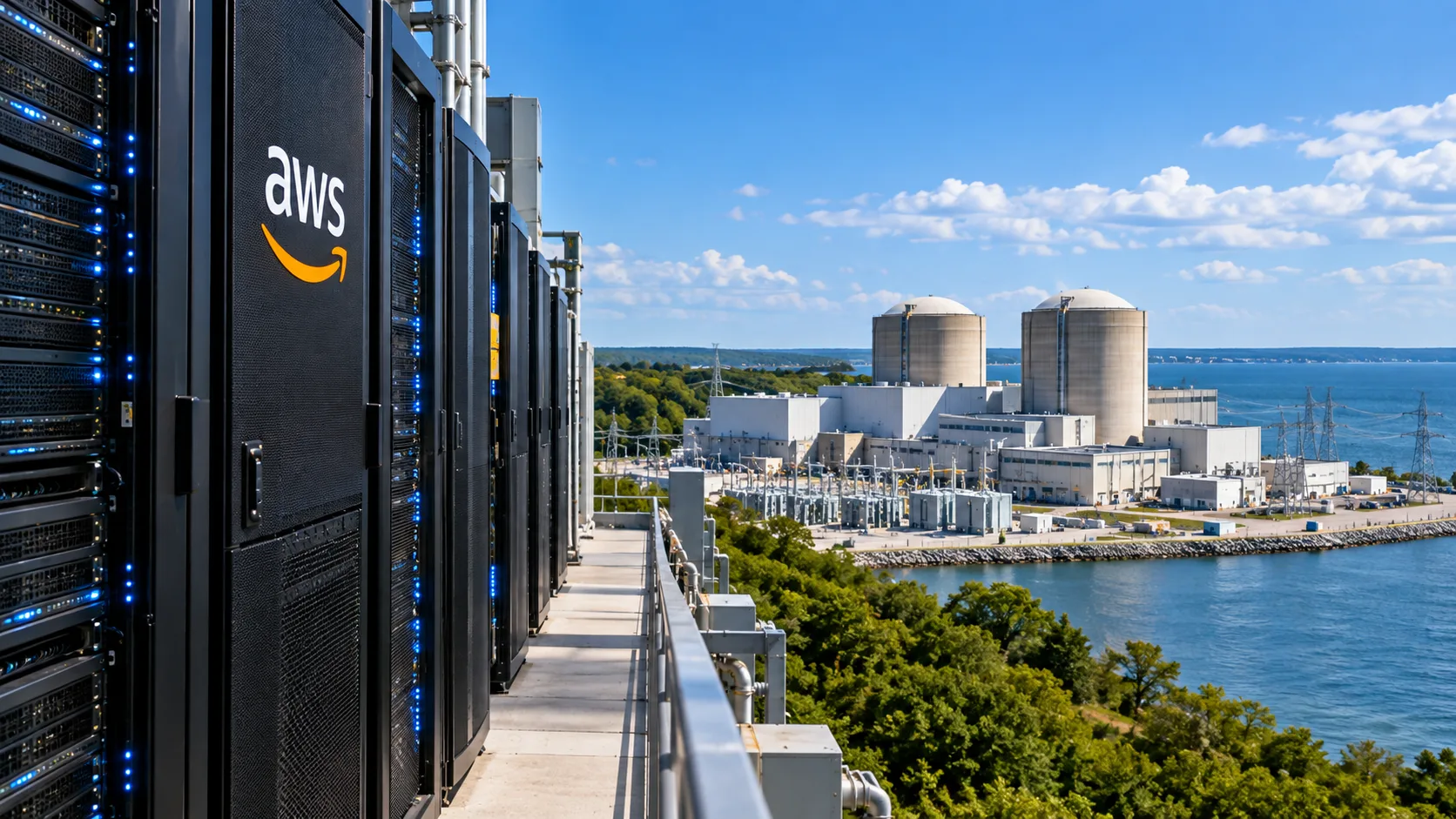
Amazon’s latest investment in the AI economy comes with a different kind of hardware: a nuclear power plant. A new 20-year electricity agreement will support more than $3 billion in upgrades at Maryland’s Calvert Cliffs facility, giving investors another reason to look beyond the companies building AI models.
The clearest beneficiary is Constellation Energy, the plant’s owner. The broader opportunity involves something every technology company needs and increasingly competes to secure: reliable electricity at a manageable price.
The Deal Behind the Nuclear Bet
Amazon and Constellation announced the agreement September 30. It covers 690 megawatts of power, including approximately 190 megawatts of additional generating capacity expected to come online between 2030 and 2032.
The commitment supports upgrades to the existing Calvert Cliffs plant and gives Constellation more predictable revenue as it pursues another 20 years of operation.
One important distinction: Amazon has signed a power-purchase agreement that enables the investment. The announcement does not say Amazon is writing a $3 billion check or buying the plant. The contract’s financial terms have not been disclosed.
Electricity from Calvert Cliffs will continue flowing into the regional PJM grid. Amazon’s agreement helps it manage energy costs for its operations across the region, without creating an exclusive electrical connection between the plant and its data centers.
For shareholders, the arrangement connects two different business needs. Amazon wants greater certainty about a major operating expense. Constellation wants a dependable customer before committing substantial capital to its facility.
The AI Trade Is Expanding Beyond Chips
Investors have spent much of the AI boom debating which chipmaker, software company or model developer will win. Amazon’s agreement points toward another question: Who owns the infrastructure those companies need regardless of which technology comes out ahead?
A data center can contain the most advanced processors available. Its economics still depend on getting electricity when it needs it.
That gives existing power producers a potentially valuable position. Operating nuclear plants already have generating equipment, established sites and grid connections. Expanding those facilities can offer a different development path from constructing an entirely new plant.
The federal government is pursuing the same approach through its UPRISE initiative, which focuses on increasing output from existing reactors, extending operating lives and restarting dormant facilities.
Amazon’s commitment shows how a large customer can help make those projects financially possible. A long-term buyer reduces some uncertainty about future revenue, making an expensive upgrade easier to justify.
The remaining uncertainty moves to construction costs, regulatory approvals and execution.
Who Could Benefit?
Constellation Has the Most Direct Connection
Constellation Energy, which trades under CEG, owns the asset and receives the long-term customer commitment. Its opportunity includes selling power, expanding output and potentially extending the plant’s operating life.
The company already has experience with this model. Its 2024 agreement with Microsoft supported plans to restart the former Three Mile Island Unit 1 as the Crane Clean Energy Center.
For investors, repeated agreements matter more than a single announcement. They could demonstrate that technology companies are becoming durable customers for nuclear generation.
However, a promising contract does not automatically make a stock attractively priced. Shareholders still need to examine project spending, expected returns and how much future growth the market already assumes.
Amazon Gains More Control Over Its Power Costs
For Amazon, which trades under AMZN, the agreement is partly a risk-management decision. Long-term electricity arrangements can make operating costs more predictable and support planning for facilities that require dependable power.
That could become valuable if electricity markets tighten. The trade-off is committing to a long-term arrangement when future power prices and computing demand remain uncertain.
The undisclosed contract price makes it impossible for outside investors to calculate precisely how favorable the agreement is for either company.
Equipment and Engineering Could Follow
Expanding a nuclear plant can require significant equipment changes and technical work. Depending on the project, beneficiaries could include engineering companies, turbine suppliers and electrical-equipment manufacturers.
Those are potential downstream opportunities. The announcement does not identify specific publicly traded suppliers receiving contracts, so a broad list of supposed winners would get ahead of the evidence.
The useful signal will be actual orders and funded project spending.
The Surprising Winner May Be an Older Plant
Much of the excitement around nuclear investing centers on small modular reactors and designs that have yet to enter commercial operation. This agreement directs substantial attention toward a facility already producing electricity.
That distinction matters. Investors can separate companies with operating assets and contracted customers from businesses whose value depends heavily on future technology milestones.
Both can have investment merit, but their risks are very different. An existing plant faces maintenance, licensing and upgrade challenges. A reactor developer may also need to prove its design, secure financing and establish a commercial market.
Constellation is evaluating possible small modular reactors at Calvert Cliffs, according to Maryland Matters. Those possibilities remain separate from the confirmed agreement supporting the existing plant.
The nearer-term financial story is the power infrastructure already in place.
Will This Help Household Electricity Bills?
Additional generation could help strengthen the regional grid, and the companies say the agreement will support that goal. Consumers should still be cautious about interpreting it as a promise of lower bills.
The added capacity is scheduled for 2030 through 2032. Households facing higher electricity costs today will not receive immediate relief from an expansion several years away.
Retail bills also reflect transmission costs, utility charges, fuel prices and total demand. If demand rises faster than supply, new generation can be valuable without producing lower monthly bills.
That is why the timeline deserves as much attention as the investment figure.
The Next Numbers That Matter
Investors should watch three developments:
- Regulatory progress: Increasing a reactor’s permitted power output requires Nuclear Regulatory Commission approval. Licensing milestones will show whether the expansion is moving toward operation.
- Costs and returns: Constellation’s future disclosures should help investors judge whether the upgrades are likely to earn an attractive return.
- Additional customer commitments: More long-term agreements could strengthen the case that nuclear power is becoming essential infrastructure for the technology industry.
There is also a local lesson. Amazon previously abandoned plans for a data-center campus at Calvert Cliffs following community opposition. The new power agreement demonstrates that companies can secure energy through the regional grid even when building directly beside a reactor proves difficult.
Follow the Customer, Then Check the Price
Amazon’s commitment makes the financial opportunity tangible: an established plant, a large customer and a long-term agreement supporting expansion.
That is a useful way to evaluate the next wave of AI investments. Look for businesses with assets customers need, contracts that support spending and a credible route to profitable growth.
Then check the stock price. An excellent business opportunity can still become an expensive investment.
About Author