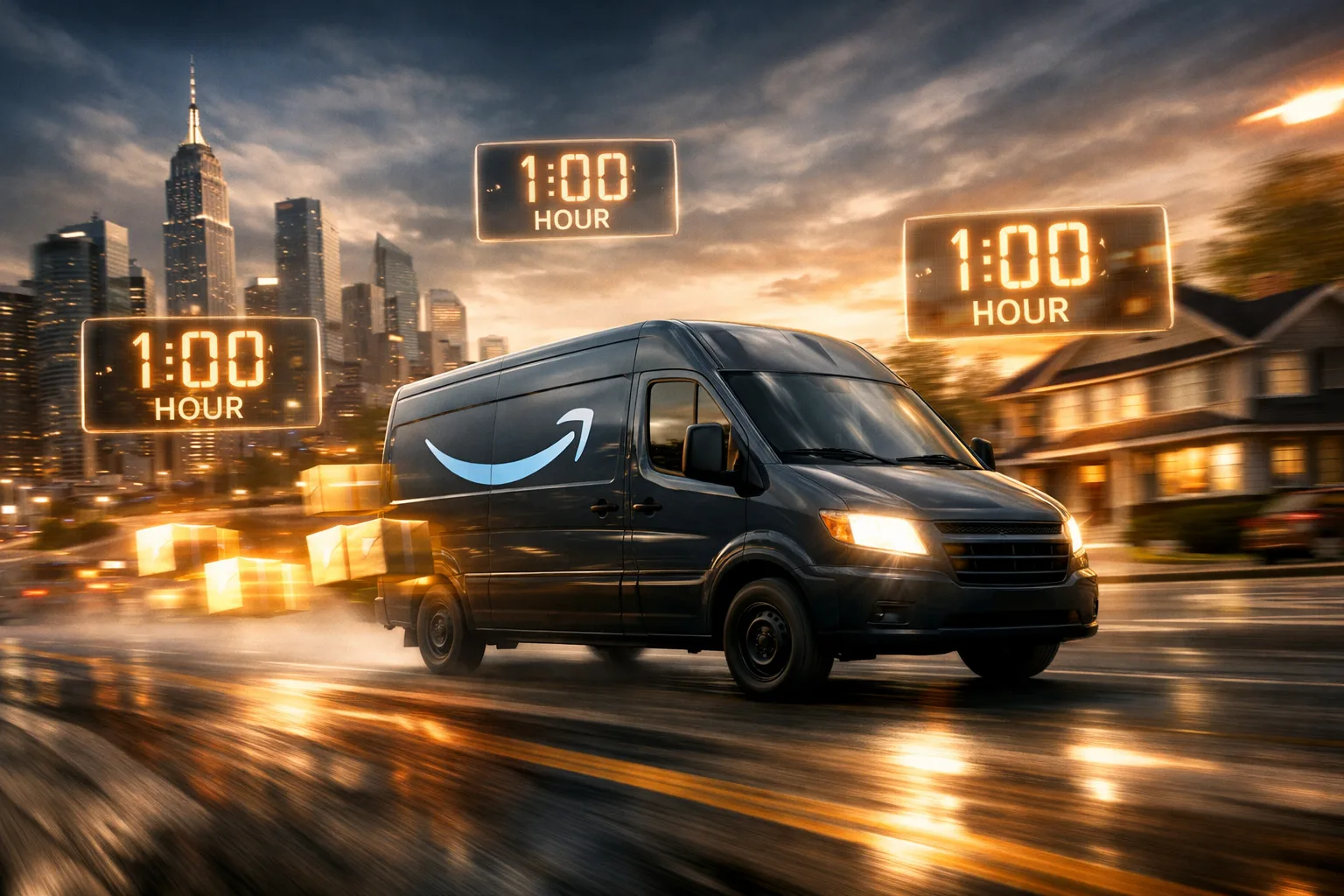
Amazon is once again raising the bar in the battle for consumer convenience, rolling out new one-hour and three-hour delivery options across large parts of the United States.
The move signals a clear shift in the retail landscape. Fast is no longer fast enough. Now the race is about who can deliver almost instantly.
The company confirmed that three-hour delivery is already available in roughly 2,000 cities and towns, while one-hour delivery has launched in hundreds of those markets, with more expansion expected in the coming months.
For investors and competitors alike, this is not just a logistics update. It is the next phase of a high-stakes war over consumer expectations, margins, and long-term dominance in e-commerce.
Amazon Is Rewiring Consumer Expectations Again
Amazon has spent the last two decades training consumers to expect faster delivery at lower cost.
That strategy started in 2005 with the launch of Prime and its then-revolutionary two-day shipping. By 2019, Amazon had pushed the industry toward one-day delivery as the new baseline. Now, the company is attempting to normalize delivery windows measured in hours instead of days.
The latest rollout dramatically expands access to ultrafast delivery for everyday items. More than 90,000 products are currently eligible for delivery in three hours or less, including:
- Pantry staples
- Cleaning supplies
- Over-the-counter medications
- Clothing and accessories
- Toys and household goods
Amazon is also integrating the experience directly into its platform. Customers in eligible regions can filter search results by delivery speed or browse a dedicated storefront highlighting items available within one or three hours.
The company’s “Get It Fast” interface further reinforces this shift, making speed a central part of the shopping decision.
Udit Madan, Amazon’s senior vice president of worldwide operations, summed up the company’s rationale clearly:
“Our customers are busier than ever and are looking for new ways to save time while keeping their households running.”
That statement reflects a broader trend. Convenience is now one of the most valuable currencies in retail.
The Real Strategy: Winning the Last Mile
Behind the scenes, this is not just about faster delivery. It is about controlling the most difficult and expensive part of logistics: the last mile.
Amazon has spent billions building a dense fulfillment network that allows it to position inventory closer to consumers. This includes:
- Regional fulfillment centers
- Same-day delivery hubs
- Micro-fulfillment facilities in urban areas
- A massive fleet of delivery drivers and Flex gig workers
By shrinking the distance between products and customers, Amazon can reduce delivery times while maintaining cost efficiency at scale.
This infrastructure advantage is extremely difficult for competitors to replicate.
It is also why Amazon has continued experimenting aggressively with new delivery models.
A History of Experiments and Failures
Amazon’s push into ultrafast delivery did not happen overnight. It has gone through multiple iterations, some of which failed.
The company previously shut down its standalone Prime Now service in 2021, folding its capabilities into the broader Amazon ecosystem.
In 2024, it discontinued a program designed to deliver products directly from mall retailers and brick-and-mortar stores, suggesting that not all partnerships or fulfillment models scale effectively.
But Amazon has not slowed down.
Instead, it has doubled down on internal solutions and newer concepts like “Amazon Now,” a program testing 30-minute deliveries of groceries and essentials in select U.S. cities, including Seattle and Philadelphia, as well as international markets such as India and the UAE.
At the same time, the company continues to invest in drone delivery, a project more than a decade in the making. While still limited in scope, drone delivery remains a potential long-term breakthrough that could further compress delivery times.
The Competitive Pressure Is Intensifying
Amazon may have set the standard, but it is no longer alone.
Major retailers and tech-enabled delivery platforms are aggressively competing on speed:
- Walmart has emphasized its ability to reach approximately 95% of U.S. households with delivery in under three hours
- Instacart continues expanding beyond groceries into general retail categories
- DoorDash and Uber Eats are rapidly evolving into multi-category delivery platforms, offering everything from electronics to home goods
This emerging category is often referred to as “quick commerce,” and it is becoming one of the fastest-growing segments in retail.
The key difference today is that speed is no longer a premium feature. It is quickly becoming a baseline expectation.
The Economics: Convenience Comes at a Cost
While faster delivery is appealing to consumers, it raises important questions about profitability.
Amazon’s pricing structure reflects the real cost of ultrafast fulfillment:
- Prime members:
- $9.99 for one-hour delivery
- $4.99 for three-hour delivery
- Non-Prime customers:
- $19.99 for one-hour delivery
- $14.99 for three-hour delivery
These fees help offset the higher costs associated with rapid fulfillment, including labor, transportation, and inventory positioning.
However, the long-term goal is not just to charge for speed. It is to increase customer dependence on the platform.
The more consumers rely on Amazon for immediate needs, the more frequently they shop. That drives higher lifetime value, which can justify the upfront investment in logistics.
Why This Matters for Investors
Amazon’s latest move is not just about delivery. It is about reinforcing its competitive moat.
Here are the key investor takeaways:
1. Amazon Is Expanding Its Dominance in Convenience
The company is positioning itself as the default option for immediate needs, not just planned purchases. That shift could increase order frequency and deepen customer loyalty.
2. Margins Could Be Pressured in the Short Term
Ultrafast delivery is expensive. Investors should expect continued heavy investment in logistics and fulfillment infrastructure, which may weigh on margins in the near term.
3. Long-Term Upside Comes From Scale
If Amazon can scale ultrafast delivery efficiently, it could create a significant barrier to entry. Competitors without similar infrastructure may struggle to keep up.
4. The Retail Industry Is Being Forced to Adapt
Walmart and others are investing heavily to match Amazon’s speed, which could trigger a broader industry shift. This may lead to increased capital spending across retail, impacting profitability sector-wide.
5. New Revenue Streams Could Emerge
As delivery speeds improve, Amazon could unlock new monetization opportunities, including premium services, advertising tied to urgency, and higher-margin impulse purchases.
Instant Gratification as the New Normal
Amazon’s push into one-hour delivery is part of a larger trend reshaping consumer behavior.
People are no longer just shopping online. They are outsourcing time.
Whether it is groceries, medicine, or last-minute essentials, the expectation is increasingly simple: get it now.
That shift has massive implications for retail, logistics, and even urban infrastructure.
Amazon is betting that whoever controls instant gratification will control the future of commerce.
And once again, it is moving first.
About Author