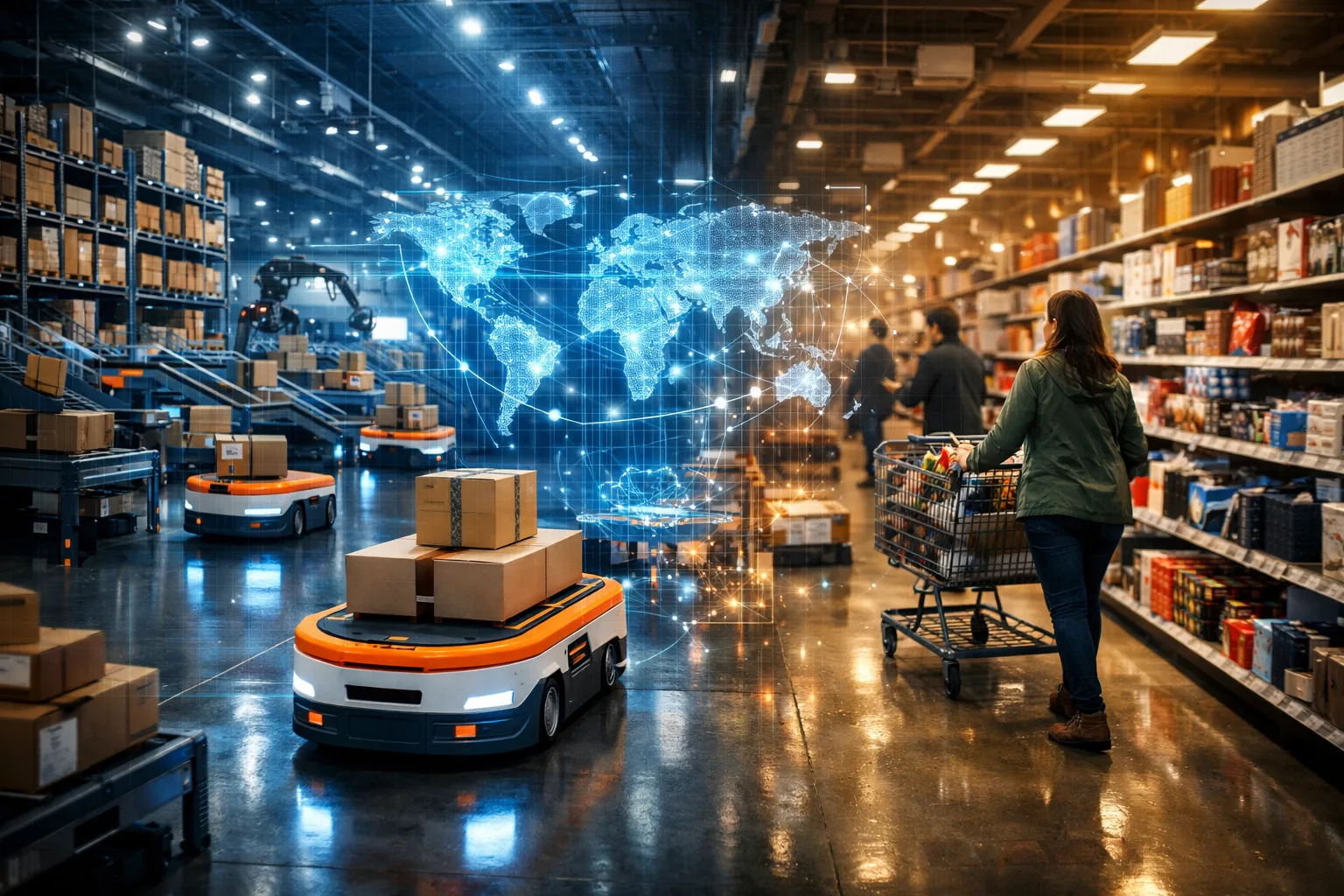
The global business landscape has shifted in a historic way. For the first time in more than a decade, Walmart is no longer the world’s largest company by revenue. Amazon has taken the top spot, marking a symbolic turning point in the evolution of global commerce.
But the headline alone does not tell the full story.
This is not simply a case of one retailer surpassing another. It reflects a deeper transformation in the structure of the global economy. Technology infrastructure, artificial intelligence, and cloud computing are now reshaping retail at its core. And the companies that control these systems are positioning themselves to dominate the next decade of commerce.
For investors, the real question is not who won the revenue race. It is who is winning the future.
The Revenue Shift That Signaled a Structural Change
Amazon reported approximately $717 billion in annual revenue, narrowly surpassing Walmart’s roughly $713 billion. This milestone ends Walmart’s long-standing reign at the top and represents one of the most significant shifts in corporate leadership in modern history.
The transition highlights the rise of digital commerce and the expansion of Amazon’s cloud and technology services, which have become major drivers of its growth. Analysts widely view this moment as symbolic of a broader shift away from traditional physical retail toward digitally powered ecosystems.
Walmart’s loss of the revenue crown does not signal weakness. The company continues to generate massive sales and remains the dominant force in grocery and physical retail. However, Amazon’s growth trajectory has been fueled by expanding beyond retail into cloud computing, digital advertising, and advanced logistics infrastructure.
Why Amazon Pulled Ahead
Amazon’s lead did not come from retail alone. The company’s expansion into high-margin and technology-driven businesses has created structural advantages that traditional retail models struggle to match.
One of the biggest contributors has been Amazon Web Services. AWS generates a substantial portion of Amazon’s operating profit and has funded the company’s continued investment in logistics, artificial intelligence, and Prime ecosystem expansion. Without its cloud division, Amazon’s retail business alone would still trail Walmart’s retail-driven revenue.
In addition, Amazon has grown faster. Its revenue growth has significantly outpaced Walmart’s, driven by continued expansion in e-commerce, cloud services, and digital advertising.
The company has also made aggressive investments in faster delivery, same-day logistics, and automation. These investments are designed to reinforce long-term competitive advantages rather than deliver immediate short-term profit.
The AI Retail War Is Now the Real Battle
The race between Amazon and Walmart is no longer just about sales. Artificial intelligence is now the defining force in retail competition.
AI is shaping pricing, inventory management, supply chains, customer experience, and operational efficiency. The company that best integrates AI into its retail ecosystem will likely dominate long-term.
Logistics and Supply Chain
Amazon currently leads in AI-driven logistics. The company uses predictive algorithms to position inventory closer to customers, optimize delivery routes, and manage warehouse robotics. This reduces shipping time and operational costs.
Walmart has improved rapidly by turning its stores into localized fulfillment hubs, but Amazon’s fully integrated logistics ecosystem still sets the global standard.
Pricing and Demand Forecasting
Both companies are highly advanced in predictive pricing and demand modeling. Amazon leverages marketplace data and real-time algorithmic pricing, while Walmart uses massive physical retail data, especially in grocery, to forecast demand. This category remains competitive and relatively balanced.
Automation and Robotics
Amazon maintains an advantage in automation. Its fulfillment centers rely heavily on robotics and machine learning to manage inventory and order processing. Walmart is investing heavily in automation as well, but Amazon’s earlier start and global scale provide a measurable edge.
Customer Experience and Personalization
Amazon leads in personalization. Its artificial intelligence drives product recommendations, search optimization, and targeted advertising. Its ecosystem, including Prime and voice integration, produces deeper data insights than traditional retail models.
Walmart has made strong progress through digital improvements and AI tools such as its customer-facing chatbot Sparky, which has reportedly increased customer order sizes. Still, Amazon’s digital ecosystem remains structurally stronger.
Infrastructure Control
This is where Amazon’s long-term advantage is clearest. Through AWS, Amazon not only uses artificial intelligence internally but also provides the infrastructure powering AI across industries.
Walmart uses AI. Amazon sells the infrastructure behind AI.
That distinction is critical.
Walmart Still Holds Key Strengths
Despite losing the revenue crown, Walmart remains a formidable competitor.
The company dominates physical retail and grocery, maintains strong cash flow, and continues expanding its digital capabilities. Walmart has also accelerated investments in automation, artificial intelligence, and e-commerce.
Recent data shows Walmart’s online sales continue to grow rapidly, and its AI-powered tools are improving customer engagement and spending. The company has also attracted higher-income shoppers while maintaining its reputation for value pricing.
In economic downturns, Walmart often benefits from consumers shifting toward lower-cost retailers. This makes Walmart a more defensive investment during periods of economic stress.
Why Amazon Stock Did Not Surge on the News
Despite the historic milestone, Amazon shares did not rally dramatically. Investors are focused on the company’s massive capital expenditures related to artificial intelligence infrastructure.
Amazon has announced plans to spend heavily on data centers, chips, and AI expansion. While these investments could strengthen long-term dominance, they also create short-term margin pressure and execution risk.
Markets are waiting for clear evidence that these investments will translate into sustainable profitability growth.
What This Means for Investors
The revenue shift reflects a deeper structural trend.
The world’s largest company is no longer defined by physical retail dominance. It is defined by digital infrastructure, data, and artificial intelligence.
If AI infrastructure continues to drive economic transformation, Amazon’s positioning could support long-term growth. Its cloud computing, advertising, and logistics ecosystems provide multiple engines for expansion.
Walmart, however, remains highly competitive and stable. Its physical footprint, grocery leadership, and improving digital capabilities ensure it remains one of the most powerful companies in the global economy.
This is not a winner-take-all outcome. It is a strategic divergence.
Amazon represents technological acceleration and long-term digital infrastructure leadership. Walmart represents consumer stability and physical commerce dominance.
Both will likely remain central to the global economy, but the trajectory of artificial intelligence and cloud computing will play a decisive role in determining future leadership.
The Bigger Economic Shift
This moment reflects a broader transformation in capitalism.
Retail dominance once came from store networks and physical distribution. Today, competitive advantage increasingly comes from data, logistics algorithms, and infrastructure control.
The companies building the backbone of artificial intelligence, cloud computing, and automated logistics are shaping the next phase of global commerce.
Amazon currently sits at the center of that shift.
The AI retail war is still unfolding, but for now, Amazon holds the lead.
Sources
https://finimize.com/content/amazon-just-overtook-walmart-in-sales
https://www.wsj.com/business/retail/amazon-biggest-us-company-walmart-cfd0cac4
https://www.agenzianova.com/en/news/Amazon-surpasses-Walmart-to-become-the-world%27s-largest-company-by-annual-revenue/
https://www.ft.com/content/15fef72e-e5ea-429c-94c4-46715471b96a
https://www.investors.com/news/technology/amazon-stock-walmart-revenue-crown/
https://www.investopedia.com/meet-sparky-the-ai-chatbot-walmart-says-is-a-whiz-at-sales-wmt-11909966
https://canopymanagement.com/aws-amazon-ai-strategy-retail-dominance/
https://finance.yahoo.com/news/amazon-overtakes-walmart-lead-world-150944435.html
About Author