Amazon is reportedly working on a new smartphone project more than a decade after the Fire Phone turned into one of the company’s most memorable consumer hardware flops. This time, though, the story is not just about whether Amazon can sell another phone. It is about whether the e-commerce giant thinks the next big consumer tech battle will be won through AI-powered devices that control how people shop, search, watch, listen, and interact all day long. Reuters reported on March 20, 2026 that Amazon’s internal ZeroOne unit is developing a new device under the codename “Transformer,” and the company is said to be considering everything from a conventional smartphone to a more limited minimalist handset.
That makes this much bigger than a gadget rumor.
If Amazon were simply trying to build another generic smartphone, investors would have every reason to shrug it off. The smartphone business is brutally competitive, margins are tight outside the top tier, and Amazon already got burned once. But if the company is trying to build an AI-first personal device that deepens customer dependence on Alexa, Prime, shopping, and Amazon’s broader ecosystem, then this move starts to look like a strategic shot across the bow at Apple, Google, and potentially even Meta.
Why This Report Matters Now
According to Reuters, Amazon’s new phone effort is tied to a broader push to make Alexa central to its consumer hardware strategy again. The reported plan is to create a more personalized mobile device that integrates tightly with Amazon services such as shopping, Prime Video, and Prime Music. Reuters also reported that Amazon has not yet settled on whether the product will be a fully featured smartphone or a stripped-down secondary device with fewer capabilities.
That distinction matters.
A full smartphone would mean Amazon is once again trying to enter the core mobile market dominated by Apple’s iPhone and the Android ecosystem led by Google and Samsung. A minimalist phone would suggest something different: Amazon may be chasing a smaller but potentially important niche in AI-assisted personal devices, perhaps betting that some users want a simpler device that prioritizes voice, shopping, productivity, and media over the crowded app model that dominates today’s phones. That would still be risky, but it would at least be a more targeted strategy than trying to go head-to-head with the iPhone on traditional terms.
The timing is also not random. The AI race is no longer confined to cloud services and chatbots. Big tech companies are increasingly trying to own the interface through which users access AI every day. Samsung said in January it plans to double its AI-enabled mobile devices to 800 million units in 2026, with many of those features powered by Google’s Gemini. That shows how seriously the industry is taking the idea that mobile hardware is becoming an AI distribution channel, not just a communications device.
Amazon’s Fire Phone Failure Still Hangs Over This
Investors should not forget the last time Amazon tried this.
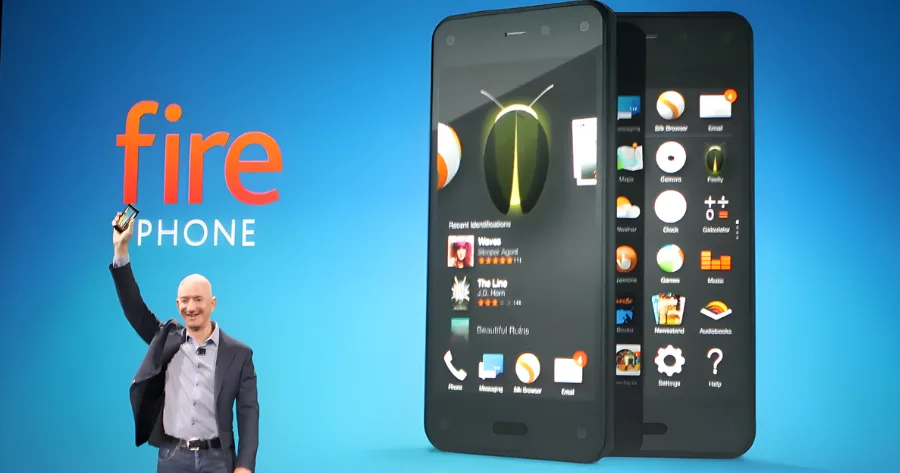
Amazon launched the Fire Phone in 2014, and it failed badly. Reuters reported that the collapse of that effort led to about $170 million in losses tied to unsold inventory and writedowns. The Fire Phone was widely criticized for its limited app ecosystem, high price, and weak consumer appeal, and it never came close to becoming a serious player in mobile.
That history is why this story deserves both attention and skepticism. Amazon has enormous scale, deep pockets, and one of the most powerful consumer ecosystems in the world, but none of that automatically translates into smartphone success. Apple’s dominance in premium smartphones is not an accident. It comes from tight integration across hardware, software, services, and branding. Google, meanwhile, benefits from Android’s massive installed base and its growing reach in mobile AI. Amazon would be trying to break into a market where users are deeply locked into existing habits, platforms, and app stores.
Still, Amazon seems to have learned at least one lesson from its earlier hardware missteps. Reuters separately reported in August 2025 that Amazon was considering moving its Fire tablets away from its heavily customized in-house software toward a more standard Android base. That suggests the company may be more willing now to adapt to what consumers and developers already want, rather than forcing them into a closed system with limited app support.
If that thinking carries over to a new phone, Amazon’s odds may be better than they were in 2014. Better does not mean good. It just means not hopeless.
Why Amazon May Want a Phone Again
The bull case for Amazon’s reported plan is not really about hardware profits.
It is about control.
Right now, Amazon depends heavily on platforms it does not own to reach consumers on mobile. A shopper may buy from Amazon, stream Prime Video, or use Alexa services, but much of that activity still happens through Apple’s iOS ecosystem or Google’s Android ecosystem. That means Amazon does not fully control the interface, the data flow, the default settings, or the broader user relationship on the device that people carry with them all day.
A successful phone, or even a successful niche AI mobile device, could help Amazon change that. It could increase engagement across commerce, subscriptions, advertising, and entertainment. It could make Alexa more useful in a way that smart speakers never fully achieved. And it could give Amazon a direct distribution platform for whatever consumer AI experiences it wants to build next.
That is the key investor angle. The real prize is not necessarily unit sales. The real prize is deeper monetization of users already inside Amazon’s ecosystem.
This is why the project should be viewed as an ecosystem move first and a hardware move second.
Why the Timing Also Looks Terrible
There is a hard reality here that Amazon cannot ignore: the smartphone market is heading into a rough period.
Reuters reported on February 26, 2026 that IDC expects the global smartphone market to suffer its steepest decline ever this year, with shipments projected to fall 12.9% to 1.12 billion units, the lowest level in more than a decade. IDC cited surging memory chip prices and supply pressures tied to AI infrastructure demand as major reasons for the downturn. Reuters also reported in January that Apple led the global smartphone market in 2025 with a 20% share, while Samsung held 19%, underscoring how entrenched the top players remain.
That environment is brutal for a new entrant.
When the market is expanding, a company can sometimes carve out share without triggering as much pain. When the market is shrinking and costs are rising, the bar goes way up. New hardware has to be compelling enough to pull consumers away from familiar brands while also overcoming price pressure and uncertain demand. That is a tough assignment for anyone, especially a company with a poor smartphone track record.
So even if Amazon’s strategy is smart in theory, the market backdrop is ugly in practice.
What This Could Mean for Apple
For Apple investors, this is not an immediate emergency.
Amazon does not appear to be close to launching a mass-market iPhone killer. Reuters made clear that many critical details remain undecided, including launch timing, price, and the exact type of device Amazon wants to build.
Still, Apple should not dismiss the broader signal. The threat is not that Amazon suddenly steals massive iPhone share next quarter. The threat is that more rivals are trying to own the AI relationship with users, which could weaken Apple’s long-term grip on how people interact with services on mobile.
If AI becomes the primary interface layer, then the company that controls that layer has enormous leverage. Apple clearly understands this, but it also faces rising pressure to prove that its own AI strategy is strong enough to defend the value of the iPhone ecosystem over time. Amazon’s reported phone effort is one more reminder that big tech rivals see opportunity in reshaping mobile around AI assistance, voice, personalization, and commerce.
For now, though, Apple remains in a position of strength. Reuters reported this week that Apple’s China smartphone sales jumped 23% to start 2026, even as broader market conditions remained weak. That does not mean Apple is invincible, but it does show the iPhone is still operating from a position Amazon can only dream of reaching.
What This Could Mean for Google
Google has more to watch here conceptually.
Amazon’s success in mobile would not just challenge Android market dynamics. It could also threaten the role Google plays in search, discovery, and AI assistance on mobile devices. The more Amazon can create a device experience centered on Alexa, shopping, and Amazon-owned services, the more it can try to reduce Google’s importance in day-to-day consumer behavior.
At the same time, Google still has major advantages. It sits at the center of Android, it has deep AI distribution through Gemini, and partners like Samsung are scaling those AI features aggressively. Samsung’s plan to ship 800 million AI-enabled devices this year is a reminder that Google is not standing still.
So the real risk to Google is not immediate financial damage. It is that Amazon is trying to create one more alternative funnel through which users can bypass Google’s ecosystem.
That matters over the long term, especially in advertising and AI.
What This Could Mean for Amazon Stock
For Amazon shareholders, the near-term stock impact is probably limited unless management officially confirms the project and gives details that allow investors to model costs, pricing, and strategic intent.
Right now, this is still a reported internal effort, not a formal launch.
That means it should be treated as a strategic clue, not a valuation driver.
The bullish interpretation is that Amazon is showing ambition in exactly the right place. AI is changing how consumers interact with technology, and Amazon has every reason to want its own distribution layer rather than living as an app inside someone else’s device ecosystem. If Amazon can build something differentiated enough to deepen spending, engagement, and subscription retention, the upside could extend well beyond hardware revenue.
The bearish interpretation is just as clear. Amazon has a long history of experimenting with hardware, and not every experiment matters financially. A failed phone would likely be a sideshow rather than a thesis-breaking event for Amazon’s overall business, but it could still burn capital and distract from more valuable efforts in cloud, advertising, logistics, and AI infrastructure.
My read is simple: this is not a buy or sell signal on Amazon today. It is a strategic development worth tracking because it tells investors where Amazon may believe the next consumer tech moat can be built.
The Real Question Investors Should Ask
The most important question is not whether Amazon can sell millions of phones.
It is whether Amazon can build a mobile AI experience so useful that consumers want Amazon at the center of their daily digital life, not just at the moment they place an order.
If the answer is no, this project probably ends up as a curiosity or another expensive hardware experiment.
If the answer is yes, then Amazon could slowly strengthen its grip on shopping, media, subscriptions, and consumer AI in a way that matters much more than unit sales alone.
That is why this story is worth paying attention to.
The smartphone itself may not be the business. It may be the Trojan horse.
What Investors Should Watch Next
Investors should watch for five things over the coming months.
First, whether Amazon formally confirms the project and provides a clear category definition. A full smartphone and a minimalist AI device are very different bets.
Second, whether the company ties the device to a major Alexa upgrade. If the phone exists mainly to showcase a more capable AI assistant, that changes how the market should view it.
Third, whether Amazon leans on Android more openly rather than repeating its old Fire OS mistakes. That could make the device more consumer-friendly and more developer-friendly.
Fourth, whether management describes the product as a commerce and services engine rather than a hardware margin story.
Fifth, whether this remains a lab experiment or moves into an actual launch window with pricing and distribution details.
Until then, investors should stay grounded. This is a real story, but it is still an early-stage one.
Bottom Line
Amazon’s reported new smartphone plan matters because it signals the company is not giving up on owning a bigger piece of the consumer device experience. After the Fire Phone disaster, that sounds bold, maybe reckless. But it also reflects a bigger truth in tech right now: whoever controls the AI interface may control the next wave of consumer loyalty and monetization.
Apple and Google are still in much stronger positions. Amazon is the one trying to prove it belongs in the conversation. But investors should not ignore the attempt. It says a lot about where the next battle may be headed.
About Author