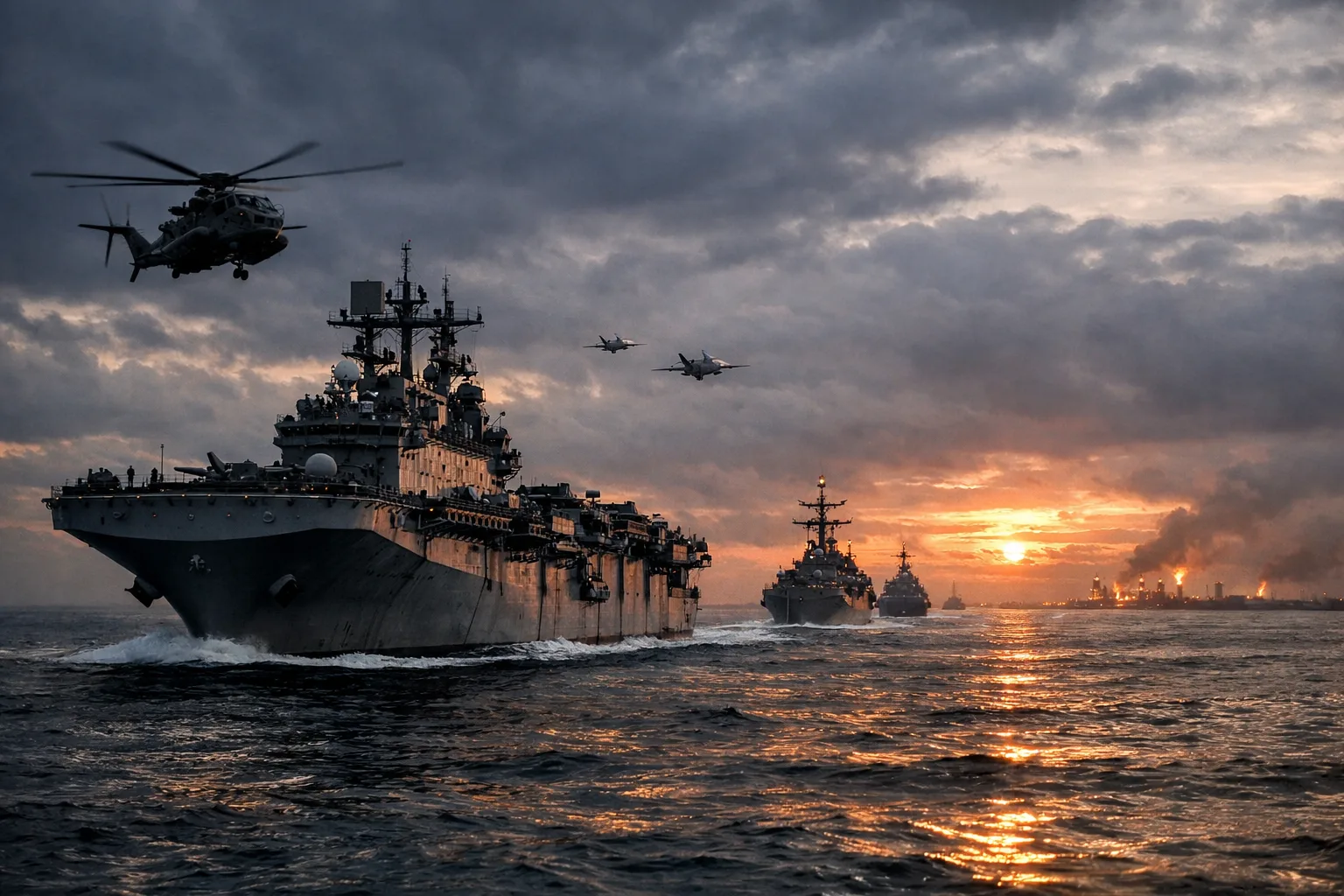
The Pentagon is sending thousands of additional U.S. troops and multiple warships into the Middle East as the war involving Iran, Israel, and the United States moves into a more dangerous phase, with Tehran signaling that it still has the ability and the intent to keep fighting.
U.S. officials said the deployment includes roughly 2,200 to 2,500 Marines from the California-based USS Boxer amphibious ready group and the 11th Marine Expeditionary Unit, along with additional warships headed toward the U.S. Central Command theater. The move marks the second major Marine deployment to the region in about a week and underscores how seriously Washington is treating the risk of wider regional spillover.
This is no longer a contained air campaign. It is turning into a broader geopolitical and market-moving crisis with implications for oil, LNG exports, global shipping, defense stocks, inflation, and recession risk.
At the same time, Iran is projecting open defiance. Iranian military-linked messaging has insisted that U.S. and Israeli strikes have not destroyed the country’s ability to keep producing missiles and weapons. The rhetoric coming out of Tehran has also become more threatening. Iran’s new supreme leader declared that “safety must be taken away” from the country’s enemies, a statement that is being interpreted as a signal that retaliation may expand beyond conventional battlefield targets.
That matters for investors because whenever the U.S. military posture escalates in the Middle East, markets immediately start repricing energy risk, defense demand, and broader global growth expectations.
A Military Buildup That Changes the Market Conversation
The latest troop movement is not just symbolic. Sending an amphibious ready group and a Marine Expeditionary Unit adds flexible strike and response capability. These are forces designed for rapid deployment in unstable theaters, able to support evacuations, secure assets, conduct raids, and reinforce regional operations if conditions worsen.
Reuters reported Friday that the United States is deploying thousands of additional Marines and sailors to the region earlier than planned, a sign that the military is adjusting to a conflict that could become more unpredictable and more prolonged than originally expected. AP separately reported that the buildup includes three more warships and about 2,500 Marines.
That shift is critical for readers trying to understand where this story could go next. Once Washington starts layering in additional naval and Marine assets in this kind of environment, the market stops looking at the conflict as a short-lived shock and starts pricing in a sustained risk premium.
That is already visible in energy.
Oil Stays Elevated as Traders Price in Supply Risk
Brent crude has remained around the $108 level after a sharp spike, reflecting fears that the war could damage more regional energy infrastructure or further disrupt shipping through key routes.
The oil market is reacting to two overlapping threats. First, there is the direct threat of physical damage to production and export infrastructure. Second, there is the threat of transport disruption around the Strait of Hormuz, one of the most important chokepoints in the global energy system.
Those risks are not theoretical anymore.
Iranian strikes have already damaged major energy infrastructure in the Gulf. Reuters reported that Indian officials are now bracing for reduced LNG supply from Qatar after Iranian attacks damaged facilities tied to the country’s export system. According to reporting cited Friday, the damage disabled about 17% of Qatar’s LNG export capacity. Reuters Breakingviews also reported that the hit could cost Qatar about $20 billion annually and drag heavily on growth if the disruption lasts.
That is a major development because Qatar is one of the world’s most important LNG exporters. Damage there is not just a Gulf issue. It affects energy-importing nations across Asia and Europe and raises the odds of higher global energy prices feeding into inflation again.
For U.S. investors, this is the kind of event that can ripple outward fast. Higher oil and gas prices can pressure transportation, industrials, airlines, consumer spending, and inflation-sensitive sectors. It also complicates any hope for easier monetary conditions if commodity inflation starts running hotter again.
Iran’s Message: We Can Still Hit Back
Iran is clearly trying to send a message that it remains capable of imposing pain despite weeks of strikes.
Associated Press reported Friday that Iranian-linked rhetoric and military statements continue to insist the country is still building missiles and can continue retaliatory operations. The same coverage highlighted growing fears that Iranian retaliation could stretch beyond traditional military targets, with threats referencing not only enemies in the region but also broader civilian or symbolic targets.
That is where the language from the country’s supreme leader becomes important. “Safety must be taken away” is not routine posturing. It is the kind of phrasing that suggests Iranian leadership wants uncertainty to spread. The goal is not just military. It is psychological and economic. If adversaries and markets believe no site is fully safe, the cost of doing business rises.
That helps explain why regional countries have been intercepting drones and missiles during what should have been a holiday period of celebration around Eid al-Fitr. Gulf states are not acting like the danger is contained. They are acting like they expect additional waves of attacks.
A major Kuwaiti oil refinery was also reportedly struck by a drone attack, which adds to the sense that energy assets remain in the crosshairs.
Trump’s Balancing Act
There is also a political layer that investors cannot ignore.
Even as the U.S. sends more military assets into the region, President Trump has publicly tried to avoid the appearance of committing ground troops into Iran itself. Reuters noted that Trump said such decisions would not be shared with the media, while the actual deployments tell a story of deepening U.S. involvement.
At the same time, there are signs Washington is trying to manage escalation selectively. According to reporting cited in live war coverage Friday, Israeli Prime Minister Benjamin Netanyahu said Israel would halt strikes on Iranian gas facilities at Trump’s request.
That matters because it suggests the White House may be trying to stop the conflict from triggering an even bigger energy shock. In plain English, the administration may be willing to intensify pressure on Iran militarily while still trying to avoid a full-scale destruction of energy infrastructure that would send oil and gas markets into an even more violent panic.
Whether that balancing act holds is another question.
Why This Matters for Investors
There are several reasons this story matters beyond the headlines.
First, energy inflation is back on the table. If oil holds above $100 and LNG disruptions worsen, the disinflation narrative that many investors were hoping for could weaken fast.
Second, defense and security spending could remain elevated for longer than the market expected. Sustained deployments, replenishment cycles, and partner-country defense needs all tend to support military contractors and related supply chains.
Third, global growth expectations may need to come down if the war causes a prolonged energy squeeze. Higher fuel and transport costs hit households and businesses alike, especially in Europe and Asia.
Fourth, this kind of instability tends to boost safe-haven trades while pressuring risk assets. That can mean stronger flows into defense names, some commodity plays, and selective hard assets, while sectors sensitive to input costs or economic slowdown come under pressure.
Fifth, shipping and insurance costs may continue rising. Even if oil supply is not fully cut off, the cost of moving goods through a threatened region can rise enough to push prices higher elsewhere in the economy.
The Scotland Nuclear Base Incident Adds Another Layer
One of the more unusual developments tied to the broader tension environment came out of the U.K., where police arrested individuals after an attempt to enter the Faslane nuclear submarine base in Scotland.
AP and Reuters both reported on the arrests Friday. Authorities said a man and woman were detained after trying to access the base, which houses Britain’s nuclear-armed submarine fleet. Investigations are ongoing.
Standing alone, that would already be a serious security incident. But in the context of a widening confrontation involving Iran and heightened fears of covert retaliation or espionage, it takes on extra significance.
This is one more reminder that geopolitical conflicts do not remain confined to the original battlefield. They often spill into cyber operations, sabotage fears, proxy activity, intelligence activity, and infrastructure security concerns in other allied countries. Markets may not price those risks immediately, but the threat environment changes quickly when incidents like this begin to pile up.
The Bigger Picture: The War Is Expanding Economically Even If It Does Not Expand Geographically
A lot of investors are still asking the wrong question. They want to know whether this becomes a formal regional war. That matters, but it is not the only thing that matters.
The more relevant question for markets is whether the war continues expanding economically.
In many ways, it already has.
Qatar’s LNG export capacity has been damaged. Kuwaiti energy infrastructure has reportedly been hit. Gulf countries are intercepting drones and missiles. Oil is elevated. Additional U.S. naval and Marine forces are moving into the region. Iran is promising continued retaliation. That is already enough to affect inflation expectations, risk appetite, shipping costs, and commodity pricing.
So even if the war does not immediately widen on a map, it is widening in economic effect.
That is what readers and investors need to focus on.
What to Watch Next
There are a few key signals worth monitoring from here.
The first is whether oil stays near current levels or breaks materially higher. A sustained move above recent highs would suggest traders expect either worse infrastructure damage or a greater transport disruption.
The second is whether more Gulf energy assets come under attack. If the pattern spreads, the market will likely add an even larger geopolitical premium to crude and gas.
The third is the tempo of U.S. force deployments. If Washington keeps adding naval, air, and Marine assets, it will signal that policymakers see a rising risk of broader conflict or regional instability.
The fourth is whether the White House continues trying to limit attacks on certain categories of infrastructure, especially energy assets. That would indicate concern not only about military escalation but also about domestic inflation and voter backlash from higher fuel prices.
The fifth is whether Iran shifts from regional retaliation toward asymmetric or international operations. That would raise the stakes considerably.
Bottom Line
The Pentagon’s latest deployment shows the United States is not treating this conflict as a short-lived flare-up. It is reinforcing its position with real assets and real manpower as Iran vows it can still produce weapons and keep striking back.
For markets, this is not just a war headline. It is an energy story, an inflation story, a defense spending story, and potentially a global growth story.
The biggest risk for investors is assuming this is already priced in.
It probably is not.
If the fighting continues to damage critical infrastructure, disrupt exports, and force more U.S. military escalation, the next leg of the market reaction may come not from the battlefield itself but from what the conflict does to oil, supply chains, inflation expectations, and investor confidence.
Sources
https://apnews.com/article/28202423a66327455e898deab2fde88c
https://apnews.com/article/bd0d3fb0ca72aea65d06319e7e731cc7
About Author