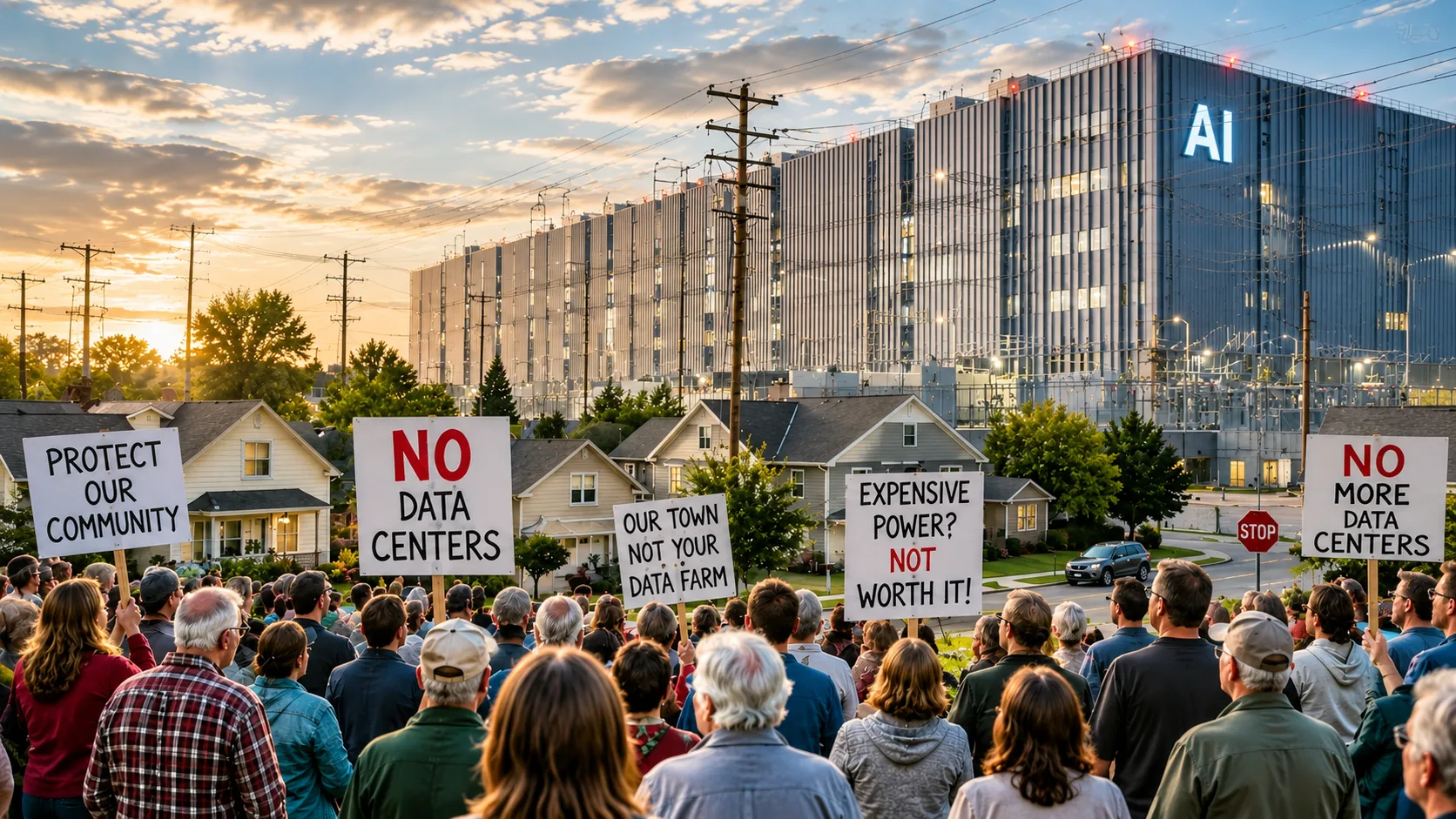
From angry town halls to blocked billion-dollar projects, the backlash against AI and the data centers powering it is accelerating far faster than most investors realize. Protesters are targeting OpenAI, local elections are being flipped over data-center approvals, and communities across the country are openly revolting against the infrastructure behind the AI boom.
For Wall Street, this creates a serious new problem. The entire AI trade depends on one assumption: that America will continue allowing massive amounts of energy, land, water, and infrastructure to be redirected toward AI expansion. That assumption is starting to crack.
America’s Mood Shift Around AI Is Getting Worse Fast
The political environment around artificial intelligence has changed dramatically over the past year.
Polls now show widespread concern over AI replacing jobs, increasing electricity costs, damaging education, and concentrating even more power inside a handful of technology companies. The shift has become so severe that even former Google CEO Eric Schmidt was booed while discussing AI during a commencement speech at the University of Arizona.
That kind of public hostility matters more than many Silicon Valley executives want to admit.
The AI industry has spent the last two years convincing investors that demand for computing power is essentially infinite. Companies including OpenAI, Anthropic, Oracle, and xAI are aggressively racing to secure data-center capacity across the United States.
But local communities increasingly see those projects as economic threats instead of opportunities.
Residents are blaming data centers for rising utility costs, strain on electrical grids, water consumption concerns, environmental degradation, and declining quality of life. In multiple states, voters are actively punishing politicians who approve AI infrastructure projects.
That is a major development investors cannot ignore.
The AI Trade Suddenly Has a Political Risk Premium
The AI rally has largely been driven by a small chain reaction:
AI models require more computing power.
More computing power requires more data centers.
More data centers require massive electricity expansion.
That loop has fueled huge gains in semiconductors, utilities, energy infrastructure, cooling systems, and nuclear-power speculation.
But now a new variable is entering the equation: political resistance.
According to Data Center Watch, local opposition blocked or delayed at least 48 projects worth roughly $156 billion last year. Another 20 projects were reportedly canceled in the first quarter alone because of backlash.
That changes the math for investors.
When hyperscale projects face delays, the ripple effects hit multiple industries simultaneously:
- Semiconductor demand forecasts become harder to sustain
- Utility expansion timelines stretch
- Grid-upgrade projects face uncertainty
- Power pricing assumptions change
- Construction timelines lengthen
- AI deployment costs rise
The market has been pricing AI growth like a straight line upward. Public resistance introduces friction.
And friction changes valuations.
Energy Markets Could Become the Next Flashpoint
One of the biggest stories beneath the surface is energy.
Data centers consume enormous amounts of electricity. Utilities across the country are already seeking approval for large rate increases to support grid expansion tied directly to AI growth.
That is starting to anger consumers.
Texas Agriculture Commissioner Sid Miller recently called for a moratorium on new hyperscale data-center development, citing pressure on the power grid and risks to farmers. Similar fights are breaking out nationwide.
This creates a complicated setup for investors.
On one side, utilities, natural gas producers, nuclear developers, and power infrastructure firms still stand to benefit from long-term AI demand growth.
On the other side, political blowback could slow permitting, delay projects, and increase regulatory scrutiny.
The market has largely focused on the upside scenario. Investors may now need to price in resistance risk.
Silicon Valley’s Messaging Problem Is Becoming Dangerous
The deeper issue here is trust.
Americans increasingly believe AI is being built for corporate efficiency rather than public benefit. That perception has intensified following several high-profile layoffs where executives openly attributed job cuts to AI adoption.
For many voters, AI no longer feels theoretical. It feels personal.
That is why the backlash is spreading beyond progressive activist circles. Opposition is now crossing party lines.
Republican Senator Josh Hawley has proposed additional requirements for data centers and AI companies. Democratic activists in Tennessee are campaigning against Elon Musk’s xAI project. Local Facebook groups opposing data centers are exploding in membership.
Even President Donald Trump recently acknowledged that data centers “need some PR help.”
That comment may end up being more important than it sounded at the time.
Because when industries start needing political rehabilitation campaigns, investors should pay attention.
What Wall Street May Be Missing
The market still views AI primarily as a technology story.
This is increasingly becoming an infrastructure and political story instead.
That distinction matters enormously.
The companies winning the AI race may not simply be the ones with the best models. They may be the ones capable of securing political support, reliable power access, favorable permitting, and community acceptance.
That creates potential separation inside the AI trade.
Some companies may navigate the backlash successfully by investing in local infrastructure, nuclear partnerships, cheaper energy production, and community incentives.
Others could find themselves trapped in permitting wars, lawsuits, environmental opposition, and mounting political hostility.
Investors betting broadly on “AI” may eventually discover that infrastructure bottlenecks matter as much as software innovation.
Key Catalysts Investors Should Watch Next
- Local and state moratorium proposals targeting new data centers
- Utility rate-hike approvals tied to AI infrastructure
- Federal permitting reforms connected to energy expansion
- Additional lawsuits involving AI-related environmental concerns
- Rising anti-AI rhetoric during midterm election campaigns
- Corporate earnings calls discussing AI-related power constraints
- Semiconductor guidance tied to hyperscale buildout delays
- Community resistance movements spreading into additional swing states
Final Take
The AI boom is colliding with political reality.
For the last two years, investors treated artificial intelligence as an almost universally positive growth story. That environment is changing. Americans are beginning to connect AI expansion with higher electricity costs, job displacement, environmental strain, and local disruption.
That creates a new layer of uncertainty the market has barely started pricing in.
AI infrastructure spending is still massive. The long-term opportunity remains enormous. But the assumption that America would quietly absorb unlimited data-center expansion is breaking down in real time.
And once a technology boom becomes politically controversial, the investment landscape changes very quickly.
About Author