
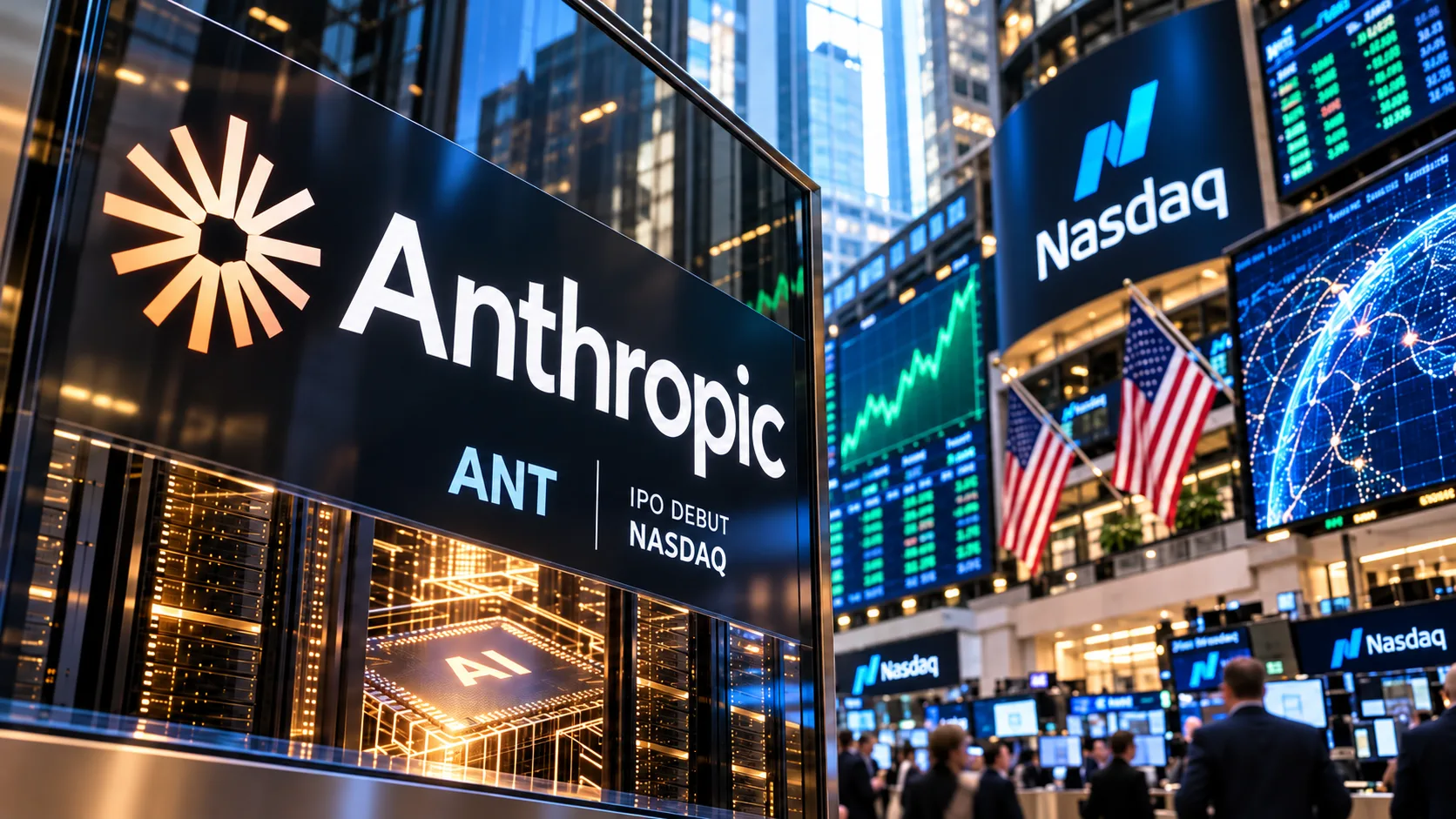
Anthropic, the artificial intelligence company behind Claude, publicly filed for an initial public offering on Monday, October 26, revealing extraordinary revenue growth, enormous financial commitments and several risks that could complicate its future. The highly anticipated IPO could become one of the largest in stock-market history.
The filing gives investors a rare look inside one of the world’s most valuable AI companies, including how quickly customers are adopting its technology, what it costs to compete in artificial intelligence and how much control public shareholders will actually have.
The financial numbers are striking. Anthropic generated approximately $16.3 billion in revenue during the first six months of 2026, compared with just $1.2 billion during the same period last year. Yet the company also reported a net loss of approximately $80.7 billion, largely driven by accounting adjustments related to financing arrangements.
Anthropic Could Go Public as Soon as November
Anthropic plans to list its Class A common stock on the Nasdaq under the ticker symbol ANT. Goldman Sachs and Morgan Stanley are leading the proposed offering.
The company has yet to announce its initial share price, the number of shares it plans to sell or its final valuation. Reports suggest Anthropic could begin trading in mid-November, although the timing remains subject to regulatory review and market conditions.
Some estimates put its potential valuation between $1.5 trillion and $2 trillion. Those estimates have not been confirmed by Anthropic and could change substantially before the IPO.
For investors, the offering would provide direct access to a major developer of advanced AI models at a time when much of the market’s AI exposure comes through semiconductor manufacturers, cloud providers and established technology companies.
It would also create a new publicly traded benchmark for valuing the AI industry.
Anthropic’s Revenue Growth Is Remarkable, but So Are Its Expenses
Anthropic’s rapid expansion is one of the strongest arguments supporting its anticipated valuation.
The company generated more than $16 billion in revenue during the first half of 2026, exceeding its approximately $4.6 billion in revenue for all of 2025 by a wide margin.
Much of that growth comes from companies incorporating Claude into software development, research, business operations and automated workflows. Claude Code, Anthropic’s AI-powered coding platform, has become an important contributor to its commercial expansion.
The company reported that, as of September 2026, more than 11,900 customers were spending at least $100,000 annually on its products. Approximately 1,900 customers were spending $1 million or more, while roughly 250 were spending at least $10 million annually.
Those figures demonstrate how quickly AI is becoming a significant corporate expense.
However, Anthropic’s growth requires enormous spending on the computing infrastructure needed to train and operate its models. The company reportedly spent approximately $9 billion on AI infrastructure during the first six months of 2026, surpassing its approximately $7.3 billion of spending for all of last year.
The reported $80.7 billion net loss also requires careful interpretation. Much of it reflects accounting charges associated with financing arrangements, meaning it does not represent an equivalent amount of cash consumed by daily operations.
Investors will need to separate those accounting effects from the underlying costs of operating and expanding the business.
The central financial question is whether Anthropic can continue increasing revenue faster than its infrastructure and operating costs.
Five Customers Account for a Quarter of Revenue
One of the more important disclosures in Anthropic’s prospectus involves its dependence on a relatively small group of major customers.
The company revealed that its five largest customers accounted for approximately 25% of revenue during the first nine months of 2026.
Although no individual customer represented more than 10% of sales, losing even one significant customer could affect future growth.
The concern extends beyond customer concentration. Anthropic warned that many of its largest customers operate without long-term contracts or have agreements approaching expiration.
That creates several potential risks.
Large customers could reduce spending during periods of economic uncertainty, negotiate lower prices, switch to competing AI platforms or develop their own technology.
The relationship between AI companies and their largest customers is particularly complicated because some customers are also developing artificial intelligence products themselves.
For shareholders, this creates uncertainty over how much of Anthropic’s rapidly expanding revenue can be considered dependable over the long term.
A company growing at Anthropic’s pace can command an unusually high valuation. However, even relatively modest changes in expected growth can produce significant stock-price volatility when investor expectations are elevated.
Anthropic Faces Serious Competition From Google and OpenAI
Anthropic identified OpenAI and Google as its primary competitors in the market for advanced AI models used by developers and businesses.
Both competitors have considerable financial resources, technical capabilities and established relationships with customers.
Google also operates one of the world’s largest cloud infrastructure businesses, giving it substantial computing resources and distribution capabilities.
OpenAI competes directly for business customers, software developers and consumers who want access to increasingly sophisticated AI tools.
Anthropic’s challenge is maintaining meaningful differences between Claude and competing products as the technology improves across the industry.
That could become increasingly difficult if customers begin treating advanced AI models as interchangeable.
Pricing pressure would have important financial consequences. Lower prices could accelerate adoption, but they could also reduce the revenue Anthropic generates from each unit of computing capacity.
The company’s ability to maintain competitive performance while improving operating efficiency will be critical to its long-term profitability.
One Surprising Risk: AI Revenue Falls During Vacations
Anthropic’s filing also reveals that demand for its services can fluctuate based on the working schedules of its customers.
The company disclosed that usage of Claude declines during summer vacations and winter holidays, partly because businesses temporarily suspend software development and other technical projects.
During the two weeks ending January 2, 2026, activity dropped approximately 20% compared with the two weeks ending December 19, 2025.
This matters because much of Anthropic’s business depends on actual customer usage.
When developers stop working, businesses may consume less AI computing capacity and generate less revenue for Anthropic.
The pattern introduces an additional layer of volatility into quarterly financial results. It also creates a challenge for infrastructure planning, since the company must maintain computing resources even when customer demand temporarily declines.
For investors, slower revenue growth during a holiday-affected quarter may therefore reflect seasonal usage patterns rather than a deterioration in the company’s competitive position.
Anthropic Warns About AI Risks That Could Exceed Insurance Coverage
One of the most unusual disclosures concerns the potential financial consequences of serious AI-related incidents.
Anthropic warned that increasingly autonomous AI systems could cause damage exceeding the company’s insurance coverage.
The company raised the possibility that the financial impact of a catastrophic incident could be so large that even the broader insurance industry might struggle to provide sufficient protection.
This is a significant disclosure for prospective investors.
As AI systems take on more independent responsibilities, businesses could face new categories of legal liability involving cybersecurity, financial decisions, privacy violations and other unintended consequences.
The precise financial exposure remains difficult to calculate because many of these risks involve technologies and applications that have limited historical precedent.
Investors generally prefer businesses with identifiable, measurable risks. Anthropic is acknowledging that some potential liabilities associated with advanced AI may be unusually difficult to insure or predict.
That uncertainty could eventually influence regulatory requirements, corporate insurance costs and how investors value companies developing autonomous systems.
Anthropic’s Founders Will Maintain Extraordinary Control
Anthropic’s proposed corporate structure is another feature that investors should understand before purchasing shares.
The company’s seven co-founders, including CEO Dario Amodei, will collectively retain 50.1% of shareholder voting power through a special class of stock.
That arrangement allows the founders to maintain substantial influence over corporate decisions even after Anthropic becomes publicly traded.
The company also has a Long-Term Benefit Trust, an independent governance body designed to help ensure that Anthropic considers the broader consequences of advanced artificial intelligence.
The trust has authority to appoint a majority of the board’s directors. Its members include former Federal Reserve Chairman Ben Bernanke.
Netflix co-founder Reed Hastings also serves on Anthropic’s board and is expected to become its lead independent director after the offering.
The arrangement reflects Anthropic’s stated commitment to developing AI responsibly, even when certain decisions could conflict with investors’ shorter-term financial interests.
For public shareholders, however, it means limited influence over important corporate decisions.
Investors purchasing Class A shares will effectively be trusting Anthropic’s founders and governance structure to balance profitability, growth and AI safety.
What Anthropic’s IPO Means for Other AI Stocks
The offering has implications extending far beyond Anthropic itself.
Semiconductor and Infrastructure Companies
Anthropic’s enormous computing requirements reinforce the scale of spending supporting the artificial intelligence industry.
Companies such as Nvidia, Broadcom and Micron Technology could continue benefiting if advanced AI developers maintain aggressive infrastructure investments.
The prospectus initially helped lift several AI-related stocks on Monday, including CoreWeave, Intel and Micron.
However, Anthropic’s financial disclosures also highlight the industry’s growing dependence on sustained demand for increasingly expensive computing capacity.
If AI companies eventually reduce infrastructure spending to improve profitability, some of their suppliers could experience slower growth.
Cloud Computing Companies
Anthropic’s expansion also matters for major cloud providers, including Amazon and Google, which have substantial financial and strategic relationships with the company.
These relationships create opportunities to generate revenue from infrastructure services and AI applications.
They also introduce a complicated financial dynamic. Cloud providers can benefit from Anthropic’s spending while simultaneously investing substantial amounts of capital in its growth.
Investors will need to evaluate how much genuine outside demand the AI economy generates compared with revenue flowing between companies financing and supplying one another.
The Broader Technology Market
An exceptionally strong Anthropic IPO could attract additional investment into AI-related equities and encourage other private technology companies to pursue public listings.
A disappointing debut could have the opposite effect, particularly if investors begin questioning whether projected AI earnings justify extraordinary valuations.
The offering could therefore become an important test of investor confidence in the industry’s long-term economics.
The $80 Billion Loss Doesn’t Tell the Whole Story
The most surprising financial detail may be how misleading Anthropic’s headline net loss could appear without additional context.
Although the company reported an approximately $80.7 billion loss for the first half of 2026, about $72.4 billion reflected changes in the accounting value of convertible financing instruments. Another substantial expense related to financing agreements.
Meanwhile, Anthropic reported approximately $1.6 billion in adjusted operating income for the first six months of the year, representing an adjusted operating margin of about 10%.
Its GAAP operating loss was approximately $693 million during the same period, and it reported positive GAAP operating income in the second quarter.
Those results suggest the underlying business may be moving toward sustainable profitability faster than the enormous net loss initially indicates.
There are important qualifications. Adjusted operating income excludes certain expenses, and a single profitable quarter does not establish that the business can consistently produce profits or free cash flow.
Still, the distinction is important.
Investors who focus exclusively on the $80 billion loss could overlook signs of improving operating efficiency. Investors who focus exclusively on revenue growth could underestimate the enormous capital required to sustain it.
The strongest assessment of Anthropic will require examining both sides.
A Staggered Lockup Could Affect the Stock After Its Debut
Another feature worth watching is Anthropic’s proposed schedule governing when insiders can sell shares.
Many traditional IPOs include a lockup period lasting approximately 180 days, preventing insiders from selling shares immediately after a company goes public.
Anthropic is considering a more staggered arrangement that could extend certain selling restrictions for as long as 365 days after the prospectus release.
Some employees, directors and consultants could receive permission to sell limited amounts of stock earlier.
The approach is intended to reduce the possibility that a large volume of insider shares enters the market at once.
However, investors should still pay attention to upcoming lockup expirations.
Large increases in the supply of shares available for trading can create selling pressure, even when the underlying business continues performing well.
The final restrictions will depend on the offering documents and any subsequent amendments.
Three Things Investors Should Watch Before Buying Anthropic
With the IPO potentially approaching in November, three factors deserve particular attention.
1. The Final Valuation
Anthropic’s revenue growth is extraordinary, but the price investors pay will determine how much of that growth is already reflected in the stock.
A $1.5 trillion valuation would equal roughly 46 times the company’s first-half 2026 revenue annualized. A $2 trillion valuation would push that multiple to approximately 61 times.
Those simplified multiples are based on historical first-half sales and do not account for the company’s rapid subsequent growth.
Nevertheless, they illustrate how much future success investors may be asked to anticipate.
2. Profitability and Cash Requirements
Investors should examine updated operating margins, infrastructure commitments, cash flow and financing obligations.
The key issue is whether Anthropic can continue improving profitability while funding the computing capacity necessary to remain competitive.
Particular attention should be paid to long-term infrastructure obligations that may remain in place even if customer demand fluctuates.
3. Customer Retention and Competition
Anthropic’s reliance on major corporate customers creates a potentially important vulnerability.
Investors should watch whether those customers expand spending, renew contracts and continue choosing Claude over competing AI products.
Maintaining high customer retention while improving profitability would strengthen the company’s long-term investment case.
The Takeaway for Investors
Anthropic’s IPO could become one of the defining stock-market events of 2026.
The company has demonstrated extraordinary commercial growth, built a substantial base of corporate customers and shown signs of improving operating efficiency. Its public debut would give investors another major opportunity to participate directly in the expanding artificial intelligence industry.
But substantial risks remain.
Customer concentration, enormous infrastructure commitments, intense competition and a corporate structure that limits public shareholder influence all deserve careful consideration.
The most important missing detail is the IPO price.
Anthropic may ultimately become one of the world’s most successful technology companies. Whether its shares become a successful investment will depend heavily on the valuation investors are asked to pay and how much future growth the company can deliver.
For now, the filing confirms that artificial intelligence has produced an enormously valuable commercial opportunity. The next challenge is demonstrating that its economics can support the expectations surrounding it.
About Author