

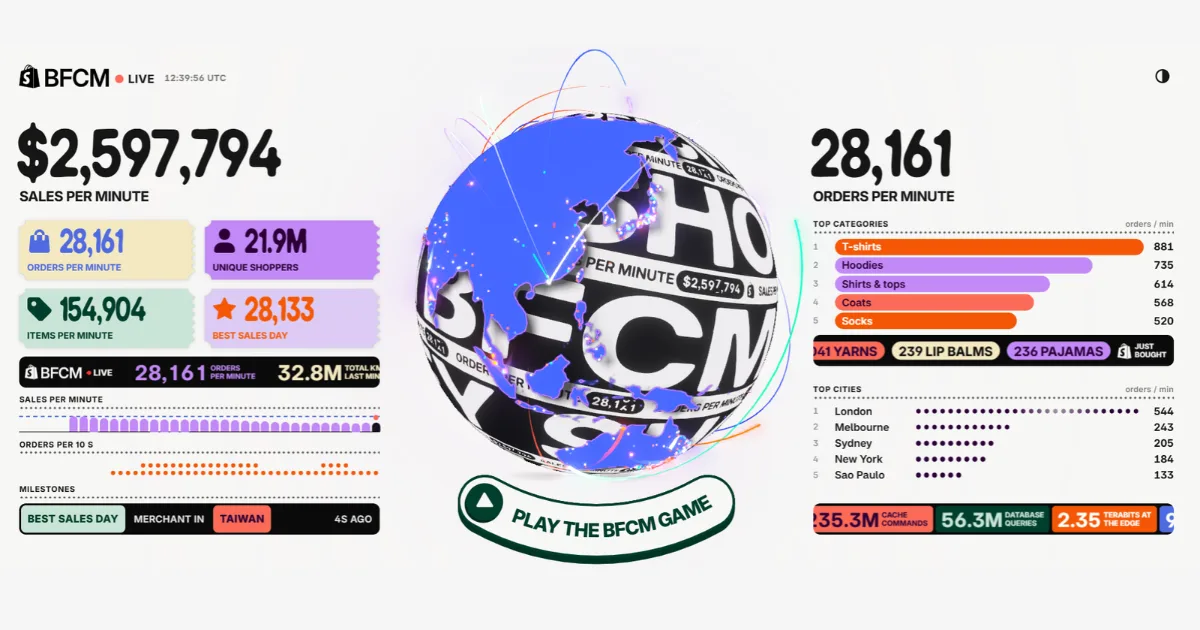
At 5:20 a.m. Eastern, shoppers were spending more than $2 million a minute at Shopify-powered stores worldwide. London topped the live order rankings, followed by Melbourne and Sydney. Last year, Shopify’s busiest minute came just after noon Eastern, when merchants rang up $5.1 million. How high will the counter go once U.S. shoppers get going?
Black Friday Was Already in Full Swing Overseas
A snapshot of Shopify’s live dashboard captured by e-commerce consultancy ExactWhy showed $2.03 million in sales, nearly 28,000 orders and more than 63,000 items sold per minute at 5:20 a.m. Eastern. It was already late morning in London and evening on Australia’s east coast. The early leaderboard offered a glimpse of how much shopping was already underway before the U.S. workday would normally begin.
The live globe tracks spending at Shopify merchants worldwide. Its sales rate and city rankings change throughout the day, so the early reading gives a sense of scale. Last year’s peak of $5.1 million at 12:01 p.m. Eastern is a benchmark for today’s busiest minute. For the full weekend comparison, Shopify’s merchants recorded $14.6 billion from Black Friday through Cyber Monday in 2025, up 27% from the previous year.
The city rankings show where orders are coming from as the day unfolds. The category rankings offer a different clue. In the early snapshot, T-shirts, hoodies and coats were among the leaders by orders per minute. A separate look at U.S. spending shows how far that appetite for everyday purchases goes.
Americans Are Using Black Friday to Stock the Cupboard
From Nov. 1 through Nov. 22, U.S. online sales of personal hygiene products ran 40% above October’s average, according to Adobe data reported by the Associated Press. Household cleaning products were up 33% on the same basis, and clothing basics rose 27%. The early shopping surge included plenty of things people were going to buy anyway.
That changes how to read a busy checkout. A family that buys three months’ worth of detergent on sale gets a lower price and can skip the next few trips down the cleaning aisle. The retailer rings up those sales in November, with some of the spending effectively borrowed from December or January. A strong promotional week can reflect both genuine demand and a shift in when households choose to spend.
There was already substantial spending before Thanksgiving. Adobe tracked $82.5 billion in U.S. online purchases through Nov. 22, up 9.1% from the same period last year. Salesforce also told AP that November discounts ahead of Black Friday were 8% bigger than a year earlier and that average selling prices for physical goods were 1% lower in its data. Those figures come from different sets of retailers, but together they help explain why rising sales can coexist with shoppers who are still careful about price.
Black Friday Could Hit $12.9 Billion. How Much Will Retailers Keep?
Adobe forecasts $12.9 billion in U.S. online spending on Black Friday, up 9.2% from last year. It projects $15.1 billion for Cyber Monday, up 6.2%, and $47.5 billion for the five days from Thanksgiving through Monday. Adobe expects some of the season’s biggest discounts on TVs, apparel and appliances to land on Friday, helping explain why Black Friday spending is projected to grow faster than Cyber Monday’s.
For investors, a retailer can post a record sales day and still earn less on the items it sells. Take a $100 product that costs a retailer $70. A 20% discount leaves $10 in gross profit per unit, down from $30 at full price, before expenses like shipping and marketing. At that price, the retailer has to sell three units to earn the same gross profit it would have made on one full-price sale.
A markdown can still be a good decision. If it clears inventory the retailer would otherwise have to discount more heavily in January, an early sale can free up cash and reduce the risk of being stuck with unsold goods. When holiday earnings arrive, watch gross margin alongside inventory. Falling inventory with steady margins would suggest promotions helped clear merchandise efficiently. Falling margins with inventory still elevated would leave more work for the retailer after the holidays.
Shopify and Its Merchants Have Different Stakes
More transactions can benefit Shopify through its payments business even when a merchant accepts a slimmer profit on each order. Last year, 32% of orders in Shopify’s Black Friday through Cyber Monday figures used Shop Pay. Shopify also reported $119.1 billion in merchandise volume across its platform in the third quarter and $3.74 billion in revenue. The live globe measures the dollars flowing through its merchants. The earnings report shows how much of that activity Shopify turns into revenue and profit.
The Numbers to Watch After the Checkout Rush
- Today’s peak and Shopify’s full weekend total. The peak shows how busy the platform got. The full Black Friday through Cyber Monday total offers a better comparison with last year’s $14.6 billion.
- Adobe’s five-day U.S. spending figure. See how it lands against the $47.5 billion forecast. A big Friday followed by a softer Monday could mean shoppers acted earlier, especially in categories where the best deals arrived Friday.
- Retailers’ holiday earnings. Compare sales growth with gross margin and ending inventory to see which retailers turned the rush into profitable sales and which still have merchandise to clear.
At 5:20 a.m., the most striking number was how much shoppers were spending every minute. After Cyber Monday, the more revealing numbers will be what they bought, how heavily it was discounted and how much of the sale each retailer got to keep.
About Author