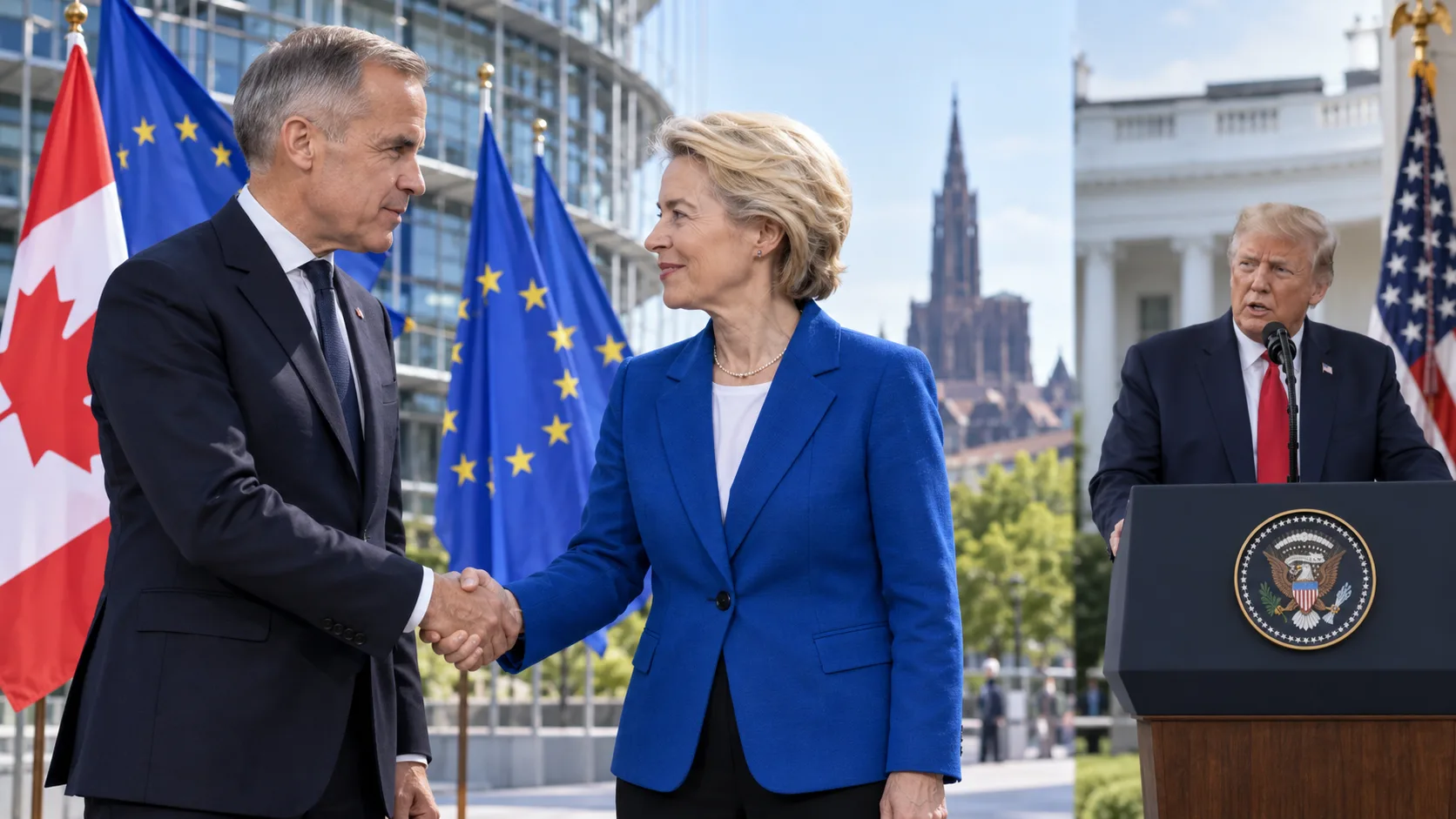
Canada is considering a first-of-its-kind partnership with the European Union that could pull the country deeper into Europe’s trade, defense and technology networks. President Donald Trump is already warning that the United States could respond with new tariffs.
The proposal sounds more advanced than it is. Canada has not been invited to join the EU as a full member, and no detailed agreement has been written. Still, the idea could mark a meaningful shift in how Canada reduces its dependence on the United States.
Canada Would Become the EU’s First Associate Member
European Commission President Ursula von der Leyen introduced the idea during her State of the European Union address on September 16. Canadian Prime Minister Mark Carney welcomed the proposal the following day during an address to European lawmakers in Strasbourg.
The two sides are discussing closer cooperation in critical minerals, defense manufacturing, artificial intelligence, computing, energy security, space, financial services and digital trade. A more formal plan could begin taking shape at an EU-Canada summit scheduled for late October in Montreal.
Canada would be the first country to receive the proposed “associate member” designation. The problem is that the designation does not currently exist in EU treaties. Its rights, obligations and approval process still have to be defined, and EU member states would have to support it.
Canada Is Not Joining the European Union
Associate membership would not automatically give Canada a vote in EU institutions, access to every part of the European single market or any role in setting European laws. Canada would remain a sovereign North American country with its own currency, government and trade agreements.
The most likely outcome is an umbrella partnership that expands programs Canada already participates in. The country has traded with Europe under the Comprehensive Economic and Trade Agreement since 2017. It also participates in the Horizon Europe research program and became the first non-European country admitted to the EU’s SAFE defense procurement initiative.
Those existing relationships give the proposal substance. EU-Canada trade in goods and services reached €130 billion in 2025, an 80% increase from 2016. Most tariffs between the two markets have already been eliminated under CETA.
Trump Turned the Proposal Into a Trade Threat
Trump called the idea “laughable” and said he could impose heavy tariffs on Europe if he viewed the partnership as hostile to the United States. He also raised the possibility of stopping trade with Europe in some sectors.
That response creates the most immediate financial risk. The proposed partnership could take years to define and approve. Tariff threats can affect business decisions, currencies and markets much sooner.
Canada and the United States exchanged an estimated $872.3 billion in goods and services during 2025. Canada sends more than three-quarters of its goods exports to the United States, and North American supply chains are deeply integrated across autos, energy, agriculture, aerospace, machinery, steel and aluminum.
Closer ties with Europe could give Canada more options over time. They cannot quickly replace the United States as Canada’s main customer and supplier.
Where Investors Could Feel the Effects
Autos and Manufacturing
New U.S. tariffs could raise costs for companies that move components across the Canadian border during production. Automakers, parts suppliers, railroads and industrial manufacturers would be especially exposed if Washington applied tariffs broadly.
Critical Minerals and Energy
Europe wants reliable sources of uranium, nickel, copper, potash and other strategically important materials. Canadian producers could gain access to new investment, supply agreements and infrastructure spending if the partnership produces concrete procurement commitments.
Canadian energy could also become more important to Europe as the bloc tries to reduce dependence on less reliable suppliers. Transportation capacity, pricing and environmental rules would still limit how quickly that opportunity could grow.
Defense and Aerospace
Canada’s participation in the EU’s SAFE program already allows Canadian companies to compete in European joint-defense procurement. A broader partnership could create additional opportunities for aerospace, satellite, cybersecurity and military-equipment companies.
Investors should wait for actual contracts and spending commitments. Political agreements often create appealing themes long before they generate revenue.
Currencies and Trade-Sensitive Stocks
The Canadian dollar could become more sensitive to trade headlines if tensions with Washington intensify. Companies with substantial cross-border sales may also face higher volatility as investors try to determine where tariffs will land and whether exemptions will apply.
The Hardest Part Comes Next
Europe and Canada already agree on the value of closer cooperation. Turning that agreement into a workable legal structure will be much harder.
EU governments must decide what associate membership actually means. They will also have to resolve disagreements over market access, government procurement, domestic sourcing rules and regulatory control.
Canada’s existing CETA agreement still has not completed full ratification across every EU member state, nearly nine years after taking provisional effect. That history is a useful warning. The announcement is politically significant, although implementation will depend on slow negotiations and national approvals.
About Author