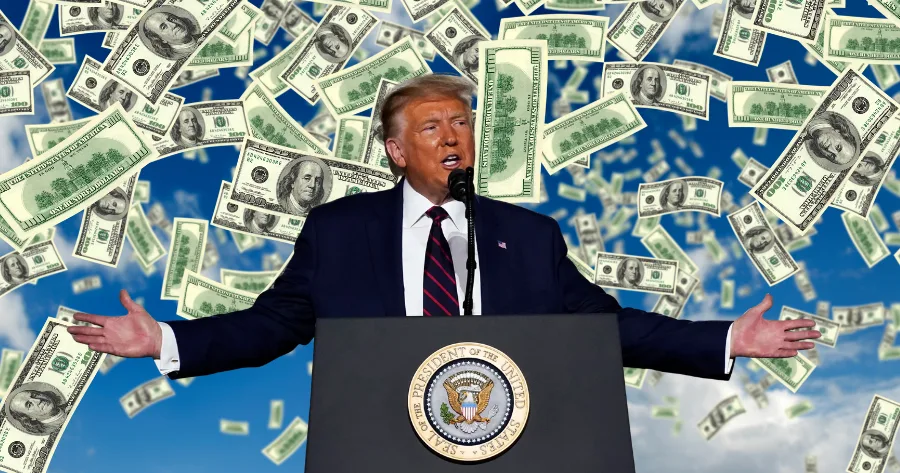
President Donald Trump is once again promising Americans $5,000 checks if Republicans retain control of Congress, repeating a pledge he first made last month as the midterm elections enter their final stretch.
At the same time, the administration is already sending out much smaller federal payments, including $90 payments to millions of eligible Medicare beneficiaries and $500 refunds to certain Affordable Care Act customers. That has created an unusual mix of real payments, campaign promises and growing questions about what Americans could actually receive.
The distinction matters. While the $90 and $500 programs are already funded and underway, the proposed $5,000 checks would require congressional approval, a funding plan and roughly $1.2 trillion.
Here is what Americans are actually getting, what Trump is promising again and why investors should pay attention.
The Checks That Are Already Going Out
Two smaller federal payment programs are real and already moving forward.
The Trump administration announced a one-time $90 payment for more than 20 million eligible Medicare Part B beneficiaries. According to the Centers for Medicare & Medicaid Services, most eligible recipients are expected to receive the money through direct deposit on or around October 8, with paper checks following later in October.
The money is being drawn from the Medicare Improvement Fund. Eligibility is narrower than simply being enrolled in Medicare, with some beneficiaries excluded depending on how their premiums are paid and whether they are subject to higher-income premium adjustments.
The administration is also sending $500 payments to nearly 1 million people who purchased unsubsidized health insurance through the federal Affordable Care Act marketplace. The White House describes those payments as refunds tied to excess exchange fees paid by people who bought full-price coverage.
Those two programs have defined recipients and existing funding mechanisms. The proposed $5,000 checks do not.
Trump Is Repeating the $5,000 Promise
Trump renewed the idea over the weekend, tying the payment directly to the outcome of November’s congressional elections.
“If Republicans win the House of Representatives and the Senate in the 2026 Midterm Elections, I’m going to give all Adult Citizens in the United States of America, $5,000,” Trump said in a Truth Social video.
This is not the first time he has made the pledge. Trump previously floated the same $5,000 payment at the Republican National Committee’s midterm convention in September, making the latest statement a reiteration rather than a one-time campaign remark.
That matters because repeating the promise increases the likelihood that voters will see it as a serious policy commitment rather than political improvisation.
Still, major questions remain unanswered. Trump has not provided a detailed funding mechanism, legislative proposal or timeline for how the money would reach Americans.
At an estimated cost of roughly $1.2 trillion, a nationwide $5,000 payment would rank among the largest direct-payment programs in U.S. history and would require Congress to authorize the spending.
For households hearing about a possible $5,000 check, the key point is simple: there is currently no approved federal $5,000 payment program.
Congress has not appropriated the money, eligibility rules have not been established and no payment schedule exists.
The $1.2 Trillion Question
The biggest issue is where the money would come from.
Washington has several options when it wants to spend on this scale. Congress could raise taxes, cut spending elsewhere, redirect existing funds or borrow more money. Without a clearly identified funding source, a large national payment program would likely add to federal borrowing.
That could have effects well beyond the households receiving checks.
Interest Rates
More federal borrowing generally means more Treasury securities being issued. If investors demand higher yields to absorb that debt, borrowing costs across the economy could rise.
Treasury yields influence mortgage rates, corporate borrowing costs and many other forms of credit. That is why a large new federal spending program can quickly become a market issue rather than simply a political one.
Inflation
Sending $5,000 to every adult citizen would also inject an extraordinary amount of purchasing power into the economy.
The inflation impact would depend on consumer behavior, economic growth, Federal Reserve policy and how the payments were financed. Still, the basic concern is straightforward: if demand rises much faster than the supply of goods and services, prices can rise with it.
That creates an obvious tension around a proposal being promoted during an election dominated by affordability concerns. Americans frustrated with high prices could receive additional cash, while the scale of the program itself could add new inflationary pressure.
The Federal Reserve
The Fed could face another challenge if a large payment program boosted consumer spending enough to keep inflation elevated.
That could make policymakers more cautious about cutting interest rates, potentially leaving mortgages, auto loans and other borrowing costs higher for longer. In that scenario, households could receive more cash upfront while facing higher financing costs elsewhere.
The final economic effect would depend heavily on how the program is structured and funded.
Voters Are More Skeptical Than the Headline Suggests
A promise to send Americans $5,000 sounds like the kind of idea that should be overwhelmingly popular. Polling suggests otherwise.
A September Marquette Law School poll in Wisconsin found 70% of registered voters opposed the proposed checks, compared with 29% who supported them. The poll also found that 59% believed the payments would hurt the economy, while 19% thought they would help.
A separate Rasmussen survey found likely voters much more evenly divided, while other polling has shown considerable skepticism over whether Trump would actually deliver the payments even if Republicans retained control of Congress.
The broader takeaway is that voters appear to be evaluating the proposal alongside inflation, government spending and the credibility of the promise itself. That makes the political impact more complicated than simply offering people cash.
Americans Have Heard Similar Proposals Before
Some of that skepticism comes from history.
During Trump’s second term, several large cash-payment ideas have received significant attention without ultimately producing checks.
In early 2025, Trump and Elon Musk promoted the possibility of a $5,000 “DOGE dividend” funded by savings from government spending cuts. Those checks were never created.
Trump later proposed sending Americans at least $2,000 using tariff revenue. That idea also failed to result in payments.
There are examples where direct payments did happen. About 1.45 million military members received $1,776 supplemental housing payments in December 2025, according to the IRS, after Congress had appropriated money for the underlying benefit.
Congress also authorized multiple rounds of pandemic stimulus payments during Trump’s first term.
The pattern shows the importance of congressional approval. Presidential support can elevate a proposal, but large national payment programs generally require lawmakers to create the legal authority and provide the funding.
The Real Market Story Is Bigger Than the Checks
For investors, the most important development would come if the $5,000 proposal begins moving from repeated campaign rhetoric toward actual legislation.
That is when markets would have to begin pricing the consequences.
A credible push toward roughly $1.2 trillion in additional spending could affect several parts of the market at once.
Treasury bonds: Additional borrowing or rising inflation expectations could pressure bond prices and push yields higher.
Gold: Greater concern about federal deficits, debt and inflation could strengthen demand for hard assets.
Consumer stocks: Retailers, restaurants, travel companies and other discretionary businesses could benefit from a short-term increase in household spending.
Banks and lenders: Higher rates can improve some lending margins while also slowing loan demand and increasing pressure on borrowers.
Rate-sensitive stocks: Utilities, REITs and other income-oriented investments could face pressure if Treasury yields rise.
The biggest market reaction may ultimately have less to do with the checks themselves than with what Washington has to do to finance them.
Watch Congress, Not Just the Campaign Trail
There is a simple way to evaluate the proposal from here.
The first thing to watch is whether actual legislation appears. The second is whether the White House provides a clearly defined funding source. The third is whether Republican congressional leaders publicly commit to passing the plan.
Until those things happen, there is little for markets to price beyond political speculation.
That could change quickly if Republicans maintain control of Congress and the administration begins pushing a real bill. At that point, investors would need to focus on the structure of the program, its effect on federal borrowing and how much additional demand economists believe it could create.
The Checks May Not All Turn Into Spending
One important point could reduce the inflation risk somewhat.
A $5,000 payment would not automatically create $5,000 in new consumer spending from every recipient. Some households would save the money, others would pay down credit-card balances or other debt, and higher-income recipients might invest much of it.
Money used to reduce debt or increase savings creates less immediate demand for goods and services than money spent at stores, restaurants or car dealerships.
That means the economic impact would depend partly on who receives the checks and what those households do with them.
A targeted program could behave very differently from a universal payment covering virtually every adult citizen, which is another reason the missing details matter.
The Numbers That Matter Now
For Americans trying to separate confirmed payments from campaign promises, the picture is relatively straightforward.
The $90 Medicare payment is real, with eligible recipients expected to receive it during October. The $500 Affordable Care Act refund is also real, with eligible full-price marketplace customers receiving payments.
The $5,000 payment remains a proposal, even though Trump has now repeated the pledge more than once and is tying it directly to Republican control of Congress.
That distinction could become increasingly important as Election Day gets closer.
The Bottom Line
Trump is making direct cash payments a major part of the closing weeks of the 2026 midterm campaign, and his $5,000 proposal is clearly no longer a one-off remark. He has now repeated the pledge, reinforcing the idea that it could become a policy priority if Republicans retain control of Congress.
Some federal payments are already real. Millions of Medicare beneficiaries are receiving $90 payments, while nearly 1 million eligible Affordable Care Act customers are getting $500 refunds.
The $5,000 checks remain far less certain.
Delivering them nationwide could cost roughly $1.2 trillion and would require Congress to approve the spending. Until legislation appears, Americans should treat the proposal as a campaign pledge rather than money they can count on receiving.
For investors, the most important number may ultimately be the $1.2 trillion price tag and what Washington would need to do to finance it.
About Author