A Texas woman is suing Tesla for $1 million after a crash she claims was caused by the vehicle’s driver-assistance system. The case adds to a growing list of legal and regulatory challenges surrounding Tesla’s Autopilot technology, just as the company pushes aggressively into fully autonomous vehicles.
What Happened in the Cybertruck Crash
According to the lawsuit, Justine Saint Amour was driving her Tesla Cybertruck on August 18, 2025, along Houston’s 69 Eastex Freeway when the incident occurred.
Her attorney described the moment in stark terms:
“On August 18, 2025, our client Justine Saint Amour was driving her Tesla Cybertruck on Houston’s 69 Eastex Freeway with autopilot engaged,” Attorney Bob Hilliard said in a statement.
“Something terrifying happened, without warning, the vehicle attempted to drive straight off an overpass.”
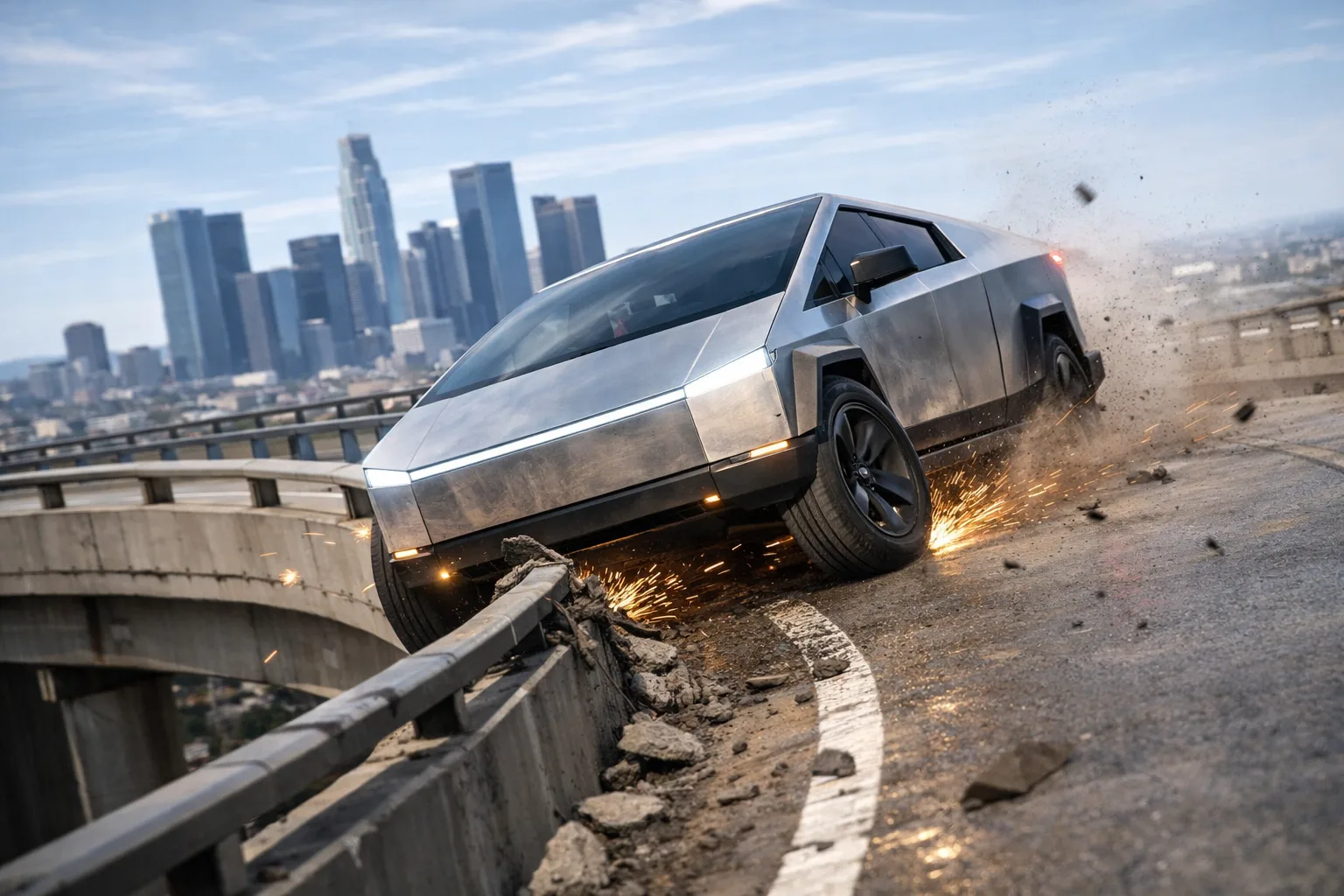
Dashcam footage reportedly shows the Cybertruck failing to follow a right-hand curve on a Y-shaped overpass. Instead, the vehicle continued forward, ultimately slamming into a concrete barrier.
The impact was severe. The vehicle ricocheted off the barrier, with debris visibly breaking off from the truck.
Driver Tried to Take Control Too Late
The lawsuit claims Saint Amour attempted to regain control moments before the crash.
“She tried to take control, but crashed into the barrier and was seriously injured (mostly her shoulder, neck, and back),” Hilliard said.
According to reports, she suffered multiple injuries, including:
- Two herniated discs in her lower back
- One herniated disc in her neck
- Nerve damage in her right hand
- A wrist sprain and ongoing mobility issues
Her 1-year-old child was also in the vehicle at the time but was not injured.
The Core Allegations Against Tesla
The lawsuit centers on claims that Tesla misrepresented the capabilities of its driver-assistance systems and failed to implement adequate safety measures.
Among the key allegations:
- The Autopilot system did not respond correctly to road conditions
- The vehicle lacked sufficient safeguards to prevent catastrophic errors
- Tesla relied too heavily on camera-based systems instead of alternative sensors
Hilliard was blunt in his criticism:
“Tesla’s self driving relies on cheap video cameras alone, with no LiDar.”
“The vehicle also lacks a proper driver alert system to ensure drivers are ready to take over driving.”
He went even further, arguing:
“Tesla could have avoided all of this by not cutting corners.”
“Tesla’s decisions made Justine’s accident inevitable.”
“This company wants drivers to believe and trust their life on a lie: that the vehicle can self-drive and that it can do so safely. It can’t, and it doesn’t.”
Tesla has not publicly responded to the specific claims in this lawsuit.
A Pattern of Scrutiny Around Autopilot
This case does not exist in isolation. Tesla’s driver-assistance technology has been under increasing scrutiny from regulators, courts, and safety agencies.
One major flashpoint came from California regulators, who accused Tesla of misleading consumers with branding such as “Autopilot” and “Full Self-Driving.”
The state argued that these terms suggested a level of autonomy that the vehicles did not actually deliver.
Tesla ultimately adjusted some of its terminology, including renaming “Navigate on Autopilot” to “Navigate on Autosteer,” signaling a shift toward more cautious messaging.
At the federal level, the National Highway Traffic Safety Administration has also investigated multiple crashes involving Autopilot, particularly incidents where vehicles failed to recognize obstacles or emergency vehicles.
Why This Matters Right Now
Timing is everything here.
Tesla is not pulling back from autonomy. It is doubling down.
The company is actively rolling out its Robotaxi vision, including the Cybercab, a fully autonomous vehicle concept that removes the steering wheel and pedals entirely.
That means Tesla’s valuation is increasingly tied to one core belief: that it will successfully solve self-driving at scale.
Cases like this one directly challenge that narrative.
The Bigger Technology Debate: Cameras vs LiDAR
One of the most important issues highlighted in this lawsuit is Tesla’s long-standing decision to rely primarily on camera-based vision systems rather than LiDAR.
LiDAR uses laser-based sensing to map environments in 3D and is widely used by competitors like Waymo and Cruise.
Tesla CEO Elon Musk has repeatedly dismissed LiDAR as unnecessary and expensive, instead betting on AI-powered vision systems.
This lawsuit revives that debate in a very real way.
If courts begin to view Tesla’s hardware decisions as a safety liability, it could open the door to broader legal challenges.
Investor Takeaways
For investors, this situation is not just about one lawsuit. It is about risk, narrative, and long-term valuation.
Here is what to watch closely:
1. Legal Risk Is Rising
If similar lawsuits begin to pile up, Tesla could face significant financial exposure. Even more importantly, repeated cases can shape public perception and regulatory action.
2. Regulatory Pressure Could Increase
State and federal agencies are already watching closely. High-profile incidents can accelerate new rules around autonomous driving claims and safety requirements.
3. Brand Trust Is on the Line
Tesla’s brand has long benefited from being seen as a technological leader. Incidents like this can erode trust, especially among mainstream consumers who are less tolerant of risk.
4. The Robotaxi Thesis Faces Real-World Tests
Tesla’s future growth narrative is heavily tied to autonomy. If confidence in Autopilot weakens, it raises questions about the timeline and feasibility of full self-driving.
5. Competitors May Gain Ground
Companies using LiDAR and more conservative rollout strategies could benefit if regulators or consumers shift toward perceived safer systems.
The Bottom Line
This lawsuit is not just another headline. It is a signal.
Tesla is pushing the boundaries of what is possible with autonomous driving, but the margin for error is shrinking as the technology moves from early adopters to everyday consumers.
For investors, the key question is no longer whether Tesla can innovate. It is whether it can do so safely, consistently, and at scale without triggering a wave of legal and regulatory consequences.
Because if it cannot, the company’s most important growth story could face serious headwinds.
About Author