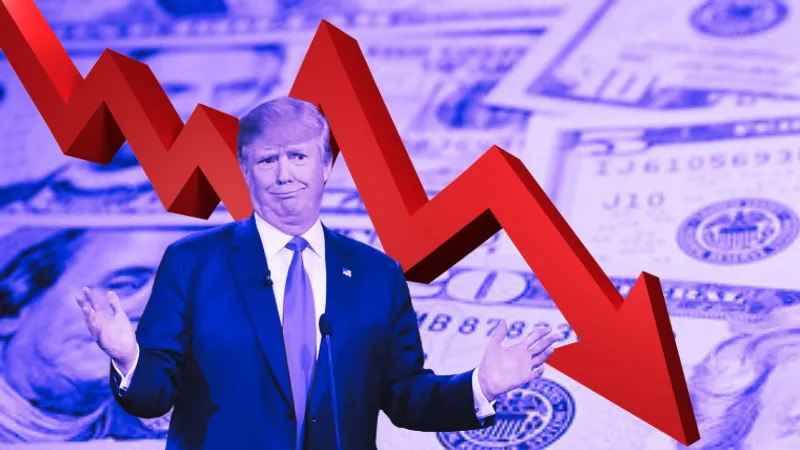
The U.S. dollar has fallen to its weakest level in years, reigniting debate over America’s long-term financial dominance and reshaping everything from international travel costs to corporate earnings and global capital flows. While the dollar remains the world’s reserve currency and is still historically strong, the speed and persistence of the recent decline have investors, policymakers, and businesses recalculating risk.
For everyday Americans, the impact shows up quickly in airfare prices, hotel costs, imported goods, and inflation. For investors, currency moves ripple through stocks, bonds, commodities, and global allocation strategies.
The shift also arrives at a politically sensitive moment as President Trump signals comfort with a softer dollar while markets weigh future Federal Reserve policy and rising economic competition overseas.
Below is what is driving the dollar’s decline, how it affects consumers and companies, and what investors should be watching next.
How a Weaker Dollar Is Already Hitting Travelers and Consumers
Currency swings are not abstract concepts for people booking international trips.
Oregon travel adviser Carol Tricoche locked in hotel rates for a group traveling to London late last year before the dollar began sliding. That move protected her clients from higher costs as the exchange rate moved against U.S. travelers.
“If the dollar changes, your hotel cost goes up. With me, you’re locked in,” Tricoche said, adding that the currency’s recent weakness has added to pressure on less-affluent Americans hoping to go abroad. “Those aren’t the folks I’m seeing right now.”
When the dollar weakens, Americans effectively lose purchasing power overseas. Hotels, meals, transportation, and entertainment all become more expensive when converted back into dollars. That same dynamic applies to imported goods at home, including electronics, apparel, furniture, and vehicles that rely on foreign components.
This creates an inflationary tailwind that can complicate the Federal Reserve’s battle to keep price growth under control, especially if energy prices or shipping costs also rise.
Why the Dollar Is Falling After Years of Dominance
For more than a decade, the dollar benefited from what investors called American exceptionalism. The U.S. economy outperformed most developed markets, corporate profits surged, political stability attracted foreign capital, and U.S. interest rates often exceeded those available overseas.
Foreign investors poured money into U.S. stocks, bonds, real estate, and private assets. That demand pushed the dollar higher and lowered borrowing costs for American households and businesses.
That narrative is now shifting.
Several forces are pressuring the currency:
1. Trade Tensions and Policy Signals
President Trump recently escalated trade rhetoric toward Europe, reviving fears of broader tariff battles. Trade conflicts tend to create uncertainty around economic growth, supply chains, and corporate profitability, which can weigh on currencies.
Trump also publicly downplayed concerns about the dollar’s weakness, reinforcing market expectations that the administration is comfortable allowing the currency to drift lower to support exports and domestic manufacturing.
2. Treasury Actions and Yen Speculation
Recent Treasury Department activity sparked speculation that U.S. officials could tolerate or even welcome a stronger Japanese yen relative to the dollar. Currency markets are highly sensitive to perceived government intervention or coordination, even when officials deny direct involvement.
On Wednesday, Treasury Secretary Scott Bessent addressed the speculation directly.
“We don’t comment other than to say we have a strong dollar policy,” Bessent told CNBC about possible future interventions. “2025 was about setting the table. And now, I think we’re going to have a very strong economy this year.”
Despite those remarks, markets continue to price in currency volatility and downside risk.
3. Stronger Growth Outside the U.S.
Economic momentum is improving in parts of Europe and Asia as fiscal stimulus and industrial policy spending pick up. Equity markets overseas have recently outperformed U.S. benchmarks, drawing incremental capital away from American assets.
“We are seeing growth outside of the U.S., which is very important for currencies,” said Antonina Tarassiouk, Reams Asset Management’s director of international economic analysis.
Capital flows follow growth opportunities. If investors see better relative returns abroad, currency demand shifts accordingly.
4. Expectations for Federal Reserve Rate Cuts
Although the Federal Reserve held rates steady this week, Wall Street increasingly expects rate cuts in 2026. Lower interest rates reduce the yield advantage of U.S. Treasury bonds relative to foreign government debt, making the dollar less attractive to global investors.
Trump has continued pushing publicly for easier monetary policy, raising concerns about central bank independence and adding another layer of uncertainty for markets.
If yield spreads narrow further, global funds may continue diversifying away from dollar-denominated assets.
“That hedging has become slightly cheaper,” Tarassiouk added.
How Far Could the Dollar Fall?
Some investors believe the adjustment is far from finished.
“The world is not ready,” said Stephen Jen, chief executive of London-based asset manager Eurizon SLJ Capital, who is expecting a further 20% decline in the dollar. “The level of the dollar was and still is way out of balance.”
The dollar posted its worst annual performance last year since 2017 as trade disruptions, slowing growth signals, and debt concerns triggered what some traders labeled a “Sell America” rotation. While stocks and bonds stabilized, the currency remained under pressure.
The renewed slide in recent weeks pushed the dollar index to its lowest level since 2022.
Global Ripple Effects Are Already Emerging
Currency moves do not happen in isolation. A weaker dollar strengthens other currencies, especially the euro, yen, and emerging market currencies tied to global trade.
European central bankers are now monitoring how a stronger euro could impact inflation, which is already trending below target levels. Stronger currencies lower import prices but can hurt export competitiveness.
European exporters already face pressure from U.S. tariffs and slower Chinese demand.
Manufacturers in Central and Eastern Europe are feeling the impact directly. Polish furniture producer Complet Furniture has seen a roughly 12% currency swing against the zloty combined with tariffs, making its products more expensive for U.S. buyers.
“It has become increasingly difficult to meet the price points expected by American buyers,” said Agnieszka Chmielewska, whose husband and father-in-law run the company.
Currency moves can compress profit margins, disrupt contracts, and force price renegotiations across global supply chains.
What It Means for U.S. Companies
A weaker dollar creates both winners and losers inside the U.S. economy.
Companies That Benefit
Businesses with significant international revenue can see earnings boost when foreign sales are converted back into dollars. This typically supports:
- Technology companies with global software and hardware sales
- Energy producers exporting oil and liquefied natural gas
- Industrial manufacturers selling overseas equipment
- Consumer brands with strong international distribution
Multinationals often report currency tailwinds in earnings calls when the dollar weakens.
Companies That Face Pressure
Import-dependent businesses may see higher costs for parts, raw materials, and finished goods. This can squeeze margins unless prices are raised. Retailers, automakers, electronics firms, and construction companies are particularly exposed.
Some investors warn that sustained dollar weakness could eventually push inflation higher, complicating the Fed’s policy path. Federal Reserve Chair Jerome Powell declined to comment on the currency’s value this week.
How Investors Are Positioning
Not everyone believes a full-scale dollar collapse is coming.
“We don’t subscribe to the ‘Sell America’ trade. It’s probably going to be investing less in America, rather than outright selling the U.S.,” said Fredrik Repton, senior portfolio manager at Neuberger Berman. “It’s the deepest capital market in the world. It’s hard to see the currency in free fall.”
Still, portfolio allocations are shifting:
- Global investors are increasing exposure to non-U.S. equities
- Currency hedging activity is rising among institutions
- Commodity allocations are benefiting from dollar weakness
- Emerging markets are seeing renewed capital inflows
A softer dollar often supports gold, oil, and industrial metals, which are priced globally in dollars. That dynamic can benefit resource producers and commodity-linked equities.
What This Means for Individual Investors
Investors should not overreact to short-term currency volatility, but ignoring currency trends can create blind spots in portfolio risk.
Key considerations:
1. International Exposure
If you hold international ETFs or global mutual funds, a weaker dollar can amplify returns when foreign currencies strengthen. This can be a tailwind for diversification strategies.
2. Inflation Sensitivity
Dollar weakness can eventually push import prices higher, which could support inflation-hedging assets such as energy stocks, commodities, and select real assets.
3. Earnings Season Impacts
Watch how large multinationals guide on currency effects. Translation benefits can materially impact earnings growth projections.
4. Interest Rate Policy Risk
If the Fed cuts sooner or faster than expected, the dollar could weaken further. Bond investors should monitor yield spreads closely.
5. Geopolitical and Trade Developments
Trade policy shifts under the Trump administration remain a wildcard. Tariff changes, currency diplomacy, and global negotiations can rapidly move markets.
Bottom Line
The dollar’s slide reflects a broader recalibration of global growth expectations, monetary policy paths, and geopolitical risk. While the currency remains dominant globally, its momentum has clearly shifted.
Consumers are already feeling higher costs abroad. Businesses are adjusting pricing and hedging strategies. Investors are rebalancing portfolios toward international assets and commodities.
If the dollar continues weakening into 2026, it could reshape inflation trends, corporate earnings, and global capital flows in ways that materially impact portfolios.
For investors, this is not a crisis. It is a signal to stay adaptive, diversified, and alert to how currency trends ripple across markets.
About Author