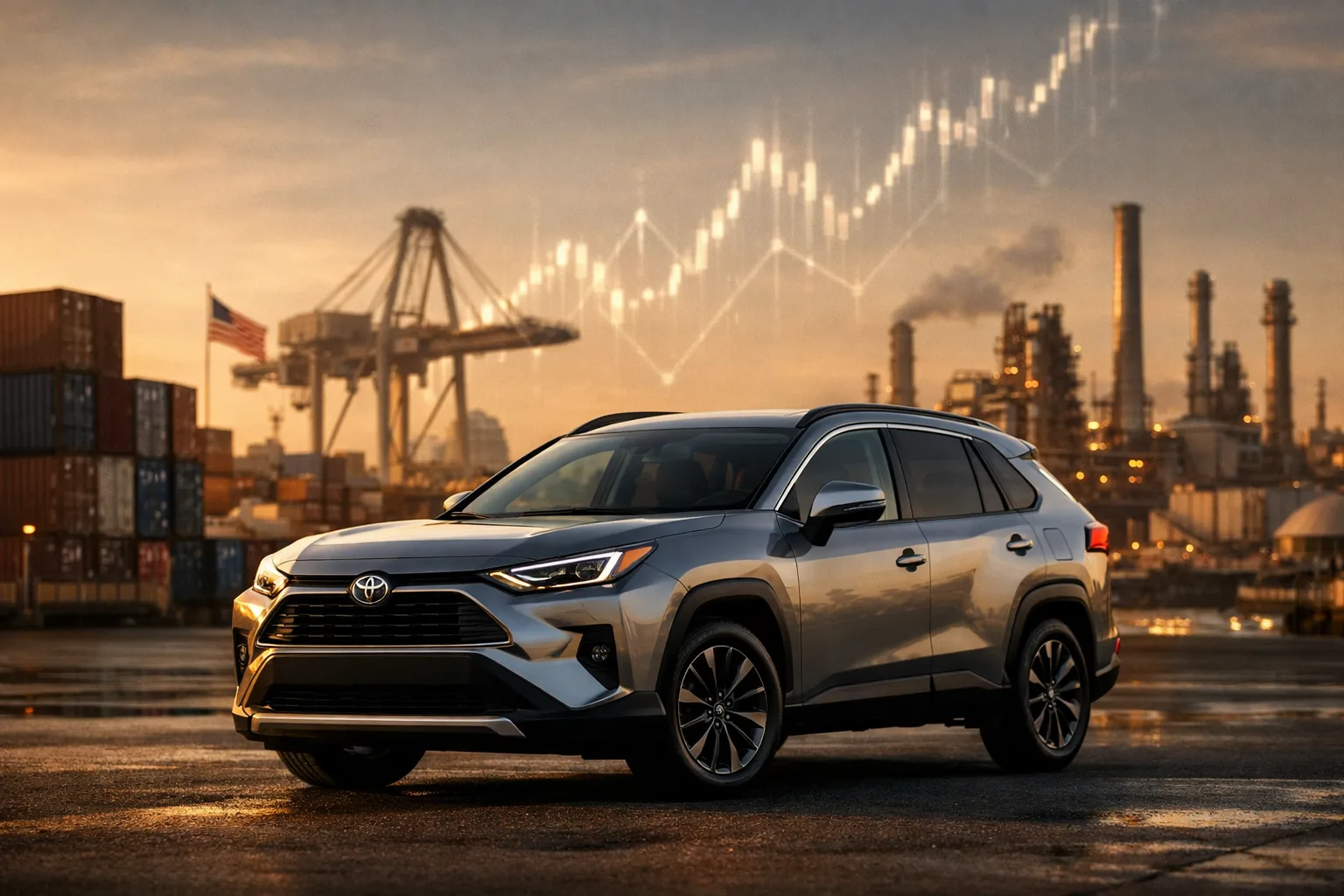
Toyota Motor just delivered a clear message to the global auto industry. Tariffs alone do not determine who wins.
Despite elevated U.S. import duties under President Trump’s trade policy, Toyota retained its crown as the world’s largest automaker in 2025 and posted the strongest sales performance in its history. The results highlight how scale, hybrid dominance, and domestic manufacturing strategy can blunt the financial impact of protectionist trade measures.
For investors, the story goes far beyond unit sales. It signals which manufacturers are structurally positioned to thrive in a tariff-heavy global economy and which ones remain vulnerable to policy shocks.
Toyota Sets a New Global Sales Record
Toyota reported global vehicle sales of approximately 10.5 million units in 2025, marking a new company record and comfortably keeping its lead over key rivals. Combined Toyota and Lexus deliveries climbed 3.7 percent from the prior year, outpacing Volkswagen Group’s roughly 9 million units and Hyundai Motor Group’s 7.27 million units.
This growth occurred during a year when many automakers faced higher financing costs, slower consumer spending in parts of Europe and China, and rising regulatory pressure around emissions standards.
Toyota’s consistency has increasingly made it a defensive name within the auto sector. While peers continue to struggle with electric vehicle demand volatility and margin compression, Toyota’s diversified drivetrain strategy has preserved both volume and profitability.
Hybrid Demand Powers U.S. Growth
A major driver of Toyota’s momentum was its performance in the United States, where hybrid models such as the Prius and RAV4 Hybrid continued to capture market share from both traditional gasoline vehicles and slower selling battery electric offerings.
Toyota and Lexus U.S. sales rose 7.3 percent to roughly 2.93 million vehicles in 2025. Consumers remain attracted to hybrids as fuel prices remain volatile and charging infrastructure growth lags in many regions of the country.
Hybrid penetration has also been rising across fleet and rideshare purchases, creating recurring demand that is less sensitive to short term economic slowdowns.
This hybrid advantage has become one of Toyota’s most valuable competitive assets as regulatory uncertainty continues around EV tax credits, charging standards, and battery sourcing rules.
Tariffs Failed to Derail Toyota’s Strategy
Toyota’s performance came despite a more aggressive tariff environment under President Trump. The administration initially implemented 25 percent tariffs on Japanese auto imports before reducing the rate to 15 percent.
Rather than passing those costs directly onto consumers through broad price hikes, Toyota chose to absorb a significant portion of the impact while tightening internal cost controls and expanding domestic production capacity.
Toyota previously estimated that U.S. tariffs would cost roughly 1.45 trillion yen, about $9.7 billion, in its fiscal year ending March 2026. However, the company also raised its operating profit forecast after achieving efficiency gains and benefiting from strong demand in markets outside the United States.
This pricing discipline helped Toyota maintain affordability while protecting long-term brand loyalty. In an inflation sensitive environment, maintaining sticker price stability has become a powerful competitive lever.
Domestic Manufacturing Provides a Structural Advantage
One of Toyota’s biggest strategic advantages is its manufacturing footprint inside the United States. Roughly 80 percent of Toyota vehicles sold domestically are already produced within North America, significantly reducing exposure to import tariffs.
Toyota continues expanding hybrid-focused production at facilities in states such as Kentucky, Texas, and Alabama, while also investing heavily in battery manufacturing through its North Carolina battery plant that began scaling production in late 2025.
This localization strategy allows Toyota to hedge trade policy risk while qualifying for domestic sourcing incentives tied to clean vehicle credits and federal procurement standards.
For investors, this manufacturing footprint reduces earnings volatility compared to competitors that remain import-heavy.
Hyundai Shows the Other Side of the Tariff Equation
Toyota’s success stands in contrast to Hyundai Motor’s more tariff-sensitive exposure.
Hyundai reported global revenue growth of more than 6 percent in 2025, supported by solid hybrid demand in the U.S. market. However, operating profit declined nearly 19.5 percent year over year as tariff costs weighed on margins. U.S. levies alone reportedly cost Hyundai approximately 4.1 trillion won.
Although South Korea and the United States reached a trade agreement last year that lowered most tariffs to 15 percent starting in November, President Trump recently warned that tariffs could return to 25 percent if implementation delays persist. Hyundai shares dropped nearly 5 percent following the comments, underscoring how quickly policy risk can impact valuation.
Hyundai remains more dependent on imported vehicles, with only about 40 percent of U.S. sales produced domestically in 2025. The company plans to increase U.S. manufacturing capacity at its Georgia facilities to over 80 percent by 2030, but that transition will take time and capital.
Until localization improves, Hyundai remains structurally more exposed to tariff volatility.
Why Toyota’s Hybrid Bet Keeps Paying Off
Toyota’s long-standing decision to prioritize hybrids over aggressive full electrification is increasingly looking prescient. While several competitors face inventory overhangs and margin pressure from slow EV adoption, Toyota continues selling hybrids at healthy volumes without heavy discounting.
Recent 2026 market data shows U.S. hybrid sales growing at a double digit pace year over year, while EV sales growth has decelerated sharply outside of fleet purchases and luxury segments.
Hybrid models also benefit from simpler charging behavior, stronger resale values, and better cold weather reliability, making them more attractive to mainstream buyers.
As policymakers debate future EV mandates and infrastructure funding, hybrids remain a politically safer and economically practical bridge technology.
Toyota’s Earnings Outlook Remains Strong
Toyota is scheduled to report its fiscal third quarter earnings on February 6. Analyst estimates compiled by Reuters suggest operating profit could rebound nearly 30 percent compared to the same period last year, driven by volume growth, pricing discipline, and cost efficiencies.
Toyota shares climbed roughly 3 percent following the sales announcement, reflecting investor confidence that margins remain resilient despite tariff headwinds.
Currency dynamics also continue to play a role. A relatively weaker yen supports export profitability and offsets some raw material cost pressures, further stabilizing earnings.
What This Means for Investors
Toyota’s performance sends several important signals for investors:
Tariff resilience matters. Companies with domestic manufacturing depth and diversified supply chains are better positioned to withstand political volatility.
Hybrids remain a durable growth category. Consumer behavior continues favoring hybrids over pure EVs in many regions, supporting stable margins.
Cost discipline beats price hikes. Toyota’s decision to absorb tariffs rather than push aggressive price increases preserved market share and brand strength.
Localization strategies create valuation stability. Manufacturing footprint increasingly determines earnings predictability under trade uncertainty.
For auto sector investors, Toyota represents a relatively defensive play in an industry facing regulatory flux, geopolitical risk, and shifting consumer preferences. Meanwhile, manufacturers that remain import-heavy may continue facing margin compression and headline risk tied to tariff policy.
The Bigger Picture for Global Auto Markets
President Trump’s trade agenda continues reshaping how automakers allocate capital and design production footprints. As tariffs remain a recurring policy lever, automakers are accelerating localization strategies and reassessing cross-border supply chains.
This trend benefits U.S. manufacturing investment, battery infrastructure expansion, and regional supplier ecosystems, but also raises long-term cost structures for globally integrated companies.
Toyota’s ability to scale profitably inside this environment illustrates how execution, product mix, and geographic strategy increasingly matter more than headline tariff rates themselves.
The global auto industry is entering a period where political risk management becomes as important as engineering innovation.
Toyota appears to be navigating that transition better than most.
About Author