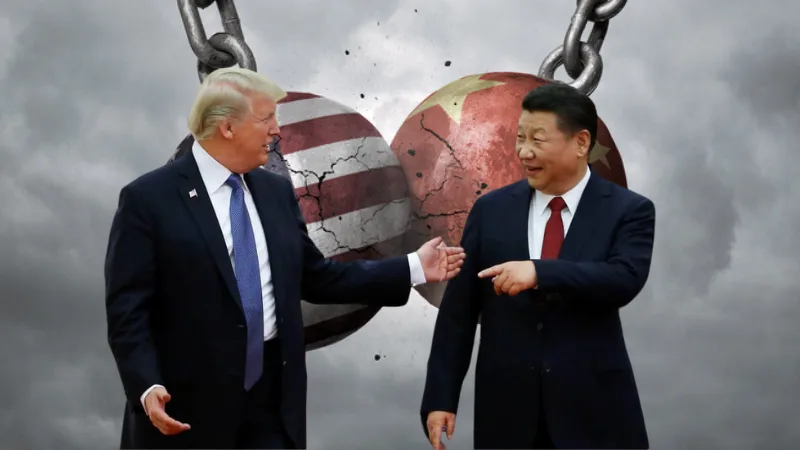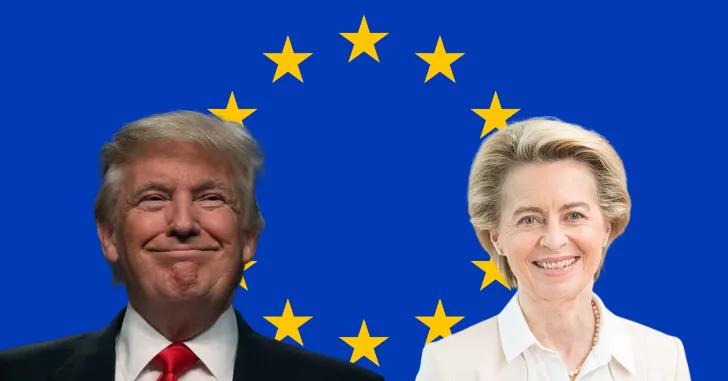
As President Donald Trump pushes forward with plans to slap a 30% tariff on European Union (EU) imports starting August 1, the EU is preparing a rarely discussed but potentially seismic response: activating its “Anti-Coercion Instrument” (ACI). Sometimes dubbed a “trade bazooka,” the ACI could escalate the trade standoff into a full-blown transatlantic trade war — and global investors need to pay attention.
What’s Triggering the EU’s Threat?
Tensions between the U.S. and EU have been mounting since Trump returned to the White House. One of his core trade criticisms has resurfaced: that the EU benefits unfairly from a goods trade surplus with the U.S.
According to the European Council, total trade between the EU and U.S. in 2024 reached €1.68 trillion (around $1.97 trillion). While the EU ran a goods surplus, it had a services deficit — resulting in an overall €50 billion trade surplus in favor of the EU.
Trump’s administration now threatens a sweeping 30% tariff on EU imports if no agreement is reached by August 1. The EU, in turn, is weighing counter-tariffs and invoking the ACI as a deterrent or retaliatory instrument if negotiations fail.
What Is the Anti-Coercion Instrument (ACI)?
Established in 2023, the ACI is a legal and economic tool created by the European Commission to respond to “economic coercion” from foreign nations — any behavior seen as pressuring the EU into changing its laws or policies through trade threats or actions.
The European Commission describes its purpose as follows:
“The primary objective of the ACI is deterrence. But if a third country resorts to coercion, the instrument enables the EU to respond — where possible through dialogue, but also through response measures.”
— European Commission
Those measures can include:
- Tariffs or quotas on foreign goods and services
- Restrictions on public procurement contracts
- Barriers to foreign direct investment (FDI)
- Limits on intellectual property rights (IPR) from the coercing country
- Export controls and service market access limits
These tools go far beyond standard counter-tariffs. They’re designed to affect strategic leverage points, especially where the coercing country benefits most — including in digital services, agriculture, manufacturing, and defense-related sectors.
“Trump’s threat to triple the rate IS seen as a negotiating tactic and not the landing zone by the EU… That said, the EU will threaten to hit as much as €116 billion worth of U.S. exports with counter-tariffs and utilize additional trade measures — including the bloc’s potent Anti-Coercion Instrument.”
— Eurasia Group analysts Mujtaba Rahman, Emre Peker, and Clayton Allen【source: https://www.cnbc.com/2025/07/21/how-europes-trade-bazooka-could-be-used-against-trump-tariffs.html】
The Process for Activating the ACI
The ACI is not a button the EU can push overnight. It involves a multi-step process:
- Investigation: The European Commission must assess if coercion is present.
- Consultation: The EU will attempt to resolve the issue through dialogue with the country in question.
- Council Approval: If dialogue fails, a qualified majority of EU member states (15 out of 27) must approve response measures.
- Implementation: If passed, the Commission enacts the countermeasures, which remain in place only as long as the coercion persists.
So far, the ACI has never been used — making its activation against a major ally like the U.S. a significant escalation.
What Sectors Could Be Targeted?
The EU’s potential ACI responses may hit sectors where the U.S. holds competitive advantages, especially those with large surpluses in EU markets:
| Target Sector | Rationale |
|---|---|
| Digital Services | U.S. tech giants like Amazon, Microsoft, Netflix, and Uber have large EU footprints. |
| Agriculture | EU leaders could retaliate against key Trump-voting blocs tied to U.S. farming exports. |
| Aerospace & Machinery | Sectors with high-value exports vulnerable to European countermeasures. |
| Public Procurement | U.S. firms could be blocked from bidding on EU government contracts. |
| Chemicals & Pharmaceuticals | U.S. companies face strict EU market access rules — new limits would bite. |
If tariffs hit European auto and industrial manufacturers hard — including Germany’s carmakers and France’s aerospace sector — retaliation would likely be proportional and targeted.
How Likely Is the EU to Use the ACI?
Analysts view the ACI as a last resort — but a serious one. According to the Eurasia Group:
“An escalatory spiral… would prompt Brussels to deploy escalatory measures, such as export controls, public procurement curbs, and/or penalties on U.S. services exports by using the ACI ‘trade bazooka’ as a last resort.”
However, internal EU divisions could shape the strategy. France and Spain reportedly favor strong retaliation, while others may prefer a more cautious approach, such as conventional tariffs or WTO litigation.
The EU is reportedly open to a 10% baseline tariff deal — with exemptions or quotas to protect strategic industries. But anything above 15% would likely trigger formal retaliation.
Investor Takeaways: What This Means for Markets
1. Watch for a Transatlantic Trade War
If both sides follow through with punitive actions, expect a new round of trade tensions that could dent investor confidence globally. The S&P 500 and Euro Stoxx 50 could react negatively to tariff headlines and tit-for-tat escalation.
2. Tech Giants Could Get Caught in the Crossfire
The ACI explicitly allows for targeting of U.S. services — with digital services being a primary focus. That puts Microsoft, Amazon, and Netflix in the firing line, potentially curbing their EU expansion or triggering regulatory headaches.
3. Aerospace and Automotive Stocks Are Vulnerable
U.S. aerospace suppliers like Boeing and manufacturers like Caterpillar could be hit with European restrictions. On the flip side, European names like Airbus, Volkswagen, and BMW could take an earnings hit if U.S. tariffs go into effect.
4. The Dollar and Euro Could See Volatility
Escalating trade tensions typically weaken the currency of the country initiating tariffs. Depending on investor sentiment, this could lead to increased EUR/USD volatility and shift flows into safe-haven assets like gold and Treasury bonds.
5. Emerging Markets May Benefit… Temporarily
As U.S. and EU markets become embroiled in tariff tit-for-tats, emerging economies that remain neutral may benefit from diverted trade flows. But if global growth expectations fall, risk assets could see a broader correction.
Chart: Potential Impact Zones if ACI Is Activated
| Sector | U.S. Exposure to EU | Risk from ACI Action |
|---|---|---|
| Digital Services | High | Very High |
| Aerospace & Machinery | Moderate to High | High |
| Pharmaceuticals | Moderate | Medium |
| Agriculture | High | High |
| Public Procurement | Moderate | High |
(Source: Global Market News analysis; trade data from European Commission and WTO)
Investors Must Watch August 1
The next week will be critical. If Trump follows through on his 30% tariff threat, and the EU responds with its Anti-Coercion Instrument, the world could witness a historic escalation in U.S.-EU trade relations.
While this is not the base case — most analysts still see a negotiated 10% tariff agreement as possible — the stakes are rising. For investors, it’s not just about tariffs. It’s about global supply chains, regulatory burdens, sectoral disruption, and political signaling.
The ACI is Europe’s version of a loaded weapon — legal, structured, and potentially devastating to targeted sectors. If it’s pulled out of the holster, U.S. multinationals and international markets alike may be facing a far more turbulent second half of the year.
Sources:
- European Commission – Anti-Coercion Instrument Overview
- European Council – EU–U.S. Trade Relations
- CNBC – How Europe’s ‘Trade Bazooka’ Could Be Used Against Trump’s Tariffs
About Author