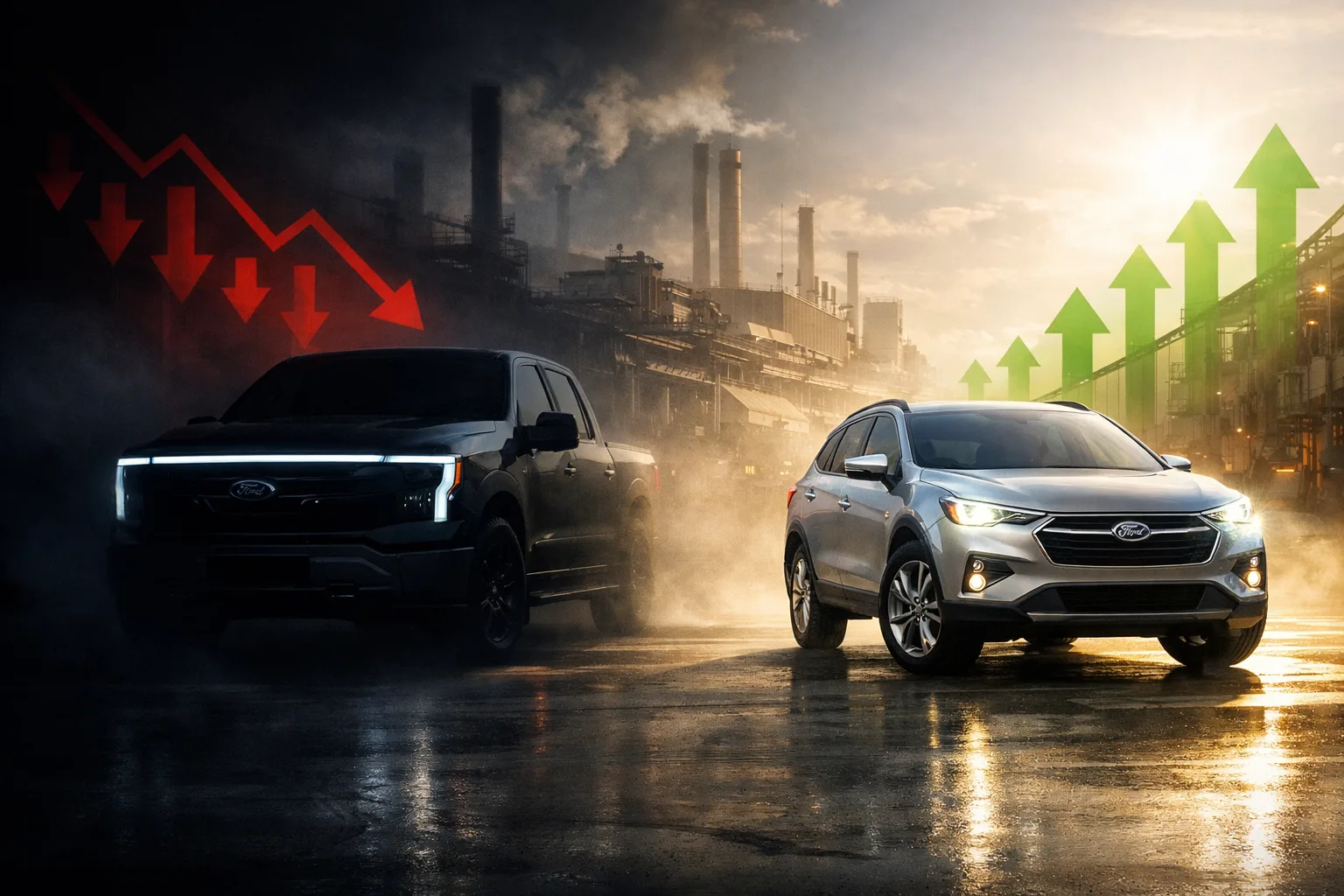
Ford Motor Company is undergoing a major strategic reset after its electric vehicle division posted nearly $5 billion in losses last year. The shift signals a broader turning point across the global auto industry, where consumer demand, affordability, and profitability are reshaping the future of electrification.
Ford CEO Jim Farley summarized the situation bluntly during the company’s earnings call: “So I think the customer has spoken. That’s the punchline.”
The message from buyers is clear. Expensive, large electric vehicles have not delivered the demand automakers expected. Now Ford is pivoting toward hybrids, lower-cost EVs, and practical solutions designed for mass adoption rather than early-adopter enthusiasm.
For investors, the company’s strategy change carries important implications not only for Ford but for the entire EV sector.
The $4.8 Billion Wake-Up Call
Ford’s Model e electric vehicle division reported a $4.8 billion loss in 2025, and the company expects another $4 billion to $5 billion loss in 2026. EV sales declined, costs remained high, and the end of federal incentives worsened the pressure.
Sales of Ford’s key electric vehicles showed weakness:
- Mustang Mach-E sales remained roughly flat year over year
- F-150 Lightning sales fell sharply
- E-Transit commercial van demand softened
- Overall EV unit sales dropped 14 percent
The drop became even more visible after the expiration of the federal $7,500 EV tax credit. Monthly F-150 Lightning sales fell significantly following the subsidy removal, highlighting how dependent demand had been on government incentives.
Meanwhile, hybrid vehicle demand surged, creating a clear contrast in consumer behavior.
Ford sold 84,934 hybrid F-150 trucks in 2025, up 15 percent, demonstrating that buyers still want electrification, just not in the form of expensive, range-limited full EVs.
Ford’s Early EV Strategy Did Not Deliver
Ford was among the first legacy automakers to aggressively challenge Tesla in the modern EV market.
The company electrified two of its most iconic nameplates:
- Mustang Mach-E launched in 2020
- F-150 Lightning launched in 2022
The strategy was straightforward. Use strong brand recognition to accelerate EV adoption and capture market share quickly.
Initial demand appeared promising. Ford received nearly 200,000 reservations for the F-150 Lightning and projected annual sales of 150,000 units. However, those projections never materialized into sustained high-volume production.
By 2025:
- Ford sold 27,307 F-150 Lightnings, down sharply year over year
- Mustang Mach-E sales stagnated
- High production costs and price sensitivity reduced profitability
The core issue became clear. Consumers liked the idea of electric trucks and SUVs, but many were not willing to pay the premium price or accept limitations in range, towing capacity, and charging infrastructure.
Ford Shifts Toward Hybrids and Extended-Range EVs
In response, Ford is leaning heavily into hybrid technology and extended-range electric vehicles, known as EREVs.
The company has paused its current all-electric F-150 Lightning production and plans to relaunch the truck later as an extended-range model that includes a gasoline generator to supplement battery power.
Farley explained the reasoning during the call:
“We’re betting on hybrid across our lineup, and EREV where it makes sense.”
He added:
“Like a large truck, where towing is a really important application, and both PHEV and pure electric will definitely not work.”
This shift addresses two major concerns from early EV truck buyers:
- Limited towing range
- Charging anxiety during heavy-duty use
By blending electric efficiency with gasoline backup power, Ford hopes to create a more practical solution for mainstream truck buyers.
The New EV Plan: Affordable and Scalable
While Ford is slowing its premium EV ambitions, it is not abandoning electrification. Instead, the company is building a new universal EV platform focused on lower-cost, high-volume vehicles.
The first model, expected in 2027, will be a mid-size electric pickup priced around $30,000. Ford plans to build at least five vehicles on this platform, including SUVs and commercial vans.
Farley stated:
“We aren’t just building compliance vehicles at Ford. We’re launching a cost-efficient, universal EV platform that will drive profitable growth.”
He also pointed to Tesla’s example:
“Tesla’s shown that they could, we can make money in that market, even without subsidy from the government at the right cost level.”
The focus now is profitability, not just market share.
A Broader Industry Trend Toward Cheaper EVs
Ford’s pivot mirrors a wider shift across the global auto industry. Several major automakers are moving toward affordable EVs in response to slowing demand for premium models.
Companies planning lower-cost EV launches include:
- Toyota
- Nissan
- Chevrolet
- Rivian
- Subaru
Many upcoming models are targeting price points below $50,000, with some aiming closer to $30,000 to reach mass-market consumers.
This transition reflects an important reality. EV adoption will not scale globally unless vehicles become affordable for average households.
Ford’s Long Road to EV Profitability
Despite the strategic reset, Ford does not expect its EV division to become profitable soon. CFO Sherry House indicated the company is targeting break-even for its electric segment around 2029.
That timeline highlights the enormous capital intensity required for EV production, battery technology, and infrastructure investment.
For investors, the key takeaway is patience. EV profitability across the auto industry remains years away for most legacy manufacturers.
How Investors Are Interpreting Ford’s Results
Ford also disappointed Wall Street on earnings. The company reported 13 cents adjusted earnings per share, below the 19 cents analysts expected.
However, not all analysts see the miss as alarming.
John Rosevear of The Motley Fool commented:
“On paper, it’s a big miss, but I don’t think it’s a big deal.”
He added that Ford’s guidance for 2026 includes expected improvements in cash flow and continued investment in long-term growth, which markets often reward.
Investors appear cautiously optimistic. Ford’s willingness to pivot quickly may ultimately strengthen its long-term position.
What This Means for the Future of EVs
Ford’s strategy shift reflects several broader realities shaping the electric vehicle market:
- Consumers want affordability over innovation hype
- Hybrids are gaining traction as a practical transition technology
- Government subsidies significantly influence EV demand
- Profitability remains a major challenge for legacy automakers
- The mass-market EV segment is still in early development
Rather than abandoning electrification, Ford is adapting to the real-world pace of adoption.
What It Means for Investors
Ford’s pivot offers several key signals for investors:
1. Hybrid demand is stronger than expected
Hybrid technology may deliver better margins and steadier demand than full EVs in the near term.
2. EV profitability is still years away
Investors should expect continued losses across much of the legacy auto industry’s EV operations.
3. Affordable EVs will define the next growth phase
Companies that succeed in producing low-cost, scalable EVs may dominate the next stage of the market.
4. Strategic flexibility matters
Ford’s willingness to adjust quickly could strengthen investor confidence compared to companies sticking rigidly to costly EV-only strategies.
About Author