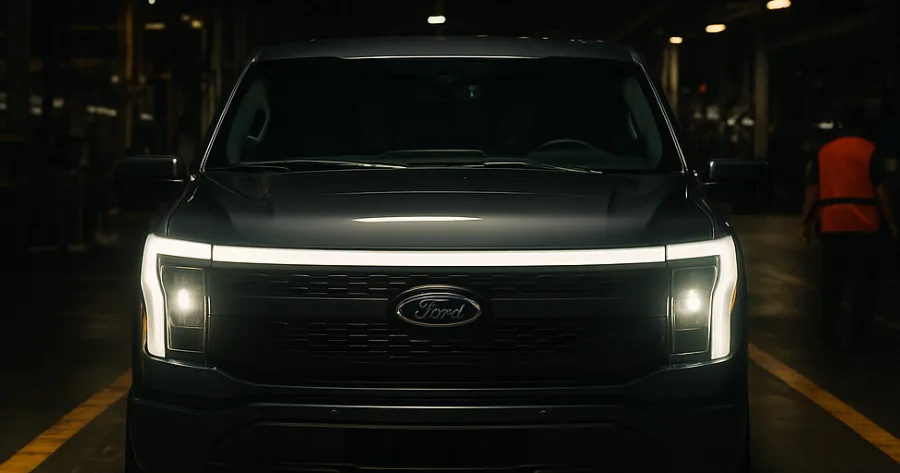
Ford Motor Co. announced it will take a roughly $19.5 billion charge tied to its electric vehicle business, marking one of the largest EV-related write-downs ever by a legacy automaker and signaling a significant shift in its long-term strategy.
The charge reflects cancelled EV programs, impaired battery investments, and a broader retreat from aggressive electrification plans that no longer align with consumer demand or profitability targets.
Ford shares were little changed following the announcement, but the move has major implications for investors, the auto industry, and the pace of the EV transition.
What Is Driving Ford’s $19.5 Billion EV Charge
Ford said the charge stems from several EV-related decisions made after a comprehensive review of its electric vehicle roadmap.
The automaker is canceling or scaling back multiple EV programs, including next-generation electric trucks that were previously positioned as central to Ford’s future lineup. Billions invested in development, tooling, and plant preparation tied to those vehicles will no longer generate expected returns.
Ford is also writing down parts of its battery strategy, including changes to joint ventures and capacity plans that assumed sustained growth in EV demand. As sales slowed and margins deteriorated, those investments lost value.
In addition, Ford is recording impairments on EV-related manufacturing assets, including factories and equipment that are now expected to operate below capacity or be repurposed.
While much of the charge is non-cash, it will significantly impact reported earnings and confirms that a large amount of capital was misallocated during the peak of EV optimism.
Slowing EV Demand Forces Strategic Reset
Ford’s pullback reflects a broader slowdown in EV demand across the U.S. market.
High vehicle prices, limited charging infrastructure, range concerns, and higher interest rates have made EVs a harder sell to mainstream buyers. Electric pickup trucks, in particular, have struggled to achieve the sales volumes needed to justify their high production costs.
Ford’s F-150 Lightning generated early enthusiasm but failed to deliver consistent profitability once incentives faded and inventory levels increased.
The company’s EV division has reported multi-billion-dollar annual losses, highlighting the difficulty legacy automakers face in scaling electric vehicles profitably.
Policy Shifts Add to EV Headwinds
Changes in the regulatory and political environment have also weighed on Ford’s EV strategy.
Federal incentives for electric vehicles have become less predictable, while emissions rules have softened. The policy tailwinds that helped justify aggressive EV investment earlier in the decade are no longer guaranteed.
Without those supports, the economics of mass-market EV production have become far more challenging.
Ford Refocuses on Hybrids and Profitability
Ford said it is not abandoning electrification, but it is redefining what that means.
The company is shifting its focus toward:
- Hybrid vehicles, which already generate strong margins
- Extended-range electric vehicles that combine electric drivetrains with gasoline backup
- Commercial vehicles, where electrification has clearer economic benefits
- Energy storage solutions that repurpose battery investments outside passenger cars
Ford now expects roughly half of its global vehicle production to be electrified by 2030, but that figure includes hybrids rather than exclusively fully electric vehicles.
The shift marks a notable departure from earlier plans that emphasized an all-electric future.
What the EV Charge Means for Investors
In the short term, the charge will pressure earnings and keep investor sentiment cautious. EV-related losses have already weighed on Ford’s valuation, and the write-down reinforces concerns about capital discipline.
Over the medium term, however, the strategic reset could stabilize cash flow and improve margins as Ford reallocates resources toward vehicles consumers are buying today.
Markets have increasingly rewarded profitability and execution over long-term narratives. Ford’s move suggests management is prioritizing financial sustainability over maintaining ambitious but unprofitable EV targets.
A Broader Signal for the Auto Industry
Ford is not alone in reassessing its EV plans. Other major automakers have also delayed or scaled back electric vehicle investments as demand growth slowed and costs remained high.
The EV transition is continuing, but at a slower pace and with a greater emphasis on hybrid technology. For legacy manufacturers, hybrids appear to offer a more practical bridge between internal combustion engines and fully electric vehicles.
A Pivotal Moment
Ford’s $19.5 billion EV charge represents a pivotal moment for the company and the broader auto industry.
The automaker is acknowledging that its earlier electrification strategy moved faster than market realities would allow. By pivoting toward hybrids and profitability, Ford is betting that discipline, not speed, will determine long-term success.
For investors, the announcement is a reminder that the EV transition remains uneven and that execution and margins matter more than bold promises.
About Author