A government shutdown is once again hanging over Washington. With the clock ticking toward a midnight deadline, both Republicans and Democrats are staking out hardline positions, leaving federal workers, businesses, and investors bracing for uncertainty.
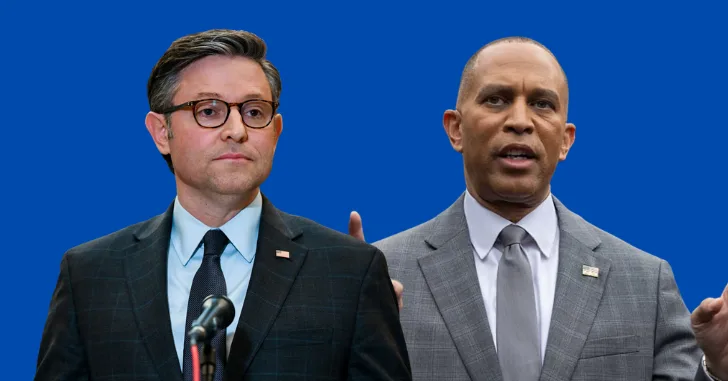
House Speaker Mike Johnson (R-La.) and House Minority Leader Hakeem Jeffries (D-N.Y.) took to CNBC’s Squawk Box on Tuesday morning to present starkly different narratives about who is to blame. Johnson accused Democrats of “holding the government hostage” over healthcare demands, while Jeffries countered that Republicans are the ones pushing the country toward a shutdown.
The outcome of this showdown could ripple far beyond Capitol Hill. A shutdown would not only furlough government workers and disrupt federal services, but also delay key economic data — information that markets rely on to price risk, forecast growth, and guide investment decisions.
Why the Government Shutdown Fight Matters
Shutdowns are more than a Washington spectacle. They cost money, slow the economy, and create uncertainty. The Congressional Budget Office has estimated that previous shutdowns have shaved billions off GDP.
For investors, the stakes are clear:
- Markets dislike uncertainty. Stocks often weaken during shutdown showdowns, particularly in sectors tied to government spending and consumer confidence.
- Economic data disruptions. If agencies close, reports like the monthly jobs numbers or inflation readings may be delayed — depriving Wall Street and the Federal Reserve of critical signals.
- Safe-haven flows. Treasurys and gold tend to benefit when investors grow nervous about political dysfunction.
That makes the 2025 shutdown standoff especially important to watch.
Johnson’s Position: Pass a “Clean” Stopgap
Speaker Mike Johnson insists that Democrats are using the threat of a shutdown to score political points. He’s pushing for a “clean” continuing resolution (CR) — a short-term bill that funds the government without policy riders.
“Democrats need to come to their senses here and do the right thing,” Johnson said on CNBC. He accused Senate Majority Leader Chuck Schumer and Minority Leader Jeffries of “painting themselves into a corner” by demanding healthcare-related provisions.
Johnson argued that debates over health policy — particularly the Affordable Care Act (ACA), also known as Obamacare — can wait. For now, he says, the only priority should be keeping the government open.
The Democratic Stance: Protect ACA Subsidies
Democrats, however, see healthcare as central to this debate. They want any short-term funding bill to extend ACA subsidies that lower premiums for millions of Americans buying insurance through exchanges. These subsidies are set to expire at the end of 2025.
“We will not support a partisan Republican spending bill that continues to gut the healthcare of the American people,” Jeffries said.
He warned that without congressional action, “notices are going to start going out” to millions of Americans about higher insurance premiums. Jeffries said Democrats are fighting to “protect the healthcare of the American people,” framing the subsidies as non-negotiable.
The Clash Over Immigration Rhetoric
The debate also turned sharp when Republicans accused Democrats of wanting to extend taxpayer-funded benefits to undocumented immigrants.
Johnson and others suggested Democrats were prioritizing immigration over fiscal responsibility. But Jeffries flatly rejected the charge, calling it “an outright lie.”
“Federal law prohibits the use of taxpayer dollars to provide medical coverage to undocumented individuals,” Jeffries said. “There is nothing in anything that we have proposed that is trying to change that law.”
This rhetorical fight is as much about political framing as it is about policy substance. Republicans are trying to link Democrats to unpopular immigration policies, while Democrats are portraying Republicans as callous toward Americans’ healthcare costs.
Thune’s View: A Manufactured Problem
Senate Republican Whip John Thune (R-S.D.) added his voice, calling the ACA subsidy issue “a made-up problem by the Democrats.” Thune argued that Democrats are simply using the shutdown as leverage to satisfy a base that remains opposed to President Donald Trump.
“This is Donald Trump. Nothing more, nothing less,” Thune said, suggesting that Democrats see the shutdown battle as a way to rally their supporters against the president’s agenda.
What Happens If the Government Shuts Down?
If no deal is reached, nonessential federal services will grind to a halt. That typically means:
- Furloughs for hundreds of thousands of federal employees. Many will miss paychecks until the government reopens.
- Suspended services. National parks and museums close, visa and passport processing slows, and small business loans stall.
- Delayed economic reports. Key releases like the September jobs report may not be published on time, which has already rattled markets in past shutdowns.
- Impact on consumer confidence. Public frustration with Washington gridlock often seeps into spending and sentiment, affecting the broader economy.
Investors should note that even short shutdowns leave a measurable dent in GDP growth and can create volatility in equities, particularly in defense, contracting, and infrastructure-linked sectors.
Investor Takeaways
For market participants, the 2025 shutdown fight is a test of political risk:
- Short-Term Volatility: Expect choppier trading as headlines shift hour by hour. Defensive positioning — through gold, utilities, or short-duration Treasurys — may gain traction.
- Delayed Data = Fed Blind Spots: If jobs or inflation reports are postponed, the Federal Reserve will be flying partially blind. That could stall or complicate interest-rate decisions.
- Sector Sensitivity: Healthcare stocks may move sharply depending on whether ACA subsidies are extended. Insurers in the ACA marketplace could be particularly volatile.
- Long-Term Impact on Confidence: Repeated shutdown brinkmanship erodes investor confidence in U.S. governance, which can eventually pressure the dollar and Treasurys.
Historical Context
The U.S. has faced more than a dozen shutdowns since 1980. Some lasted only days, while the 2018–2019 shutdown stretched a record 35 days.
Markets typically bounce back after shutdowns end, but during the standoff, uncertainty can weigh heavily. In 2013, the S&P 500 dropped 4% during a 16-day shutdown before recovering. In the 2018–2019 episode, federal workers missed two paychecks, consumer sentiment dipped, and credit rating agencies warned about U.S. political dysfunction.
The 2025 standoff comes at a delicate time, with markets already digesting slowing growth signals, Federal Reserve policy shifts, and geopolitical uncertainty abroad. A shutdown could act as an additional stress test.
The Political Stakes
For Johnson, this fight is an early test of his leadership as Speaker. Delivering a “clean” CR without caving to Democratic demands would show unity within the GOP.
For Jeffries and Schumer, holding firm on healthcare subsidies demonstrates loyalty to their base, particularly progressives who view ACA protections as non-negotiable. The shadow of Rep. Alexandria Ocasio-Cortez and other progressives looms large over Democratic leadership decisions.
And for President Trump, the standoff represents another opportunity to frame Democrats as obstructionists while rallying Republican voters ahead of 2026 midterms.
The Bottom Line
The government shutdown 2025 battle is less about immediate fiscal policy and more about political leverage. Democrats want to protect ACA subsidies and frame Republicans as anti-healthcare, while Republicans want to demonstrate fiscal discipline and avoid what they call “backdoor benefits” to immigrants.
For investors, the noise out of Washington is not just political theater — it carries real consequences. Market volatility, delayed data, and shifts in consumer confidence can all impact portfolios.
As the deadline approaches, the message is clear: buckle up for turbulence.
About Author