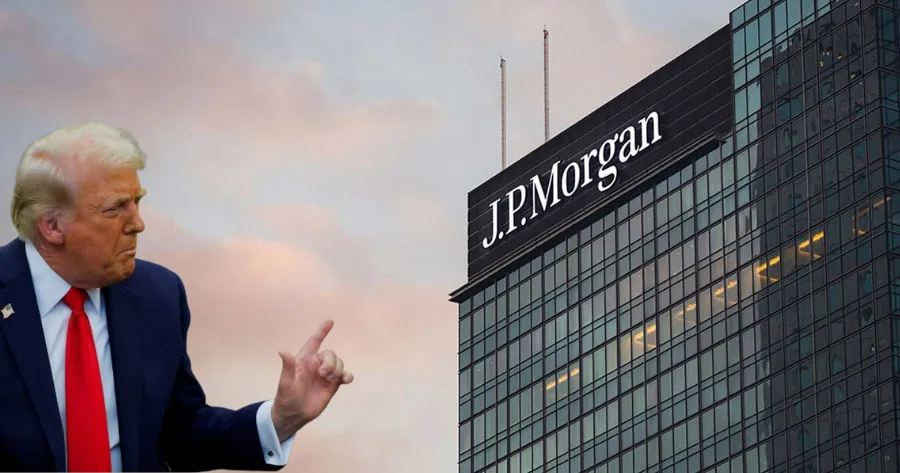
A growing legal battle between President Donald Trump and one of America’s most powerful financial institutions is putting a spotlight on a controversial issue that could affect businesses, investors, and everyday Americans alike: debanking.
JPMorgan Chase has now formally acknowledged that it ended its banking relationship with Donald Trump and several Trump-affiliated businesses shortly after the January 6, 2021 Capitol riot. The disclosure came as part of a major lawsuit filed by Trump seeking $5 billion in damages, alleging political discrimination and reputational harm.
The case is quickly evolving into something far bigger than a dispute between a bank and a former customer. It is becoming a test of how much power large financial institutions hold over access to the U.S. banking system, and whether political views can indirectly influence that access.
Here is what happened, why it matters, and what it could mean going forward.
What JPMorgan Admitted In Court
In a recent court filing, a senior JPMorgan executive confirmed that the bank notified Trump and several of his business entities in February 2021 that certain accounts would be closed. Formal letters dated February 19, 2021 were sent to both Trump personally and to Trump Organization entities.
One letter stated:
“JPMorgan Chase Bank, N.A. (‘we’) has decided to close its banking relationship with The Trump Corporation and its affiliated entities.”
Another letter to Trump read:
“We may determine that a client’s interests are no longer served by maintaining a relationship. … With that in mind, this letter is to respectfully inform you that we will need to end our current relationship.”
According to JPMorgan, the closures were carried out under standard account agreement procedures, and the bank worked with Trump’s businesses to transfer remaining funds to other institutions.
However, Trump’s legal team argues the closures were politically motivated and unlawful.
Trump’s Allegations: Political Discrimination And “Blacklisting”
Trump’s lawsuit accuses JPMorgan and CEO Jamie Dimon of targeting him for political reasons following the events of January 6. The complaint claims the bank effectively placed Trump on a financial “blacklist” and damaged his ability to conduct business.
According to court filings, Trump had been a JPMorgan client for decades and conducted hundreds of millions of dollars in transactions through the bank. His attorneys argue the termination was not based on financial risk but rather on political pressure and reputational concerns.
The lawsuit alleges:
- Political discrimination
- Trade libel
- Violation of Florida consumer protection laws
- Breach of good faith and fair dealing
Trump’s legal team wrote that the decision caused “considerable financial and reputational harm” and warned it reflects a broader trend in which financial institutions restrict access to banking based on ideology.
JPMorgan’s Position: Banks Can Close Accounts
JPMorgan has not admitted wrongdoing and is expected to argue that the closures were fully permitted under standard banking agreements.
Like most large banks, JPMorgan’s customer contracts allow either party to terminate a relationship, often with written notice and sometimes without providing a specific reason. The agreements also allow closures for compliance, legal, regulatory, or reputational risk.
Large banks operate under strict federal oversight, including:
- Anti-money laundering regulations
- Counter-terrorism financing rules
- Government sanctions compliance
- Fraud and legal risk monitoring
Financial institutions frequently cite these obligations when ending client relationships, even in cases involving high-profile customers.
Jamie Dimon’s 2025 Testimony On Debanking
In February 2025, JPMorgan CEO Jamie Dimon addressed Congress on the broader issue of debanking and denied that political ideology drives account closures.
“We don’t debank people because of political or religious affiliations,” Dimon said on Capitol Hill. “But there are a lot of things that can be fixed. We should fix them. The rules and requirements are so onerous, and it does cause people to be debanked in my opinion, should not be debated.”
Dimon’s comments suggest the issue may be less about politics and more about regulatory pressure, risk management, and reputational exposure.
Still, critics argue large banks have enormous discretion, and transparency is often limited when accounts are closed.
The Capital One Lawsuit Adds Fuel
This is not Trump’s only dispute with major banks. In 2025, the Trump Organization also filed suit against Capital One, claiming the bank terminated more than 300 Trump-related accounts in 2021 without justification.
Capital One responded publicly:
“Capital One has not and does not close customer accounts for political reasons.”
Taken together, the lawsuits are raising broader questions about whether high-profile individuals or controversial figures face higher risk of losing access to the financial system.
Why This Case Matters Beyond Trump
Regardless of political views, the outcome of this lawsuit could have major implications for:
1. Banking Access Rights
If courts limit banks’ ability to terminate accounts without clear justification, it could reshape customer protections nationwide.
2. Corporate Risk Policies
Large banks may be forced to clarify how reputational and political risk factors influence account decisions.
3. Regulatory Oversight
Lawmakers could use the case to push new rules governing when banks can close accounts.
4. “Debanking” Debate
The issue is expanding beyond politics into industries like crypto, firearms, energy, and other sectors that have faced banking access challenges.
The Bigger Trend: Financial Power And Control
Over the past decade, critics across the political spectrum have warned about the growing influence of large financial institutions over economic participation.
Banks do not just store money. They control:
- Payment processing
- Credit access
- Business operations
- Investment flows
When a bank ends a relationship, it can severely disrupt an individual or company’s ability to operate.
This is why the Trump-JPMorgan case is drawing national attention far beyond partisan politics.
What Investors Should Watch
Investors should not dismiss this case as purely political drama. It could shape financial industry rules in meaningful ways.
Key developments to monitor:
- Whether courts require banks to disclose clearer reasons for account closures
- Potential new federal or state regulations around debanking
- Impact on large bank compliance and risk models
- Possible reputational or legal costs for major financial institutions
If regulatory changes emerge, they could influence the banking sector, fintech firms, and industries frequently labeled “high risk.”
Sources
- https://www.foxnews.com/politics/jpmorgan-admits-closing-trump-bank-accounts-jan-6-lawsuit
- https://www.reuters.com/legal/jpmorgan-lawsuit-trump-account-closure-2025
- https://www.cnbc.com/2025/02/13/jamie-dimon-debanking-congress-testimony.html
- https://www.bloomberg.com/news/articles/2025-01-20/debanking-banks-account-closures-risk-compliance
About Author