From price hikes to diversity cutbacks, America’s favorite fast-food chain is under fire. This week, a growing movement of consumers is calling on Americans to join a nationwide boycott of McDonald’s—lasting from June 24 to June 30, 2025—citing a host of political, economic, and social grievances. And while McDonald’s has weathered controversies before, this boycott may hit differently.
The campaign, spearheaded by an advocacy group called The People’s Union USA, marks one of the most significant organized consumer actions against a U.S. corporation this year. It could foreshadow a broader trend of “economic resistance”—consumer-led activism targeting companies perceived as abandoning social responsibility or exploiting their economic power.
So, what exactly is fueling this latest backlash against the burger behemoth? And more importantly—for investors, analysts, and everyday Americans—will it make a real dent in McDonald’s bottom line?
What’s the Boycott About?
The movement, promoted under hashtags like #BoycottMcDonalds and #StandForWorkers, is built around four core accusations against the global fast-food chain:
1. Rollback of DEI (Diversity, Equity, and Inclusion) Initiatives
McDonald’s has quietly scaled back some of its diversity-focused initiatives. That includes:
- Pulling back from supplier diversity goals.
- Scaling down internal DEI teams.
- Ending public reporting on DEI benchmarks.
This shift mirrors a broader trend among large corporations that are retreating from public commitments to social equity in the face of political pressure and shareholder activism. Critics see this as abandoning marginalized communities and walking back promises made during the post-George Floyd era.
John Schwarz, founder of The People’s Union USA, accused McDonald’s of “prioritizing profit over principle” and turning its back on working-class Americans and minority-owned businesses.
“They sold Americans a promise of progress, then quietly backed away the moment it got politically inconvenient,” Schwarz said in a public statement.
2. Labor Practices and Union Suppression
Another pillar of the boycott revolves around McDonald’s history of resisting labor unionization and what critics describe as substandard pay and working conditions for frontline workers.
Though California’s $20/hour fast-food wage law has forced McDonald’s to raise wages in some locations, organizers argue it was done grudgingly—and that wages still lag behind inflation-adjusted cost-of-living increases in most U.S. cities.
McDonald’s has also been accused of engaging in union-busting practices and lobbying against federal minimum wage hikes. The boycott calls for McDonald’s to:
- Guarantee nationwide living wages.
- Respect worker organizing rights.
- Improve workplace safety and scheduling transparency.
3. Alleged Price Gouging
Consumers have grown increasingly frustrated with menu price hikes. A recent viral post showed a Big Mac meal priced at nearly $18 in some metro locations—a level many called “insulting,” particularly when compared to stagnant wages.
While inflation has driven up costs across the board, McDonald’s critics argue the company is using the inflation narrative to pad its margins, even as many families struggle to afford basic meals.
This sentiment was echoed by Wall Street Journal columnist Rachel Wolfe, who wrote that “fast food is no longer cheap, and Americans are starting to walk away.”
4. Tax Avoidance
The final charge against McDonald’s is an old but recurring one: corporate tax dodging.
Activists cite reports from the past decade documenting how the company, like many multinationals, used international tax loopholes and complex accounting structures to reduce its effective tax rate. Though technically legal, critics say it’s unethical—especially when the company has made billions in profits while taking advantage of public infrastructure, tax credits, and government assistance programs for low-wage workers.
“If they paid their fair share of taxes, we could fund better schools, better roads, and better healthcare for the workers who flip their burgers,” said Schwarz.
Timing and Tensions
This boycott comes at a tense time for McDonald’s.
In its most recent earnings call, CEO Chris Kempczinski acknowledged that U.S. traffic had softened, especially among lower-income customers—a demographic the company has historically relied on. Executives pointed to higher prices, economic uncertainty, and increased competition from value-based fast-casual chains.
Meanwhile, California’s $20 fast-food minimum wage has forced franchisees to raise menu prices or cut hours. Some have resorted to using automation or eliminating positions altogether.
All of this has sparked debate over whether McDonald’s is still accessible to the average American, or whether it’s transforming into a luxury convenience brand—a dangerous identity shift for a company built on affordability.
Investor Implications: Is This a Flash in the Pan or a Real Risk?
From a Wall Street standpoint, short-term consumer boycotts rarely have lasting financial consequences—unless they reflect a deeper reputational risk or shift in consumer behavior.
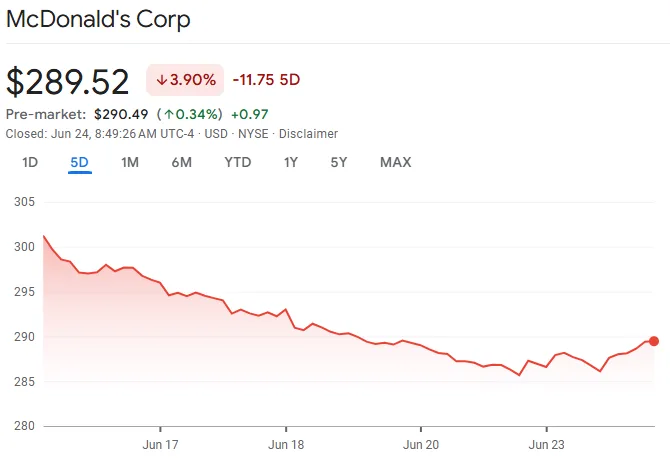
That said, investors are paying attention. McDonald’s stock is down roughly 10% over the past month, due in part to:
- Softening same-store sales growth in the U.S.
- Franchisee discontent over rising costs.
- Public backlash over pricing optics and wage debates.
Analysts at JPMorgan noted in a recent research brief that “McDonald’s remains a strong brand with global resilience, but it’s losing pricing power among its core demographic.”
If the boycott gains traction on social media and gets coverage from major influencers or progressive lawmakers, it could exacerbate a brand perception issue that’s already been simmering.
Can Boycotts Like This Succeed?
History shows mixed results. In the past few years:
- The Bud Light boycott over LGBTQ+ marketing significantly hurt Anheuser-Busch’s U.S. brand value.
- Target and Disney have faced conservative-led boycotts over cultural issues with varying degrees of financial impact.
- Starbucks has been boycotted from both ends of the spectrum—liberals over union-busting, conservatives over DEI—and largely recovered.
The McDonald’s case is unique because it blends economic populism with progressive social activism. It’s not just about one cultural issue—it’s a broader critique of corporate behavior that could resonate across political lines.
In an election year where both Democrats and Trump-style populists are calling out corporate greed, McDonald’s may find itself caught in a rare multi-front cultural war.
What Comes Next?
The boycott is scheduled to run through June 30, but organizers suggest they’ll escalate pressure if McDonald’s fails to respond. Demands include:
- Reinstating and expanding DEI commitments.
- Raising wages across all U.S. franchises.
- Cutting prices on core menu items.
- Pledging transparency on tax practices.
Whether the company issues a statement or ignores the campaign altogether could shape the media narrative heading into July earnings season.
So far, McDonald’s corporate office has declined to comment on the boycott.
Final Word
This week’s McDonald’s boycott may seem like another skirmish in America’s endless cultural and economic battles—but the issues it raises are serious.
If this campaign triggers a deeper re-evaluation of labor standards, pricing ethics, and corporate social responsibility, it may turn out to be more than just a PR headache.
For investors, the lesson is clear: consumer sentiment isn’t just noise—it’s a leading indicator. Companies that lose trust, even incrementally, often lose revenue too.
As inflation lingers and political tensions rise, the Golden Arches may need to do more than serve fries to stay golden.
About Author