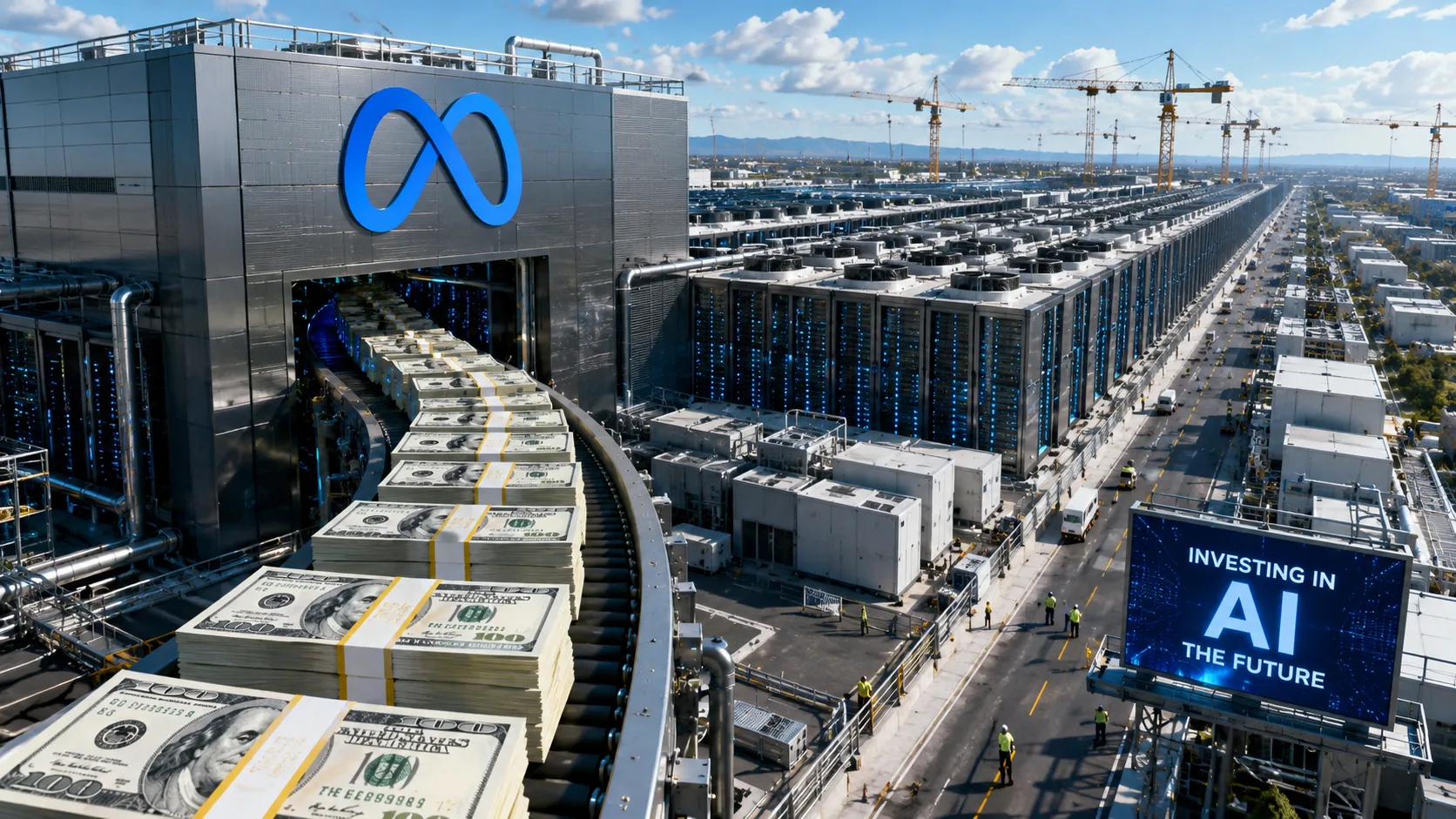
Meta’s AI ambitions just got dramatically more expensive, and investors aren’t celebrating.
Shares of Meta Platforms (NASDAQ: META) plunged nearly 10% after the company unveiled another massive increase in artificial intelligence spending, raising fresh concerns that CEO Mark Zuckerberg is spending billions faster than the company can prove it can earn them back.
The selloff highlights a growing shift on Wall Street. Investors are no longer rewarding Big Tech simply for investing in AI. They now want evidence those investments will generate meaningful profits.
Key Takeaways
- Meta stock fell nearly 10% after earnings.
- The company increased 2026 capital spending guidance to $130 billion to $145 billion.
- Free cash flow collapsed to $784 million, down from $8.55 billion a year ago.
- Investors want proof Meta can monetize AI beyond its advertising business.
- Operating margins continue to shrink as AI infrastructure costs soar.
Meta’s AI Spending Keeps Getting Bigger
Meta has been among the most aggressive companies in the AI race, investing heavily in custom chips, data centers, AI talent, and next-generation models.
Following its latest earnings report, the company increased its projected 2026 capital expenditures to between $130 billion and $145 billion, well above previous guidance.
Chief Financial Officer Susan Li said demand for computing power remains so strong that Meta is still constrained by available capacity.
Rather than slowing investment, management indicated the company expects to continue expanding its AI infrastructure as quickly as possible.
For investors, however, one question keeps getting louder:
When will all this spending start generating meaningful returns?
Free Cash Flow Just Fell Off a Cliff
The biggest surprise wasn’t simply how much Meta plans to spend.
It was how quickly that spending is affecting the company’s financial flexibility.
Meta reported second-quarter free cash flow of just $784 million, compared with $8.55 billion during the same quarter last year.
That’s an extraordinary decline for one of the world’s largest technology companies.
Free cash flow is often viewed as one of the clearest indicators of financial strength because it represents the cash left after funding operations and capital investments.
While Meta remains enormously profitable, investors are watching that cushion shrink rapidly.
Wall Street Wanted More Than Promises
Analysts generally agree Meta’s core advertising business remains healthy.
The problem is that investors increasingly believe advertising alone isn’t enough to justify hundreds of billions of dollars in AI investment.
Evercore ISI analyst Mark Mahaney noted that investors were disappointed by the lack of clarity surrounding Meta’s AI roadmap beyond 2026.
Management discussed larger and more advanced AI models but stopped short of providing measurable milestones or revenue expectations.
That uncertainty left many investors wondering whether spending is accelerating faster than monetization.
Meta Passed on an Easier Way to Make Money
One of Wall Street’s biggest disappointments came from what Meta isn’t doing.
Before earnings, many investors expected Meta to launch a cloud-computing business similar to those operated by Microsoft, Amazon Web Services, or Google Cloud.
Instead, Zuckerberg said Meta intends to prioritize using its computing infrastructure internally to power its own AI products rather than renting excess capacity to outside customers.
The decision could ultimately prove more profitable if Meta successfully builds dominant AI services.
But in the near term, it delays what many analysts viewed as an obvious source of revenue that could have helped offset soaring infrastructure costs.
Margins Continue Moving Lower
Another concern is profitability.
Meta’s operating margin fell to 31%, down sharply from 43% a year earlier.
Management attributed part of the decline to legal expenses and severance costs, but analysts also pointed to rising depreciation expenses and the growing cost of Meta’s Superintelligence Labs initiative.
The trend reflects a broader transformation occurring across the technology sector.
For years, Meta generated exceptional profits with relatively modest capital requirements.
Now the company is becoming significantly more asset-intensive as AI infrastructure replaces software as its biggest investment priority.
Meta’s Core Business Still Looks Strong
Despite the stock’s sharp decline, analysts emphasized that Meta’s advertising engine continues performing well.
The company’s AI-powered advertising tools appear to be improving engagement and helping advertisers generate stronger returns.
Meta also reported that its newly launched Meta Business Agents now serve more than 1 million monthly business users.
However, those products remain too new for investors to determine whether they will become meaningful revenue drivers.
Personal AI agents, another major initiative, are still under development.
For now, Wall Street sees plenty of potential, but very little proof.
Why Investors Are Becoming More Demanding
The reaction to Meta’s earnings reflects a broader shift taking place across the AI industry.
Over the past two years, investors largely rewarded companies simply for announcing aggressive AI investments.
That phase appears to be ending.
Today, markets increasingly want answers to tougher questions:
- How quickly will AI investments generate profits?
- Can companies create entirely new revenue streams?
- Will returns justify hundreds of billions in capital spending?
Meta remains one of the world’s strongest technology companies, but investors are signaling that future AI spending alone is no longer enough to support premium valuations.
The Bottom Line
Meta isn’t being punished because its business is weak.
It’s being punished because expectations have become extraordinarily high.
The company is asking investors to support one of the largest AI spending programs in corporate history while offering relatively little visibility into when those investments will meaningfully boost profits outside of advertising.
If Zuckerberg’s long-term vision proves correct, today’s concerns could eventually look short-sighted.
But until Meta demonstrates that its massive AI investments can translate into substantial new cash flow and revenue streams, Wall Street appears unwilling to give the company the benefit of the doubt.
About Author