
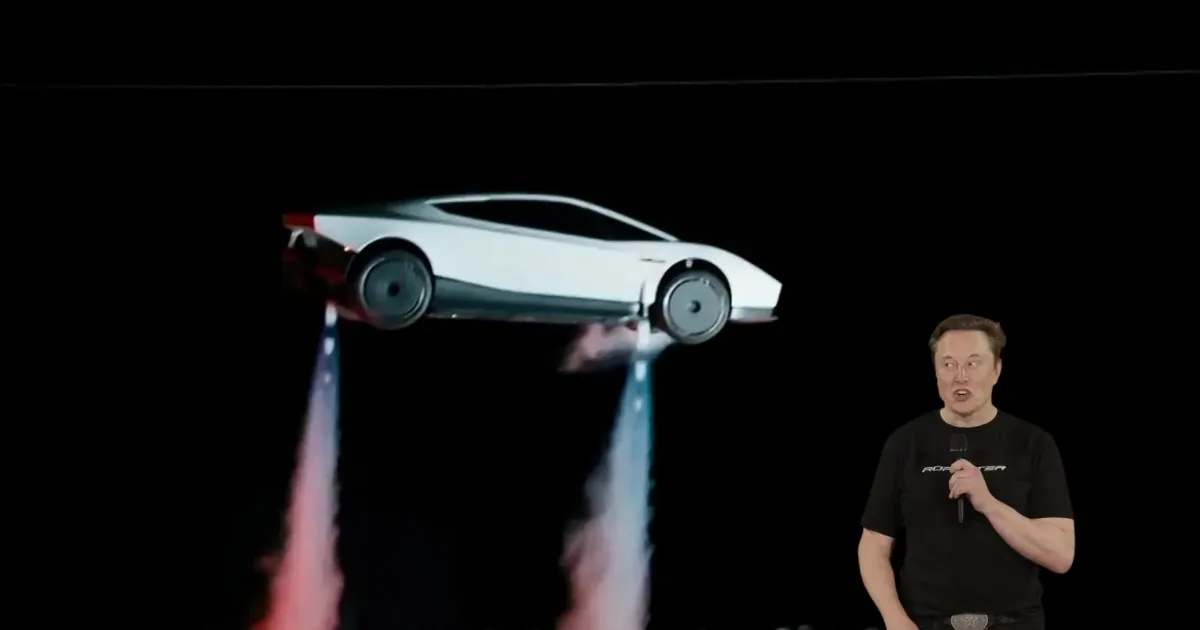
Tesla’s redesigned Roadster briefly left the ground during a dramatic demonstration Thursday night. The collaboration that made it possible is adding momentum to a much larger investment story: the possibility that Elon Musk could combine Tesla and SpaceX.
The October 15 event at SpaceX’s testing facility in McGregor, Texas, brought engineers from both companies together to showcase a car equipped with compressed-air thrusters. It drove upside down, performed airborne maneuvers and landed on its wheels.
For shareholders, a potential merger would carry far greater consequences than sales of an expensive sports car. CNBC puts SpaceX’s market value at approximately $2 trillion and Tesla’s at about $1.4 trillion, illustrating the enormous scale of a possible combination.
A merger remains speculation. Neither company has announced an agreement. The Roadster demonstrates that the businesses can develop technology together; it does not establish that a transaction is being negotiated.
What Tesla Demonstrated
The redesigned Roadster uses two systems to perform its unusual maneuvers. A suction system helped hold the car against a curved ramp, while cold-gas thrusters enabled it to leave the surface and maneuver briefly in the air.
Tesla also demonstrated acceleration from zero to 60 mph in less than a second. Those results came from a company presentation, rather than independent testing of a production vehicle.
Musk credited the project to close collaboration between Tesla and SpaceX engineers. The demonstration put that relationship on public display, with aerospace technology incorporated into a Tesla vehicle.
Production remains targeted for 2028. Final pricing was not announced.
Why the SpaceX Connection Matters
According to CNBC, Musk’s companies have worked together for years, paying one another for services and sometimes sharing personnel. Their cooperation has increased during 2026, while SpaceX’s June stock-market debut has intensified speculation about a corporate combination.
SpaceX Chief Operating Officer Gwynne Shotwell previously told CNBC that a merger “might make Elon’s life a little easier.” More recently, Barclays analyst Dan Levy suggested an announcement could arrive before the end of 2026.
Separate reporting on Levy’s analysis describes a possible announcement ahead of Tesla’s annual shareholder meeting. That is an analyst’s forecast, rather than a timetable issued by either company.
The Roadster adds a visible example to the argument for closer integration. Engineers from the two businesses combined technologies to produce something Tesla could present as a distinctive advantage.
That strengthens the case that cooperation has practical benefits. Whether common ownership would deliver enough additional value to justify a merger is a separate question.
A Combination Would Be Much Bigger Than a New Car
Using CNBC’s approximate market values, Tesla and SpaceX together represent around $3.4 trillion in equity value. That figure is the sum of two market capitalizations, not an announced transaction price or a prediction of what a combined business would be worth.
A deal could put Tesla’s vehicles, energy operations, autonomy and robotics initiatives alongside SpaceX’s launch and communications businesses under one corporate structure.
The potential appeal would be broader than installing aerospace equipment in a sports car. Shared engineering, manufacturing expertise and investment planning could become easier to coordinate.
However, collaboration already occurs without a merger. A transaction would need to offer benefits beyond what the companies can accomplish through their existing arrangements.
What Shareholders Could Gain
A combination could give investors exposure to a broader collection of businesses and technologies. It could also simplify some decisions involving projects that benefit both companies.
If common ownership reduced duplicated spending or accelerated commercially useful development, that could create value over time. Those benefits would need to show up in execution, revenue or cash flow.
What Shareholders Would Need to Examine
The terms would matter enormously. The relative valuations assigned to Tesla and SpaceX would determine how ownership was divided in any stock-based transaction.
Investors would also need to assess spending commitments, debt, management priorities and voting rights. A larger company could offer more opportunities while requiring shareholders to finance a wider range of ambitious projects.
Musk’s role at both businesses would make the process particularly important. Independent evaluation of the terms and a clear explanation of the benefits for each shareholder group would deserve close attention.
A combined company’s size would attract headlines. The ownership terms and future returns would determine whether it was a good deal.
What Buyers Can Actually Reserve
The Roadster itself remains a developing product with several configurations.
Reuters reported that Tesla’s reservation page showed a $50,000 deposit for the Performance version and $250,000 for the Thrust version, which adds acceleration thrusters. The single-seat Rocket configuration, with its fuller airborne capabilities, is invitation only.
Those amounts are reservation payments, rather than confirmed vehicle prices.
Tesla’s U.S. agreement, dated October 15, says the final price depends on a configuration that is still being developed. It also makes clear that a reservation establishes approximate ordering priority and does not constitute a vehicle purchase.
The company does not guarantee when a reserved vehicle will be delivered or whether it will be delivered. Reservations can be canceled for a full refund before customers complete their configuration after Tesla invites them to proceed.
Friday’s FAA Clarification
Reporting published Friday added an important detail to the early “flying car” coverage.
An FAA spokesperson told Business Insider: “The Tesla vehicle does not meet the FAA’s definition of an aircraft.” That statement does not establish public-road approval. Tesla lists the invitation-only Rocket configuration as not approved for public road use.
The demonstration showed brief airborne maneuvers in a controlled setting. It did not establish that customers will be able to fly over traffic or use those capabilities on ordinary streets.
The Next Test Comes With Earnings
Tesla shares initially rose nearly 5% in premarket trading Friday, although the gain narrowed after the market opened. Forbes reported shares up approximately 1.5% shortly after 10 a.m. Eastern, a timestamped morning snapshot rather than a live quote.
The Roadster gives Tesla an attention-grabbing showcase for its engineering. A high-end, low-volume car can strengthen a brand even when its direct contribution to earnings is modest.
The merger possibility raises the stakes considerably. It could change what Tesla shareholders own, how capital is allocated and how much influence they have over the resulting business.
Tesla’s October 21 earnings report is the next scheduled opportunity for investors to hear management’s outlook. Any substantive comments about SpaceX cooperation would attract attention, while an actual merger proposal would require formal disclosures and specific terms.
For now, the demonstrated engineering partnership is real. A corporate combination remains a possibility that needs evidence beyond a spectacular product launch.
About Author