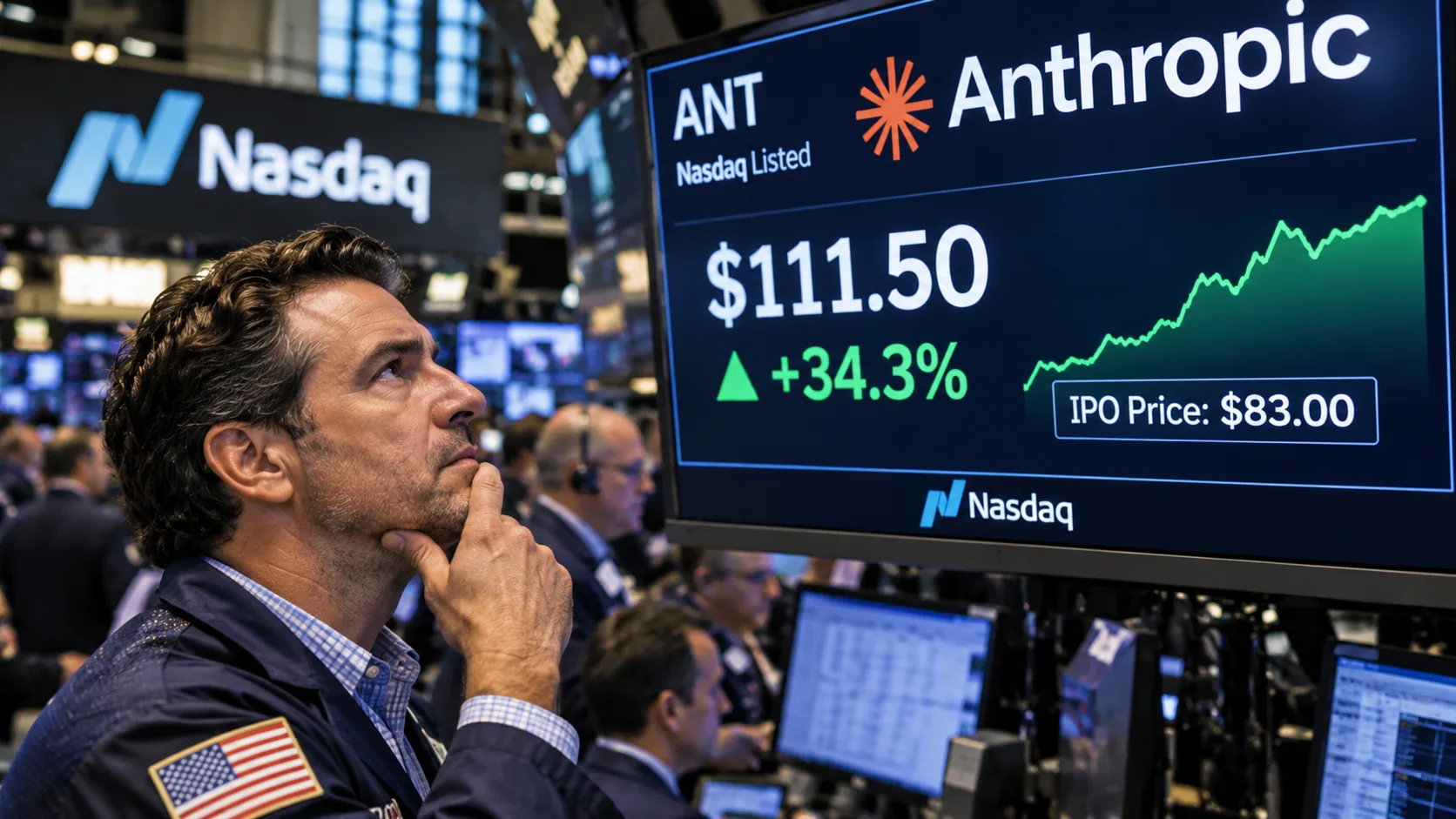


Wall Street’s AI-fueled bull market is facing one of its biggest tests in years. As the Nasdaq wipes out its gains for 2026 and Anthropic’s historic IPO quickly turns into a selloff, investors are beginning to question whether the technology stocks that powered the market higher can continue delivering.
The Nasdaq Composite has erased its gains for 2026 in Friday’s trading, while shares of artificial intelligence giant Anthropic have plunged roughly 10%, wiping out most of the excitement surrounding the largest initial public offering in history. The sudden reversal is raising an increasingly uncomfortable question on Wall Street: Has the artificial intelligence investment boom finally run out of momentum?
The selloff comes just one day after Global Market News published an article warning that buying Anthropic immediately after its historic IPO could be a costly mistake. On Thursday, we examined why investors chasing the stock’s 34% opening surge could be exposing themselves to significant downside risk. Less than 24 hours later, much of that initial premium had disappeared.
But what makes Friday’s decline particularly concerning is what is happening across the broader stock market. Nvidia, AMD and other major technology companies are falling sharply, while the S&P 500 has reached correction territory during intraday trading. Meanwhile, investors are increasingly looking toward healthcare, financials and industrial companies for opportunities outside the AI sector.
The developments suggest Wall Street may be entering a different phase of the bull market, one in which earnings, valuations and financial strength matter more than enthusiasm surrounding artificial intelligence.
The Nasdaq Just Erased an Entire Year’s Gains
Friday’s selloff has pushed the technology-heavy Nasdaq Composite into negative territory for 2026 during intraday trading, a remarkable reversal for an index that has benefited enormously from investor enthusiasm surrounding artificial intelligence.
The selling has also pushed the S&P 500 approximately 10% below its October record high, the threshold commonly used to define a market correction. The Dow Jones Industrial Average has experienced significant volatility as investors reassess the outlook for corporate earnings, interest rates and technology spending.
The damage has been particularly severe among companies closely connected to the AI industry.
Nvidia, the semiconductor giant that has become synonymous with the artificial intelligence boom, has suffered substantial losses. Advanced Micro Devices, Broadcom and other chipmakers have also come under pressure as investors question whether the extraordinary pace of AI infrastructure investment can continue indefinitely.
The decline is especially notable because it follows two events that many investors expected would restore confidence in the sector: Nvidia’s latest earnings report and Anthropic’s long-awaited public market debut.
Instead, the selling has accelerated.
That suggests investors are becoming increasingly concerned about something more fundamental than the latest quarterly earnings results. Wall Street is beginning to question how much future growth has already been reflected in technology stock valuations, and whether the financial returns from artificial intelligence will justify the enormous amounts being invested.
Anthropic’s Historic IPO Turns Into a Warning Sign
Anthropic’s public market debut on Thursday, November 19, was supposed to be a defining moment for the artificial intelligence industry.
The company behind the Claude AI platform priced its initial offering at $83 per share, raising approximately $81 billion in the largest IPO on record. Investor demand was extraordinary, with shares opening at $111.50, representing a 34.3% premium to the offering price.
At that opening price, Anthropic briefly commanded an implied valuation exceeding $2 trillion, placing it among the most valuable companies in the world.
The enthusiasm faded almost immediately.
Shares retreated throughout Thursday’s session, eventually closing at $97.17. By Friday morning, the stock had fallen to approximately $87.90, and subsequent intraday reports showed even deeper declines.
For investors who purchased shares at Thursday’s opening price, the losses have been substantial.
An investor who purchased 100 shares at Thursday’s opening price of $111.50 would have spent $11,150. At Friday’s early price of $87.90, those shares would be worth $8,790, representing a paper loss of $2,360 in approximately one day.
For investors who obtained shares at the original $83 offering price, the stock remained modestly profitable at that point. Those who chased the opening-day surge have experienced a very different outcome.
This is precisely the risk that Global Market News highlighted Thursday. Even when a company has extraordinary growth prospects, paying an inflated price during a wave of investor enthusiasm can dramatically reduce future returns.
Anthropic may still become one of the most successful technology businesses of the next decade. Its volatile opening sessions demonstrate how quickly the market can reassess what investors should pay for that potential.
Why the AI Trade Is Suddenly Losing Support
For much of the past four years, artificial intelligence has been the dominant investment theme on Wall Street.
The launch of increasingly sophisticated AI systems generated enormous interest in the companies developing advanced models, manufacturing semiconductors and building the infrastructure needed to support the technology.
Investors poured money into Nvidia, Microsoft, Alphabet, Amazon, Meta and other technology leaders. Their rising valuations helped drive major stock indexes higher, creating extraordinary wealth for shareholders.
According to Goldman Sachs research cited in recent market analysis, AI-related companies accounted for nearly half of the S&P 500’s gains since the AI-driven bull market began in late 2022. Nvidia alone contributed approximately 10% of the index’s total return during that period.
That concentration has become a significant source of vulnerability.
When a relatively small group of companies accounts for such a large percentage of market gains, declining enthusiasm for those businesses can have an outsized impact on major stock indexes.
Now investors are beginning to question whether the AI industry’s financial performance can continue supporting the valuations that developed during the boom.
The Growing Concern Over AI Spending
Perhaps the biggest issue is the extraordinary amount of capital being committed to artificial intelligence.
Major technology companies are spending hundreds of billions of dollars on data centers, advanced semiconductors, electricity infrastructure and other equipment required to develop and operate increasingly powerful AI models.
Those investments have created enormous demand for Nvidia’s chips and the services of other technology infrastructure providers.
However, the scale of the spending raises questions about profitability.
Companies must eventually generate enough revenue from AI applications and services to recover their investments while producing attractive returns for shareholders. If that revenue develops more slowly than anticipated, investors could begin questioning the economics of the entire industry.
Anthropic provides a useful example.
The company reported approximately $17 billion in third-quarter revenue, up from $1.4 billion during the same period a year earlier. That represents extraordinary growth, but Anthropic also reported an operating loss of approximately $567 million for the quarter.
Those figures illustrate both the opportunity and the challenge facing the AI industry. Revenue can grow at an exceptional pace while the cost of developing and operating advanced technology remains substantial.
At valuations measured in the trillions of dollars, investors are effectively betting that companies will maintain rapid expansion while eventually generating significant profits.
Even modest disappointments can become costly when stock prices already reflect years of optimistic expectations.
The Bigger Story: Investors Are Moving Beyond AI
While technology stocks have suffered, several other areas of the market have demonstrated considerably greater strength.
Healthcare, financial services and selected industrial companies have attracted increased attention as investors seek businesses with established earnings, strong balance sheets and less direct exposure to the artificial intelligence spending cycle.
The divergence is evident in recent sector performance.
According to the supplied market analysis, the iShares U.S. Technology ETF declined approximately 13% over the preceding six months. During that same period, the iShares U.S. Healthcare ETF gained roughly 21%, while the iShares U.S. Financials ETF advanced approximately 4%.
The difference is striking. While investors have been selling technology shares, money has continued flowing into businesses that were largely overshadowed during the AI boom.
The changing market leadership is also appearing in corporate earnings.
JPMorgan recently highlighted that third-quarter earnings growth among the Magnificent Seven fell below the growth rate of the remaining S&P 500 companies for the first time since 2022, according to the supplied analysis.
This is an important development because it suggests the broader market may be becoming less dependent on a handful of technology giants.
If earnings growth continues expanding across additional industries, the next phase of the bull market could be driven by a much wider group of companies.
For investors, identifying those emerging leaders may become increasingly important heading into 2027.
Four Sectors Investors Are Watching Instead
1. Healthcare: Strong Earnings and Long-Term Demand
Healthcare has emerged as one of the strongest alternatives to the technology sector.
Companies such as Johnson & Johnson and Eli Lilly have attracted attention because of their established businesses, pharmaceutical pipelines and exposure to long-term healthcare demand.
Johnson & Johnson has demonstrated notable relative strength during 2026, while Eli Lilly continues benefiting from investor interest in its pharmaceutical portfolio, including treatments for obesity and diabetes.
The broader healthcare industry also benefits from demographic trends, particularly the aging population and demand for medical services.
These characteristics can make selected healthcare companies attractive during periods when investors become less willing to pay premium valuations for speculative growth.
However, investors must still consider individual company valuations, competitive pressures, regulatory risks and the sustainability of earnings growth. Strong recent performance does not automatically mean a stock represents an attractive purchase at its current price.
2. Financials: Established Businesses With Diversified Revenue
Financial companies are another area receiving increased attention.
JPMorgan Chase, Goldman Sachs and Morgan Stanley have been identified by several market strategists as potential opportunities for investors seeking exposure to established businesses with diversified revenue streams.
Large financial institutions generate income through lending, investment banking, trading, asset management and other services. Their performance is influenced by interest rates, economic activity and credit conditions, giving them different earnings drivers from the technology sector.
Financial exchanges may be particularly interesting during periods of heightened market volatility.
CME Group, Cboe Global Markets and Intercontinental Exchange operate trading platforms and financial infrastructure that can benefit from increased transaction activity and demand for risk-management services.
These businesses face their own risks, including changes in trading volumes, competition and regulatory requirements. Nevertheless, they provide investors with exposure to financial market activity without requiring a direct bet on continued AI spending.
3. Industrials: Infrastructure Investment Extends Beyond AI
Industrial companies involved in electricity generation, grid modernization and critical infrastructure are also attracting attention.
GE Vernova is one example of a business positioned to benefit from growing demand for power equipment and electricity infrastructure.
Artificial intelligence is contributing to that demand, particularly as data centers require increasing amounts of electricity. But industrial investment is also being supported by manufacturing expansion, aging infrastructure and efforts to improve energy reliability.
This creates opportunities that extend beyond the immediate performance of AI software and semiconductor companies.
For investors, companies with established customers, durable order backlogs and strong competitive positions may offer exposure to long-term infrastructure investment without relying entirely on continued enthusiasm for technology stocks.
4. Consumer Stocks: Could the Biggest Losers Become Opportunities?
Some market strategists are also looking at companies that have already experienced significant declines.
Nike and Lululemon have suffered substantial stock market losses during 2026 as investors reassess consumer spending, competition and future earnings growth.
Such declines can eventually create opportunities if stock prices fall further than the deterioration in a company’s long-term business prospects would justify.
However, successful turnaround investing requires careful analysis.
Investors must distinguish between companies facing temporary challenges and those experiencing permanent changes in their competitive position. A stock that has fallen 50% can still decline further if sales, profit margins or customer demand continue weakening.
For patient investors, though, businesses that successfully stabilize operations and return to earnings growth could eventually offer opportunities outside the crowded AI trade.
Could the AI Selloff Actually Strengthen the Bull Market?
One of the more interesting possibilities is that the recent decline in technology stocks could eventually produce a healthier stock market.
Over the past several years, a relatively narrow group of companies has accounted for an unusually large share of market returns. That concentration rewarded investors who held the biggest technology winners, but it also increased the market’s vulnerability to disappointing results from a handful of businesses.
A broader market supported by earnings growth across healthcare, financials, industrials and consumer companies could create a more diversified foundation for future gains.
There are already signs that this transition is developing.
The equal-weighted version of the S&P 500, which gives each company the same influence regardless of market capitalization, has outperformed the traditional capitalization-weighted index during 2026, according to the supplied market analysis.
Value-oriented stocks have also performed relatively well compared with growth-focused investments, suggesting investors are becoming more interested in established earnings and reasonable valuations.
This creates an important distinction for investors.
The AI industry could continue growing rapidly while some of its highest-valued stocks deliver disappointing returns. Meanwhile, companies outside the technology sector could generate attractive gains as earnings improve and investors direct capital toward previously overlooked opportunities.
Of course, that scenario depends on the broader economy remaining relatively healthy. A severe economic downturn could undermine earnings growth across multiple industries, limiting the benefits of moving away from technology stocks.
Still, the possibility of a change in market leadership deserves attention, particularly after years of unusually concentrated gains.
Three Signals That Will Determine What Happens Next
Investors trying to understand whether Friday’s selloff represents a temporary correction or a lasting shift in market leadership should focus on three developments.
1. Can Anthropic Stabilize Above Its IPO Price?
Anthropic’s original $83 offering price has become an important reference point.
If shares stabilize near that level and begin attracting sustained buying interest, it could indicate that investors remain confident in the company’s long-term prospects despite the opening-day volatility.
A sustained decline below the offering price would suggest that market participants are reassessing the company’s valuation more aggressively. Investors should also watch trading volumes and the company’s first public earnings reports for evidence of changing sentiment.
2. Will Technology Stocks Regain Their Leadership?
The performance of Nvidia, Microsoft, Amazon, Alphabet and other major technology companies will help determine whether the AI trade can recover.
If semiconductor stocks stabilize and large technology companies continue delivering strong earnings growth, investors may become more confident that recent declines have created attractive valuations.
However, continued underperformance relative to healthcare, financials and industrials would strengthen the argument that investors are reallocating capital toward different areas of the market.
3. Can AI Companies Turn Massive Investment Into Sustainable Profits?
Ultimately, profitability will be one of the most important factors determining the industry’s long-term investment outlook.
Companies developing advanced AI systems must demonstrate that revenue growth can support the enormous cost of computing infrastructure, talent, research and operations.
At the same time, the technology giants financing AI expansion must show that these investments are producing measurable financial returns.
Investors will be watching future earnings reports for changes in capital expenditures, operating margins, free cash flow and management guidance.
If revenue growth begins slowing while spending remains elevated, valuations could face additional pressure. Stronger margins and improving cash generation, on the other hand, could help rebuild confidence in the sector.
Wall Street Still Sees Reasons for Optimism in 2027
Despite the recent volatility, there are reasons some strategists believe the broader bull market could continue into 2027.
Corporate earnings have generally remained resilient, with approximately 84% of S&P 500 companies reporting third-quarter results exceeding analyst expectations, according to FactSet data cited in the supplied analysis. That compares with a five-year average of 78%.
Stock valuations have also moderated as prices have declined, potentially creating opportunities for investors willing to take a longer-term view.
Goldman Sachs has maintained a constructive outlook for the broader market, with a reported S&P 500 target of 8,700 over the next 12 months. Such projections remain uncertain, particularly during periods of increased volatility, but they demonstrate that some major Wall Street institutions continue expecting earnings growth to support higher stock prices.
The composition of those gains may look considerably different from the past several years.
If earnings growth continues spreading beyond the technology sector, investors may find opportunities among businesses that received relatively little attention during the AI boom.
That would represent an important shift in how the market rewards companies.
Rather than simply favoring businesses associated with artificial intelligence, investors may increasingly prioritize sustainable profitability, strong financial positions and reasonable valuations.
Is the AI Trade Over?
Anthropic’s sharp reversal and the Nasdaq’s loss of its 2026 gains have exposed growing uncertainty surrounding Wall Street’s most influential investment theme.
For four years, artificial intelligence helped propel technology stocks to extraordinary heights. Investors rewarded companies developing advanced AI models, manufacturing semiconductors and building data centers with increasingly ambitious valuations.
Now that enthusiasm is facing a serious test.
Anthropic’s historic IPO demonstrated that demand for artificial intelligence exposure remains substantial. Its rapid decline also showed how quickly investors can reconsider the price they are willing to pay.
Meanwhile, the broader market is showing signs of a potentially significant transition as healthcare, financials, industrials and other sectors begin attracting more attention.
The AI industry’s long-term potential remains enormous, and companies that successfully commercialize the technology could continue generating substantial growth for years.
However, investors are becoming more selective about valuations, profitability and the financial risks associated with massive capital investments.
The biggest lesson from this week’s turmoil may be that the next stage of the bull market could reward a very different group of companies than the last one.
For investors, the challenge is determining which businesses can deliver sustainable earnings growth at prices that leave room for attractive future returns.
Anthropic’s first two trading sessions provide a powerful reminder that even the most exciting growth story can become a disappointing investment when expectations get too far ahead of reality.
About Author