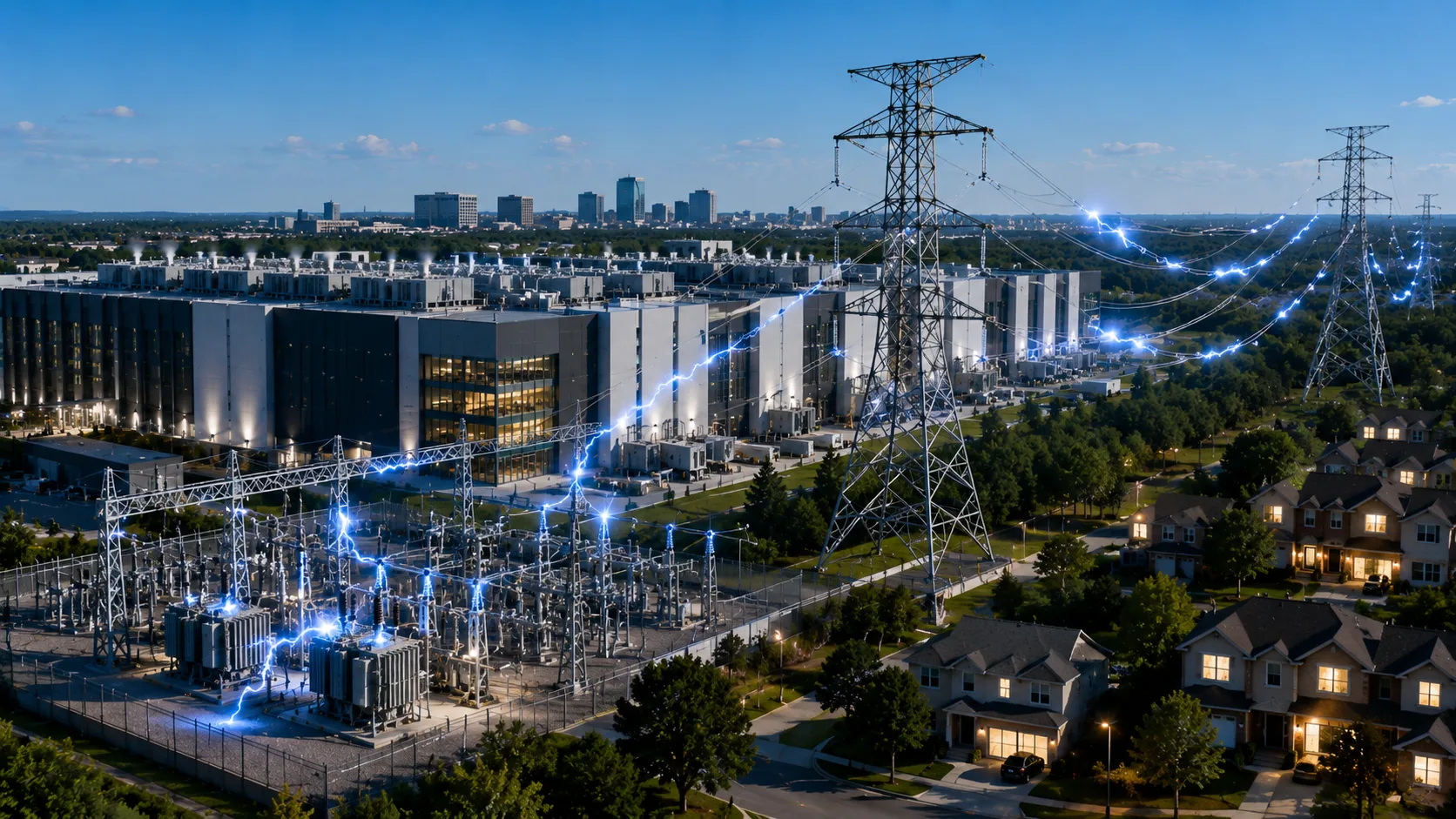
The northern Virginia data center disconnect that occurred on July 22 has become one of the clearest warnings yet that America’s AI boom is creating new challenges for the nation’s electric grid.
What began as a routine transmission fault quickly escalated into a regional power disturbance stretching nearly 1,000 miles, causing lights to flicker, appliances to behave erratically, and grid operators to scramble as more than 3 gigawatts of electricity demand disappeared almost instantly.
While no widespread blackouts occurred, the event exposed a growing vulnerability as massive AI data centers increasingly concentrate in Northern Virginia, the world’s largest data center market.
A Transmission Fault Triggered a Massive AI Data Center Disconnect
The incident began Wednesday morning when a transmission line fault occurred in Northern Virginia.
According to utility officials, the protective systems inside numerous AI data centers responded exactly as they were designed to do. Rather than remaining connected to the electrical grid during the disturbance, the facilities automatically switched to backup power.
That simultaneous response caused more than 3 gigawatts of electrical demand to disappear from the grid almost instantly.
For perspective, that’s enough electricity to power several mid-sized American cities.
The sudden change wasn’t caused by a lack of electricity. Instead, it created the opposite problem: far too much power was suddenly flowing through the grid after enormous consumers disconnected all at once.
The Disturbance Spread Nearly 1,000 Miles
The impact extended far beyond Virginia.
PJM Interconnection, the nation’s largest regional transmission organization, detected a significant frequency disturbance across its system, which serves approximately 67 million people from Washington, D.C., through the Mid-Atlantic and into the Midwest.
Meanwhile, Ting Labs reported that its network of 1.4 million power sensors detected voltage disturbances stretching from the Washington metropolitan area all the way to Chicago.
Unlike typical grid fluctuations that disappear in milliseconds, this event took roughly 10 minutes to fully stabilize.
Many homeowners reported:
- Lights briefly flickering
- Air conditioners struggling
- Refrigerators making unusual noises
- Short-lived voltage fluctuations
Although utilities did not issue blackout warnings, the event was noticeable across multiple states.
Why the Northern Virginia Data Center Disconnect Matters
The northern Virginia data center disconnect highlights a growing challenge created by AI infrastructure.
Most public discussion focuses on whether the United States can generate enough electricity to power AI.
This incident demonstrated another concern entirely.
When enormous electrical loads suddenly disappear, the grid temporarily becomes oversupplied.
That imbalance can trigger:
- Voltage spikes
- Frequency instability
- Equipment stress
- Regional power quality issues
A useful comparison is a crowded interstate where every vehicle slams on its brakes simultaneously. Even without a crash, the sudden change creates dangerous ripple effects throughout traffic.
Electric grids behave similarly.
This Isn’t the First Warning
Industry experts have been tracking this problem for several years.
In July 2024, approximately 60 Virginia data centers disconnected simultaneously after another grid disturbance, removing roughly 1,500 megawatts of demand almost instantly.
Grid operators narrowly avoided more serious cascading problems.
Following that incident, the North American Electric Reliability Corporation (NERC) established a dedicated task force to study how large data centers interact with the electrical grid.
Only two years later, the July 22 event occurred at more than double the previous scale.
The rapid growth of AI facilities means these challenges are increasing much faster than traditional grid planning anticipated.
AI Data Centers and Grid Operators Face Competing Priorities
The disagreement between utilities and data center operators is understandable.
Grid operators want large facilities to remain connected during minor disturbances so sudden demand swings don’t destabilize the system.
Data center owners have different priorities.
Allowing sensitive AI servers, networking equipment, and precision cooling systems to remain online during electrical faults could expose hundreds of millions of dollars worth of hardware to damage.
Both sides have valid concerns.
However, as AI campuses continue expanding toward gigawatt-scale electricity consumption, the existing approach becomes increasingly difficult to sustain.
Regulators Are Already Changing the Rules
Utilities and regulators are already responding.
NERC is developing mandatory modeling standards designed to better predict how hyperscale data centers behave during electrical disturbances.
High-resolution monitoring requirements are also under development to provide operators with greater real-time visibility into large commercial loads.
Meanwhile, PJM is pursuing regulatory changes that would shift more transmission and capacity costs directly onto data center developers rather than residential customers.
Several states, including Texas and Pennsylvania, are also evaluating policies that would allow utilities to reduce power to massive commercial users before affecting residential neighborhoods during grid emergencies.
In Virginia, Dominion Energy and major data center operators have already begun modifying facility control systems so they can remain connected during brief transmission faults instead of automatically disconnecting.
AI’s Power Appetite Is Becoming an Investor Story
The northern Virginia data center disconnect is more than an isolated engineering event.
It illustrates how AI infrastructure is beginning to reshape energy markets, utility regulation, and future electricity costs.
Northern Virginia has become the global epicenter of cloud computing and AI infrastructure, with new campuses consuming unprecedented amounts of electricity.
As AI adoption accelerates, investors should expect increasing attention on:
- Electric utilities
- Grid modernization spending
- Transmission infrastructure
- Nuclear and natural gas generation
- Data center construction
- Power equipment manufacturers
The companies supplying electricity may become just as important as the companies building artificial intelligence.
The Bottom Line
The July 22 northern Virginia data center disconnect exposed a weakness that few consumers realize exists.
A single transmission fault caused multiple AI data centers to disconnect simultaneously, instantly removing more than 3 gigawatts of demand and creating voltage disturbances that spread nearly 1,000 miles across the eastern United States.
No major outages occurred this time.
But as AI data centers continue growing larger and more concentrated, utilities, regulators, and technology companies face mounting pressure to redesign how America’s electrical grid handles the enormous power demands of artificial intelligence.
The infrastructure powering AI has largely remained invisible to consumers. After this event, it may become one of the most closely watched parts of the U.S. economy.
About Author