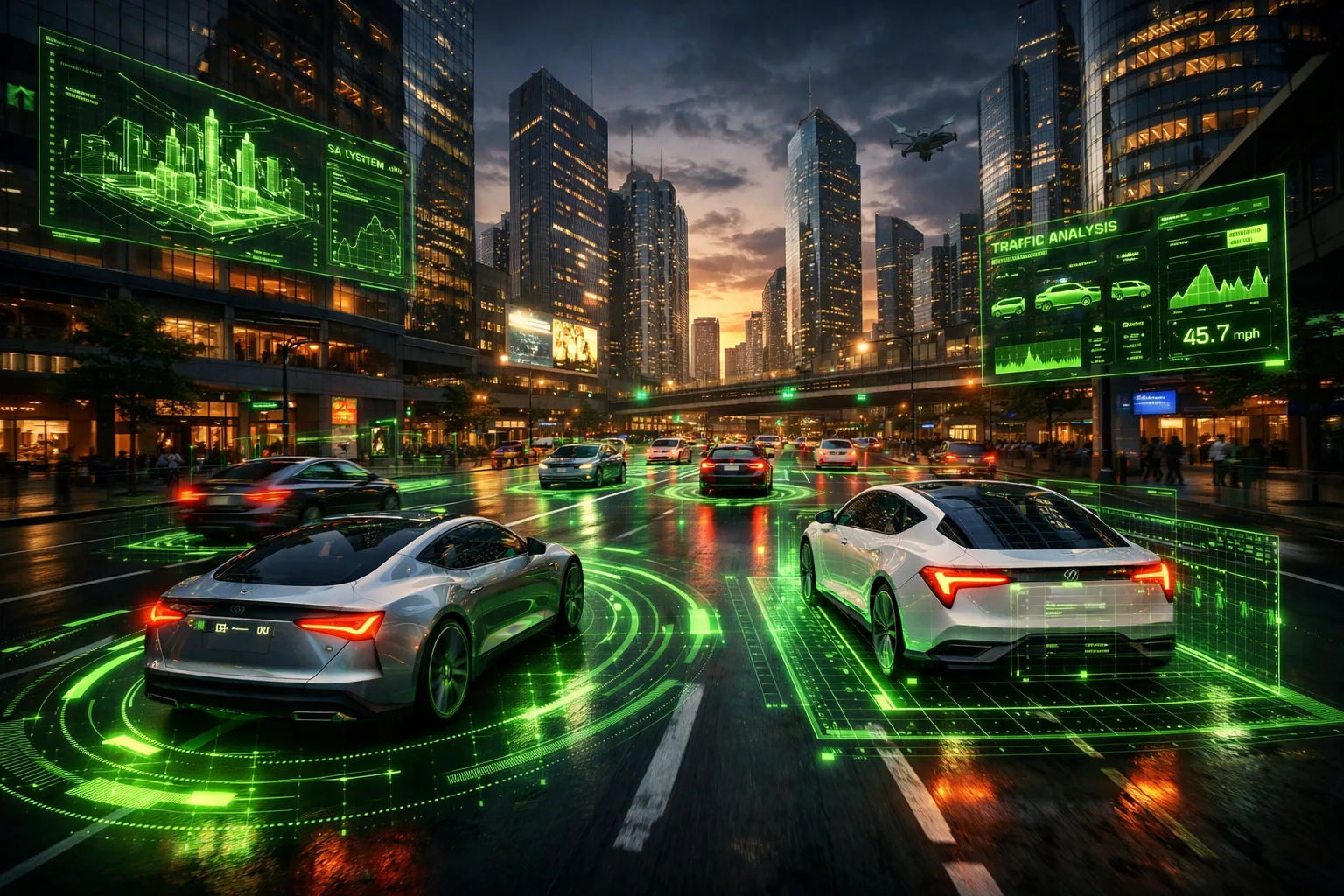
Nvidia is making a decisive move to dominate the next frontier of artificial intelligence by expanding its autonomous vehicle partnerships with some of the world’s largest automakers.
The chip giant announced new agreements with Hyundai Motor, Nissan Motor, Isuzu, China’s BYD, and Geely, signaling that the race toward fully autonomous vehicles is accelerating after years of stalled progress and high-profile setbacks.
For investors, this is not just another partnership announcement. It is a clear signal that Nvidia is positioning itself at the center of what could become a multitrillion dollar industry.
Nvidia’s Big Bet on Autonomous Driving
At the core of these new partnerships is Nvidia’s Drive Hyperion platform, a full-stack system designed to power advanced driver assistance and fully autonomous driving capabilities.
Drive Hyperion combines several critical components into a single ecosystem:
- AI chips for in-vehicle computing
- Data center infrastructure for model training
- Simulation tools for testing autonomous systems at scale
- Software for real-time decision making
This end-to-end approach is what differentiates Nvidia from many competitors. Instead of building cars, Nvidia is building the underlying intelligence layer that automakers can plug into their vehicles.
The goal is clear. Become the operating system for the autonomous driving era.
“The ChatGPT Moment” for Self-Driving Cars
Nvidia CEO Jensen Huang made a bold statement at the company’s GTC conference that reflects just how confident the company is in this transition.
“We’ve been working on self-driving cars for a long time. The ChatGPT moment of self-driving cars has arrived,” Huang said. “We now know we could successfully autonomously drive cars, and today, we are announcing four new partners for Nvidia’s robotaxi-ready platform. … The number of robotaxi-ready cars in the future are going to be incredible.”
That comparison is not accidental.
Just as generative AI exploded into the mainstream after years of development, Nvidia believes autonomous driving is now approaching a similar tipping point where the technology is finally ready for large-scale deployment.
What Level 4 Autonomy Actually Means
The new partnerships specifically focus on Level 4 autonomous vehicles, which represent a major leap beyond what consumers experience today.
Level 4 systems are capable of driving without human input under defined conditions, such as within certain geographic areas or controlled environments. This is the level typically associated with robotaxi services.
By contrast:
- Most vehicles on the road today operate at Level 2 autonomy
- Drivers must remain fully engaged and ready to take control
- Systems like Tesla’s Full Self-Driving still require supervision
This gap between current consumer vehicles and true autonomy is exactly where Nvidia sees its opportunity.
Why Automakers Are Turning to Nvidia
The automotive industry is undergoing a fundamental transformation, and traditional car companies are increasingly relying on technology partners to stay competitive.
Developing autonomous systems internally is:
- Extremely expensive
- Technically complex
- Time-intensive
By partnering with Nvidia, automakers can accelerate development timelines while leveraging cutting-edge AI infrastructure that would be difficult to replicate in-house.
The addition of Hyundai, BYD, and Geely is especially significant because it expands Nvidia’s reach across both Western and Asian markets, including the fast-growing Chinese EV sector.
Existing Partnerships Strengthen Nvidia’s Position
These new deals build on an already impressive roster of partners using Nvidia’s autonomous vehicle platform.
Current collaborators include:
- Aurora and Nuro in the self-driving startup space
- Sony and Stellantis on consumer-facing vehicle integration
- Uber, which continues to explore autonomous ride-hailing
- Lucid Group in the premium EV segment
This growing ecosystem creates a powerful network effect. As more companies adopt Nvidia’s platform, it becomes increasingly difficult for competitors to displace.
The Competitive Landscape Is Still Wide Open
Despite years of hype, fully autonomous driving has not yet reached mass adoption.
Several major players are still competing for leadership:
- Waymo remains the most advanced operator with active robotaxi fleets
- Tesla continues to push its vision-based approach to autonomy
- Amazon-backed Zoox is developing purpose-built robotaxis
- Uber is attempting to re-enter the space after earlier setbacks
Meanwhile, General Motors shut down its Cruise robotaxi operations after spending more than $10 billion, following safety controversies that damaged public trust.
That failure highlights a critical point for investors. This industry is still high risk, with massive capital requirements and regulatory hurdles.
But it also reinforces why companies like Nvidia, which sell the underlying technology rather than operate fleets, may have a more attractive risk profile.
Why This Matters for Nvidia’s Growth Story
Nvidia’s explosive growth over the past two years has been driven largely by demand for AI chips in data centers.
However, long-term investors are increasingly asking a key question:
What comes next?
Autonomous vehicles could be one of the most important answers.
The AV market is widely projected to become a multitrillion dollar opportunity over time, spanning:
- Ride-hailing services
- Logistics and delivery
- Personal transportation
- Smart city infrastructure
By embedding its technology into vehicles across multiple manufacturers, Nvidia is positioning itself to capture value across the entire ecosystem.
AI Is the Missing Piece That Changes Everything
One of the biggest reasons autonomous driving struggled in the past was the limitation of earlier software systems.
Today, AI has changed the equation.
Modern neural networks can:
- Process vast amounts of sensor data in real time
- Improve continuously through training
- Adapt to complex, unpredictable environments
This is why many analysts now believe autonomous vehicles are closer to widespread adoption than at any point in the past decade.
Nvidia sits at the center of this shift, supplying the computational power needed to make it all work.
Investor Takeaways
For investors, Nvidia’s latest expansion into the autonomous vehicle space reinforces several key themes:
- Nvidia is not just an AI chip company
It is becoming a foundational infrastructure provider across multiple industries. - Autonomous driving is back on track
After years of delays and setbacks, the technology is gaining momentum again. - Platform strategy creates long-term upside
By enabling multiple automakers rather than competing with them, Nvidia can scale more efficiently. - Risk remains, but the payoff could be massive
The AV market is still uncertain, but the potential rewards are enormous.
The Bottom Line
Nvidia’s new partnerships with Hyundai, BYD, Geely, and others are more than just incremental deals.
They represent a strategic push to dominate one of the most important technological shifts of the next decade.
If autonomous driving finally reaches mass adoption, Nvidia may not just participate in that growth. It could help define it.
About Author