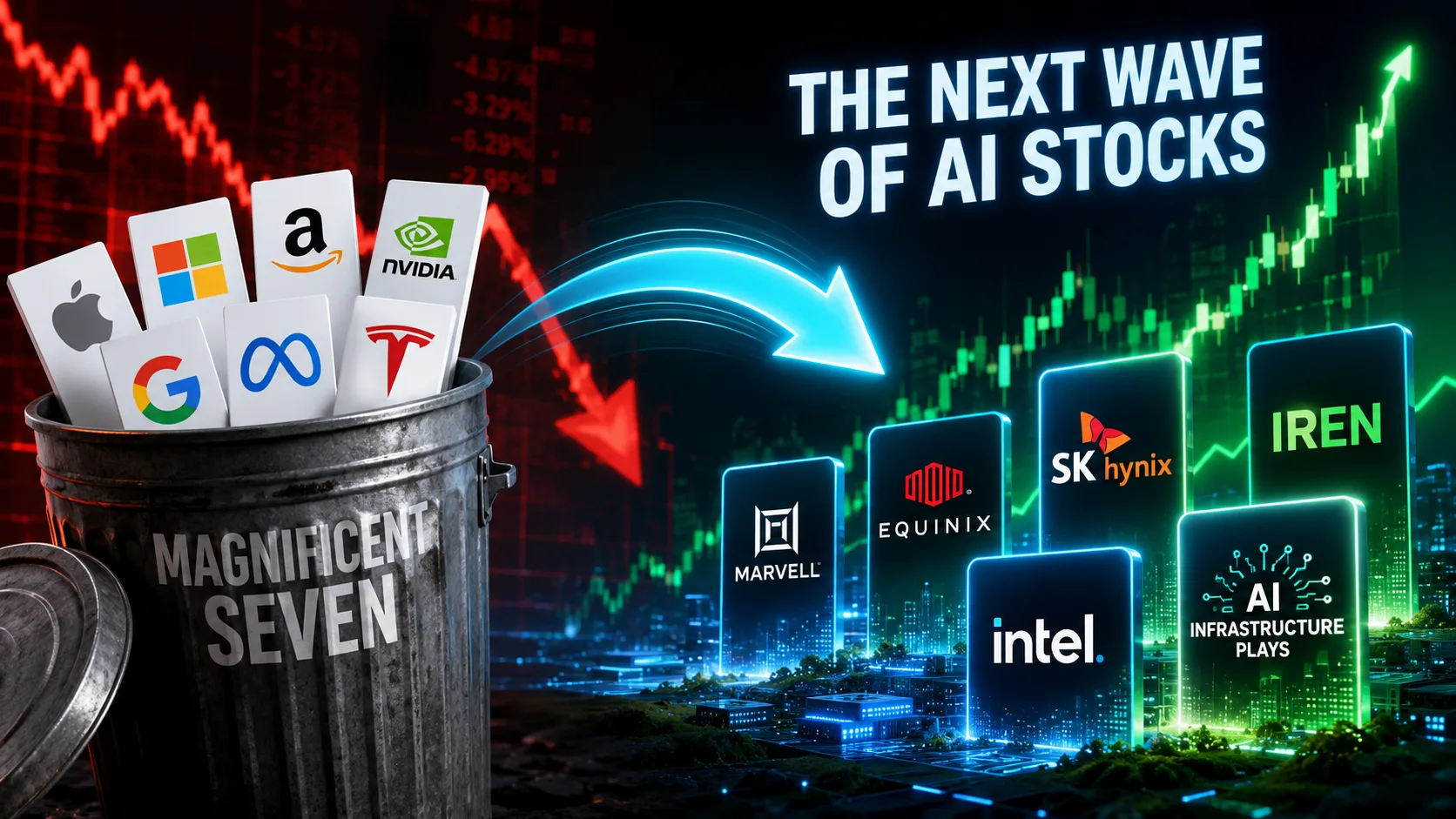
For years, the Magnificent Seven dominated both Wall Street and Main Street portfolios. Stocks like Nvidia, Microsoft, Apple, Amazon, Alphabet, Meta, and Tesla fueled historic market gains as artificial intelligence transformed from a futuristic concept into a trillion-dollar investment theme.
Now, a noticeable shift is underway.
Rather than continuing to pile into the largest technology companies, many everyday investors are rotating toward smaller AI-focused businesses that could benefit from the next stage of the industry’s expansion.
The strategy reflects a growing belief that while the biggest tech companies may continue to grow, the most explosive upside could come from the companies supplying the infrastructure powering AI.
Retail Investors Are Looking Beyond Big Tech
Individual investors remain heavily invested in the Magnificent Seven, but new money is increasingly flowing elsewhere.
Instead of concentrating fresh investments into trillion-dollar companies, retail traders are targeting businesses involved in:
- Semiconductor manufacturing
- AI memory chips
- Data center infrastructure
- Cloud computing
- Power and cooling technologies
- AI networking equipment
The thinking is straightforward.
If the largest AI companies continue spending hundreds of billions of dollars building new infrastructure, suppliers throughout that ecosystem could see substantial revenue growth.
Many investors believe those businesses may have greater upside because they are starting from much smaller valuations.
AI Infrastructure Has Become the New Investment Theme
One example is software executive Alex Cardona, who has intentionally built much of his portfolio around companies supporting AI rather than the companies selling AI products.
Instead of loading up on Microsoft or Nvidia, he has invested in firms such as Marvell Technology (NASDAQ: MRVL) and Equinix (NASDAQ: EQIX).
His reasoning is simple.
Every AI model requires enormous computing power, specialized networking equipment, advanced semiconductors, and massive data centers to operate.
Owning the companies that provide those building blocks could prove just as profitable as owning the software developers themselves.
“I’d rather own the infrastructure AI has to run on,” Cardona explained.
That mindset is becoming increasingly common among retail investors.
Money Flows Show Investors Chasing New AI Winners
Recent trading data suggests individual investors are becoming far more selective.
According to Vanda Research, Microsoft remains the most purchased member of the Magnificent Seven during July, attracting approximately $52 million in net retail buying.
However, several smaller AI-related companies have attracted even larger inflows.
Among the biggest beneficiaries:
- Intel
- IREN
- AI memory companies
- Semiconductor manufacturers
- AI-focused exchange-traded funds
Rather than buying every large technology stock, investors appear to be selecting companies tied to specific AI growth stories.
As Vanda analysts recently summarized, retail investors are no longer simply buying the Magnificent Seven. They’re buying the companies where they have the strongest conviction.
The Magnificent Seven Are No Longer Moving Together
Another reason investors are branching out is that performance within the Magnificent Seven has become much more uneven.
While Apple has delivered strong gains this year, several other members have struggled to keep pace with the broader market.
Microsoft has notably lagged despite remaining one of the largest AI investors globally.
This marks a major shift from previous years when the group generally moved higher together and consistently outperformed the broader indexes.
As performance diverges, investors are becoming more willing to search for opportunities outside the household names.
AI Investing Still Carries Significant Risks
The move into smaller AI companies also comes with higher volatility.
That risk was on display after reports surrounding a new AI model from China’s Moonshot AI rattled markets.
Technology shares broadly declined, but AI infrastructure companies experienced some of the steepest losses.
The PHLX Semiconductor Index fell sharply, pushing it more than 20% below its recent highs and into bear market territory.
The episode highlights an important reality for investors.
While infrastructure companies may offer greater upside, they can also experience much larger price swings than established mega-cap technology firms.
Investors Want Proof AI Spending Will Generate Profits
Wall Street’s focus is also evolving.
Rather than simply rewarding companies for announcing AI investments, investors increasingly want evidence those investments are translating into stronger earnings and revenue growth.
Technology companies have collectively committed hundreds of billions of dollars toward AI infrastructure.
The next phase of the investment story depends on whether those expenditures begin producing measurable financial returns.
Until then, analysts expect volatility across much of the AI sector.
Younger Investors Are Embracing Higher-Risk Opportunities
Some younger investors are pushing even further beyond traditional AI investments.
Nineteen-year-old investor Davis Cantrell recently reduced his Microsoft position and exited Nvidia entirely, redirecting capital into space technology and quantum computing companies.
His thesis is that these industries could become major beneficiaries of AI’s long-term expansion.
While he still views the largest technology companies as solid investments, he believes much of their explosive growth has already occurred.
Instead, he is searching for earlier-stage businesses that could become tomorrow’s market leaders.
What Investors Should Watch
The shift away from the Magnificent Seven does not necessarily signal the end of their leadership.
These companies still represent roughly one-third of the S&P 500’s total market value and continue investing aggressively in artificial intelligence.
However, investor attention is clearly broadening.
Rather than focusing exclusively on the companies developing AI software, many investors are looking deeper into the supply chain, targeting businesses that manufacture chips, build data centers, supply networking equipment, or provide the power needed to support AI’s rapid expansion.
As second-quarter earnings continue, investors will be watching closely for evidence that AI spending is translating into stronger profits across the broader technology ecosystem. Those results could determine whether today’s emerging AI favorites become tomorrow’s market leaders—or whether investors once again return to the familiar giants that started the AI boom.
About Author