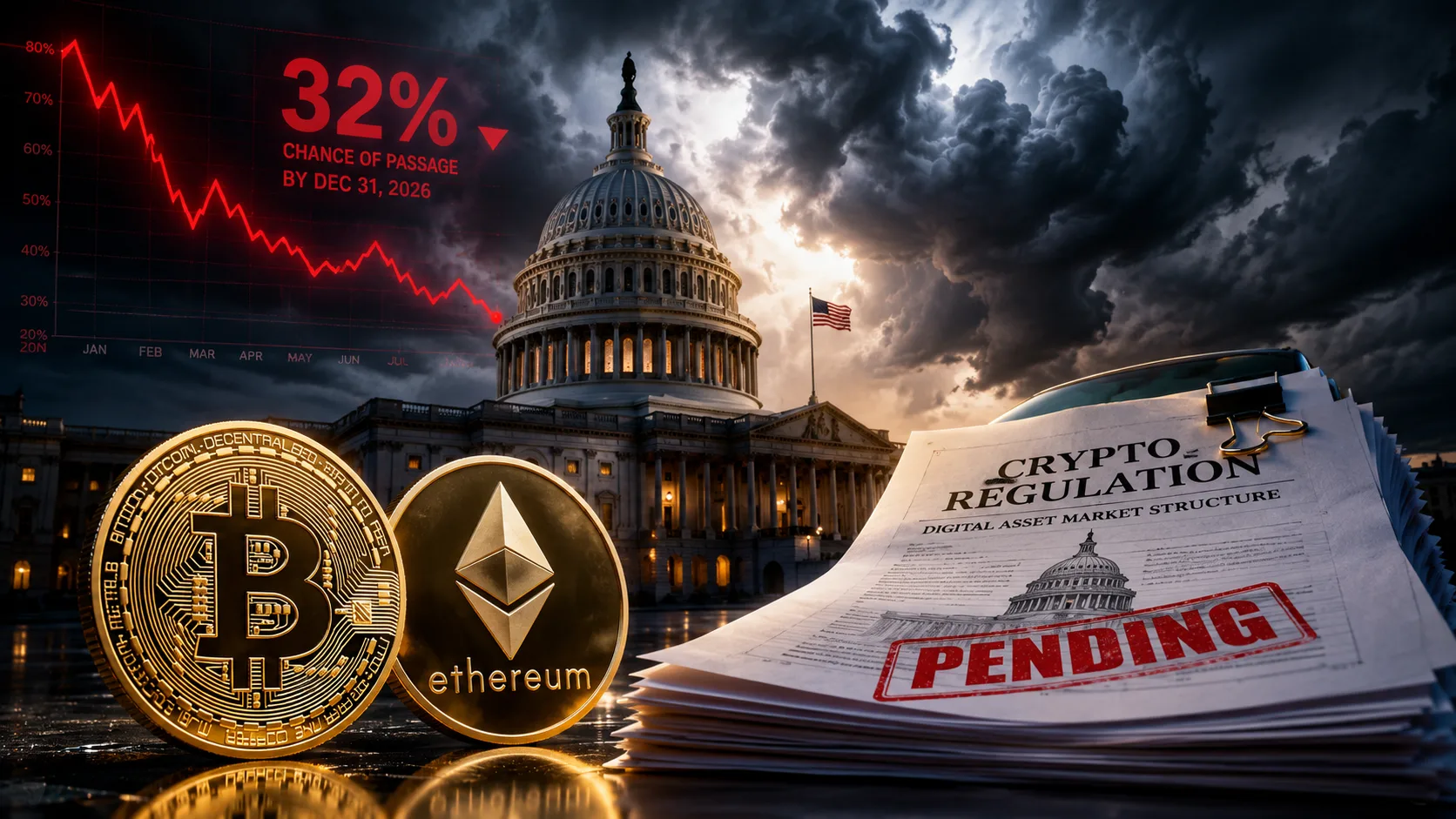
The decline highlights growing concerns that political disagreements in the Senate, particularly over ethics provisions, could delay one of the digital asset industry’s most closely watched pieces of legislation until 2027 or beyond.
Prediction Markets Signal Rising Doubt
Sentiment surrounding the CLARITY Act has deteriorated sharply on Polymarket, where traders now estimate just a 32% probability that the bill will become law before December 31, 2026.
That represents a dramatic reversal from earlier this year. After the market opened in January, confidence steadily climbed before peaking at approximately 82% in February, when many investors believed bipartisan momentum was building.
Since May, however, those expectations have steadily faded as negotiations stalled and the Senate calendar became increasingly crowded.
For many crypto investors, prediction markets are often viewed as a real-time gauge of political expectations rather than traditional polling or analyst forecasts.
Ethics Dispute Continues to Block Progress
While lawmakers continue negotiating behind closed doors, one issue has emerged as the primary obstacle.
Several Democratic senators continue pushing for stronger ethics rules governing digital asset ownership and potential conflicts of interest among elected officials.
Sen. Ruben Gallego of Arizona, one of the Democrats who previously supported advancing the legislation through committee, has publicly stated he will not vote for the bill on the Senate floor without bipartisan ethics language included.
Other Democrats have voiced similar concerns, arguing that cryptocurrency legislation should address potential conflicts involving public officials before establishing a new regulatory framework.
Despite recent discussions at the White House and ongoing Senate negotiations, no bipartisan compromise had been publicly announced as of Friday.
Why the CLARITY Act Matters
The CLARITY Act would establish the first comprehensive federal framework governing U.S. digital asset markets.
Its biggest objective is defining which cryptocurrencies fall under the jurisdiction of the Securities and Exchange Commission (SEC) and which should instead be regulated by the Commodity Futures Trading Commission (CFTC).
Supporters argue the legislation would replace years of regulatory uncertainty and enforcement actions with clear rules established by Congress.
Many industry participants believe greater regulatory certainty could encourage innovation, increase institutional investment, and reduce the incentive for blockchain companies to relocate overseas.
Industry Leaders Continue Pressing Congress
Despite weakening expectations among traders, executives from across the digital asset industry continue urging lawmakers to move forward.
During a House hearing marking one year since the chamber approved the legislation, several industry representatives argued that regulatory ambiguity has already cost the United States investment and technological leadership.
Executives said companies need a stable legal framework that remains consistent regardless of changes in presidential administrations or regulatory leadership.
Supporters also argued the legislation would protect software developers while preserving existing anti-money laundering requirements and investor protections.
Time Is Becoming the Biggest Enemy
Even if negotiators eventually resolve the ethics dispute, the legislative calendar presents another major challenge.
Congress is approaching its August recess, leaving relatively few working weeks available before the end of the year. Any additional delays could significantly reduce the likelihood of the Senate completing debate, approving amendments, reconciling differences with the House, and sending the legislation to President Donald Trump for signature before the deadline.
That increasingly compressed timeline appears to be driving the sharp decline in prediction market confidence.
Why Investors Are Watching
The outcome of the CLARITY Act could reshape the U.S. cryptocurrency industry for years.
A successful vote would likely provide clearer operating rules for exchanges, blockchain developers, token issuers, and institutional investors while reducing uncertainty surrounding federal oversight.
If the legislation stalls, however, many companies could continue operating under the existing patchwork of enforcement actions and evolving regulatory interpretations.
With prediction markets now assigning the bill their lowest probability of passage on record, investors are signaling that political hurdles may prove more difficult to overcome than many expected earlier this year.
About Author