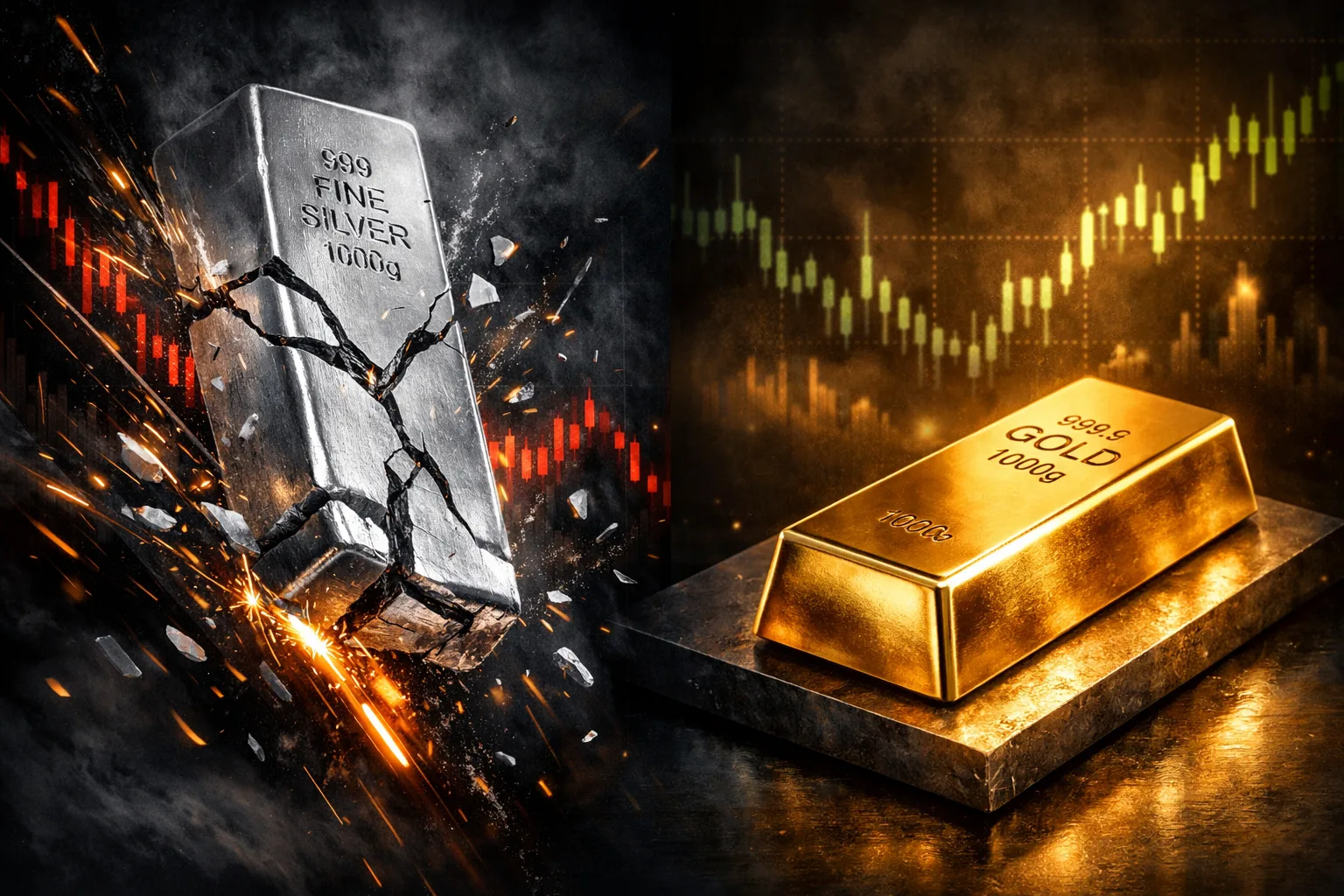
Silver took a sharp hit Thursday, plunging far more aggressively than gold as volatility ripped through the precious-metals market. The move caught many investors off guard, especially as gold began showing signs of stabilizing after its recent correction.
The divergence highlights a critical truth for investors. Gold and silver often move together, but when market stress rises, their behavior can look very different.
Here is what is really happening beneath the surface and what it means for investors.
Silver’s Sudden Drop Stuns the Market
Silver futures fell more than 9% in a single session, dramatically underperforming gold, which declined only modestly. The steep move followed a violent two-day pullback that erased more than 30% from silver prices, one of the sharpest corrections in recent years.
Market positioning and extreme volatility were the primary drivers behind the move rather than any sudden change in physical supply or demand.
“The outsize move in silver is much more about positioning and volatility than some sudden change in the physical metal markets.”
— Adam Koos, Libertas Wealth Management
Silver settled near the mid-$70s per ounce, while gold held near the upper-$4,800 range. Despite silver’s sharp decline, gold managed to remain positive for the week, reinforcing its role as the more stable precious metal during market stress.
Volatility Is the Key Difference
One of the most important drivers behind silver’s outsized drop is its dramatically higher volatility compared with gold.
Data from volatility indexes showed silver trading at nearly three times the volatility level of gold during the selloff. This is not unusual. Historically, silver has been far more volatile than both gold and even the broader stock market.
There are several structural reasons for this.
- Silver has thinner financial liquidity
- The total market size is smaller in dollar terms
- It is more sensitive to economic growth expectations
- It attracts more short-term and leveraged traders
This combination makes silver highly reactive when market conditions change quickly.
When volatility spikes, leveraged traders are forced to rapidly adjust positions, which can amplify price swings both up and down.
Why Gold Is Holding Up Better
Gold’s relative stability comes down to who owns it and why.
Gold is primarily held by:
- Central banks
- Institutional investors
- Long-term portfolio allocators
Because of this ownership structure, gold tends to react less violently to short-term market stress. Central bank demand in particular has created a strong price floor for gold over the past several years.
Gold also plays a critical role as a liquidity hedge during market turbulence. When investors seek safety, gold often benefits, even while riskier assets like silver decline.
This difference explains why the two metals can behave so differently despite being influenced by the same macroeconomic environment.
As one strategist put it, gold and silver have two very different personalities.
Silver’s Rally May Have Gone Too Far
Another factor behind silver’s drop is simple market mechanics. Silver had surged rapidly in January, reaching levels that may not have been supported by underlying fundamentals.
Some analysts now believe silver’s fair value range sits closer to $70 to $80 per ounce rather than the $110 to $120 levels reached during its recent peak.
When markets run too far ahead of fundamentals, corrections can be swift and severe, especially in assets with high volatility like silver.
This appears to be exactly what happened.
The Bigger Picture for Precious Metals
Despite the turbulence, the broader outlook for gold remains strong.
Following the recent correction, gold appears to have found solid buying support between roughly $4,500 and $5,000 per ounce. Long-term projections from major institutional analysts still point higher.
Some strategists now believe gold is more likely to reach $6,000 per ounce within the next 6 to 12 months than fall back toward $4,000.
However, the path forward is unlikely to be smooth. Short-term volatility remains elevated due to:
- Ongoing market deleveraging
- Shifting risk appetite
- Liquidity demand
- Global macro uncertainty
This environment tends to produce sharp swings, especially in more volatile metals like silver.
Silver Enters Bear Market Territory
While gold stabilizes, silver has entered what some analysts are calling a technical bear market following its dramatic January surge and subsequent collapse.
The decline does not necessarily signal long-term weakness, but it does highlight silver’s tendency to overshoot both on the upside and downside.
Silver is heavily influenced by industrial demand and global growth expectations, making it more cyclical than gold. When markets begin pricing in slower growth or tighter liquidity, silver often reacts more sharply.
Macro Forces Still Favor Gold
Several broader forces continue supporting gold’s long-term trajectory:
Central Bank Buying
Global central banks have been accumulating gold at historically high levels, reducing downside risk.
Currency Instability
Persistent concerns around fiat currency debasement continue driving long-term gold demand.
Interest Rate Uncertainty
Markets remain uncertain about the future path of global interest rates, keeping gold attractive as a hedge.
Geopolitical Risk
Ongoing geopolitical tensions continue reinforcing gold’s safe-haven status.
These forces provide a strong structural foundation for gold even during short-term corrections.
What This Means for Investors
The recent divergence between gold and silver offers important lessons.
Gold Remains the Core Defensive Asset
Gold continues to behave as a stabilizer during market stress. Its lower volatility and institutional support make it a foundational allocation in many portfolios.
Silver Is Higher Risk, Higher Reward
Silver can outperform gold during bullish phases but often suffers deeper corrections during volatility spikes. Investors must be prepared for larger swings.
Volatility Creates Opportunity
Sharp moves in silver often produce tactical entry points for long-term investors willing to tolerate risk.
Market Structure Matters
Understanding who owns an asset and why is critical. Gold’s institutional ownership dampens volatility while silver’s speculative participation amplifies it.
The Road Ahead
In the near term, markets are likely to remain volatile. Precious metals may continue experiencing sharp moves as investors reposition amid changing liquidity conditions and macro uncertainty.
Gold appears to be stabilizing and rebuilding support after its correction, while silver may need more time to reset following its rapid decline.
Long term, both metals remain important components of diversified portfolios, but their roles are very different.
Gold is the anchor.
Silver is the accelerator.
Understanding that difference is key to navigating what comes next.
About Author