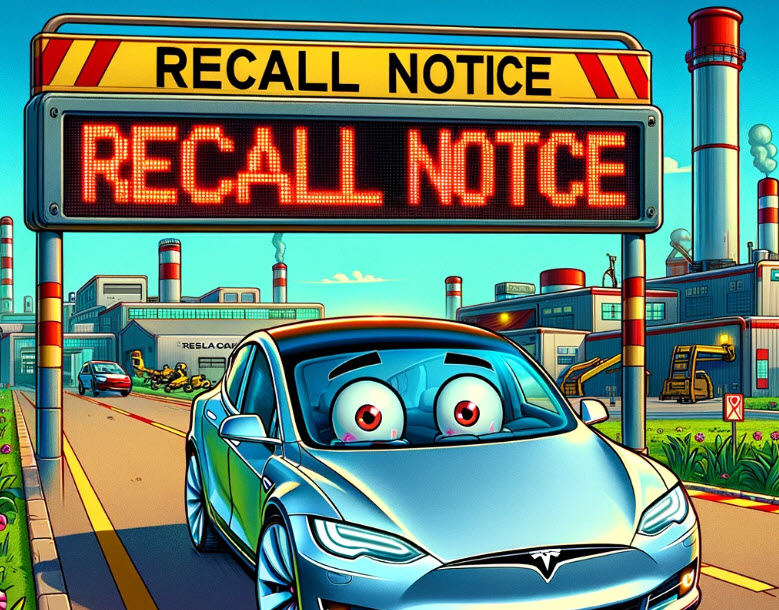
Big Picture: In a sweeping move affecting nearly every Tesla on American roads, the company announced a recall for 2 million vehicles. This isn’t your usual recall – think less of wrenches and car lifts, more along the lines of digital updates. This action follows a comprehensive two-year probe by the National Highway Traffic Safety Administration (NHTSA) into incidents linked to Tesla’s Autopilot feature.
Digital Remedy: What’s Tesla tweaking? The primary change is a software update, essentially a push of digital enhancements rather than a physical fix. This update intensifies warnings for drivers, reminding them that despite the futuristic “Autopilot” label, active and alert driving is non-negotiable. Hands on the wheel, eyes on the road – the mantra remains unchanged.
Under the Microscope: The Why Behind the Recall
The Investigation’s Findings: The NHTSA’s deep dive into hundreds of Tesla-related accidents unearthed a critical flaw: lax safety mechanisms. These gaps allowed drivers to misuse Autopilot, sometimes in extreme scenarios like drunken driving or, astonishingly, from the backseat.
Beyond the Update: Lingering Concerns: Safety experts are chiming in, suggesting that the update is a step, but perhaps a small one. They point out that additional alerts don’t fully tackle deeper issues with the Autopilot system. Particularly troubling is the system’s inconsistent performance in recognizing objects in its path, notably emergency vehicles. A Washington Post investigation brings a sobering perspective: since 2019, Autopilot-related accidents have led to at least 17 fatalities.
Contextual Additions: A Broader View
The Autopilot Dilemma: Tesla’s Autopilot has been a subject of fascination and controversy. On one hand, it’s hailed as a leap towards futuristic, autonomous driving. On the other, it’s scrutinized for how it blurs the lines between driver assistance and full automation – a gray area that, as we’ve seen, can have dire consequences.
The Regulatory Landscape: This recall is a pivotal moment in the ongoing dialogue between innovative automakers and regulators. As cars get smarter, the rules governing them are playing catch-up. This recall could be a bellwether for how the industry and regulators navigate the complex interplay of technology, safety, and consumer expectations in the era of smart vehicles.
In essence, this recall is more than just a software patch. It’s a critical juncture in the evolution of autonomous driving technology and its governance. Tesla’s response and the industry’s reaction will shape the road ahead, literally and metaphorically.
About Author