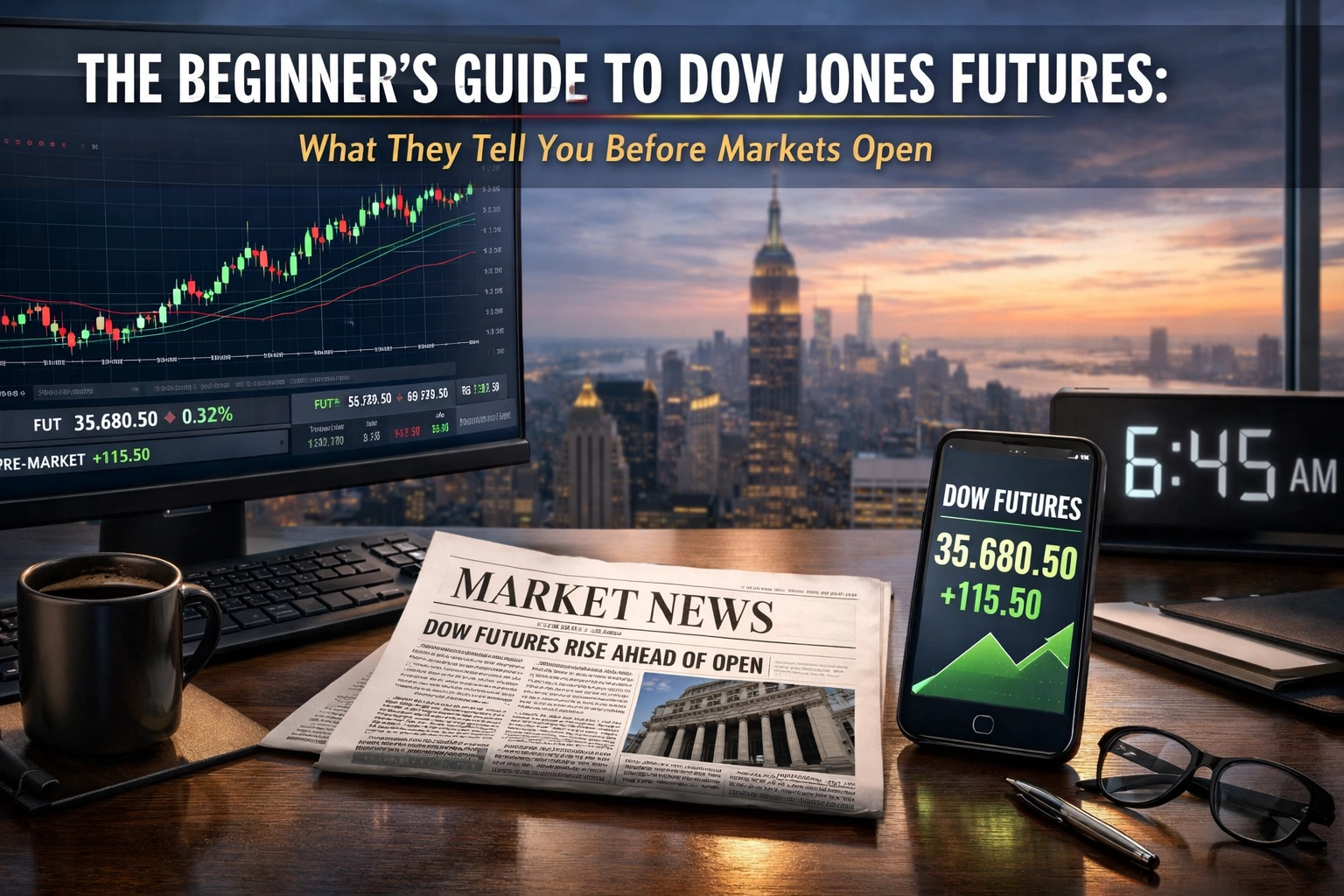
At 4:00 AM in New York, the floor of the New York Stock Exchange remains dark. The brokers are not yet at their terminals, and the iconic opening bell is hours away from ringing. Yet, on digital screens across the globe, the value of the American economy is already shifting. Numbers flicker in green and red as “the futures” move. For the uninitiated, these pre-market fluctuations can seem like noise, but for seasoned investors, Dow Jones futures are a sophisticated signaling mechanism that provides a window into market sentiment long before the first trade is executed on Wall Street.
Understanding Dow Jones futures is a prerequisite for any investor looking to transition from a passive observer to an informed participant in the global financial landscape. These instruments do more than just predict the opening price; they serve as a 24-hour pulse of investor confidence, reacting in real-time to geopolitical shifts, economic data, and corporate developments.
The Technical Foundation: What is a Dow Future?
A Dow Jones future is a legally binding contract between two parties to buy or sell the value of the Dow Jones Industrial Average (DJIA) at a predetermined price on a specific future date. Unlike a standard stock purchase where an investor takes ownership of shares in a company, a futures contract is a derivative. Its value is derived from the underlying index, which tracks 30 prominent, blue-chip companies listed on United States stock exchanges.
These contracts are traded on the Chicago Board of Trade (CBOT). Because the Dow is an index and not a physical commodity like crude oil or gold, there is no physical delivery of goods. Instead, these contracts are cash-settled. When the contract expires: typically on a quarterly basis: the difference between the contract price and the actual index price is settled in cash.
For the retail investor, the primary utility of these contracts lies in their nearly continuous trading cycle. While the “cash market” for stocks operates on a strict schedule (typically 9:30 AM to 4:00 PM EST), the futures market trades almost 24 hours a day, five days a week. This allows the market to digest news that happens while American exchanges are closed, such as economic shifts in Asia or policy changes in the European Union.
How the Value is Calculated: The Multiplier Effect
The “price” of a Dow future is not a direct one-to-one reflection of the index in dollar terms. To understand how much a contract is actually worth, an investor must look at the “multiplier.” The multiplier determines the dollar value of a single-point move in the index.
There are currently three primary types of Dow futures contracts, each catering to different levels of institutional and individual capital:
- E-Mini Dow (YM): This is the most popular contract for active traders. It features a $5 multiplier. If the Dow Jones Industrial Average is trading at 38,000, the notional value of one E-Mini contract is $190,000 (38,000 x $5).
- DJIA Futures (ZD): This mid-tier contract utilizes a $10 multiplier.
- Big Dow (DD): Designed for large institutions, this contract carries a $25 multiplier, meaning a 100-point move represents a $2,500 change in value per contract.
Because these contracts involve large notional values, they are traded on margin. Margin allows an investor to control a large position with a relatively small amount of collateral. For example, a broker might only require $10,000 in equity to hold an E-Mini contract worth nearly $200,000. While this leverage can amplify gains, it equally amplifies losses, a factor that requires disciplined risk management.

The “Indicated Open”: Reading the Sentiment Gauge
The most common way a retail investor interacts with Dow futures is by checking the “indicated open” before 9:30 AM EST. If financial news outlets report that “Dow futures are up 200 points,” they are indicating that the market expects the index to open significantly higher than it closed the previous day.
This movement is driven by the “Fair Value” calculation. Fair value is the theoretical price of a futures contract based on the current cash index price, adjusted for dividends and interest rates. When the actual trading price of the future deviates from this fair value, it signals a shift in sentiment.
For instance, if a major constituent of the Dow: such as a large tech firm or a global retailer: releases an earnings report at 7:00 AM that exceeds analyst expectations, futures traders will immediately begin buying contracts. This demand pushes the futures price up. By the time the regular market opens at 9:30 AM, the stock prices of the 30 companies in the index will likely “gap up” to align with the price levels already established in the futures market.
This makes futures an essential tool for understanding “overnight risk.” In a globalized economy, news does not stop when the NYSE closes. Events ranging from Supreme Court rulings to international trade agreements can occur at any hour. Futures ensure that these events are priced in incrementally rather than causing a total chaotic vacuum at the opening bell.
Why the Dow Remains a Critical Benchmark
Despite the rise of the S&P 500 and the Nasdaq-100 as broader measures of market health, the Dow Jones Industrial Average remains a vital psychological and operational benchmark. Its focus on 30 “Blue Chip” companies: leaders in their respective industries: means that Dow futures specifically track the sentiment regarding the bedrock of the American industrial and consumer economy.
The calculation of the Dow itself is price-weighted, meaning companies with higher stock prices have a greater influence on the index’s movement than those with lower prices. This differs from the S&P 500, which is market-cap weighted. Because of this unique structure, Dow futures react differently to market stimuli. A major move in a high-priced industrial stock will move the Dow futures more significantly than a similar move in a lower-priced tech stock, providing a specific type of industrial-centric insight that other indices might miss.

Practical Application for Long-Term Investors
While most beginners should be cautious about actively trading futures due to the inherent risks of leverage, every investor should know how to read them. For those focusing on long-term wealth building: such as those concerned with the stark realities of retirement savings: futures provide a “heads up” on market volatility.
If futures are showing extreme volatility (swings of 500 points or more) in the pre-market, it is often a sign of high institutional uncertainty. For a retail investor, this might be a signal to avoid making impulsive “market orders” at the open, when price spreads are often wide and volatility is at its peak. Instead, observing the futures can help an investor wait for the market to “settle” later in the trading session.
Furthermore, futures help put daily news into perspective. During periods of high-profile product launches or technological shifts, such as advancements in artificial intelligence, the futures market often provides the first verdict on whether the news is truly “market moving” or simply hype.
The Role of Arbitrage and Market Efficiency
The relationship between Dow futures and the actual stocks in the index is maintained through a process called arbitrage. Professional trading firms use high-frequency algorithms to monitor the price of the 30 underlying stocks versus the price of the futures contract.
If the futures contract becomes “too expensive” compared to the stocks, these firms will sell the futures and buy the stocks, pocketing the difference. If the futures are “too cheap,” they do the opposite. This constant pressure ensures that the futures and the cash market stay in lockstep. For the average investor, this means that the “indicated open” seen on Global Market News is a highly accurate representation of where the market’s collective mind is at that exact moment.
Summary of Market Mechanics
Understanding the Dow futures market is less about predicting the future and more about understanding the present state of global risk. By tracking the multiplier-based contracts, observing the “indicated open” versus fair value, and recognizing the impact of overnight news, investors gain a clearer picture of the financial environment.
Whether used as a hedging tool to protect a portfolio or simply as a morning barometer to gauge the day’s potential volatility, Dow Jones futures remain one of the most powerful informational assets in a retail investor’s toolkit. They remind us that while the trading floor may close, the global conversation about value, risk, and opportunity never truly stops.
About Author