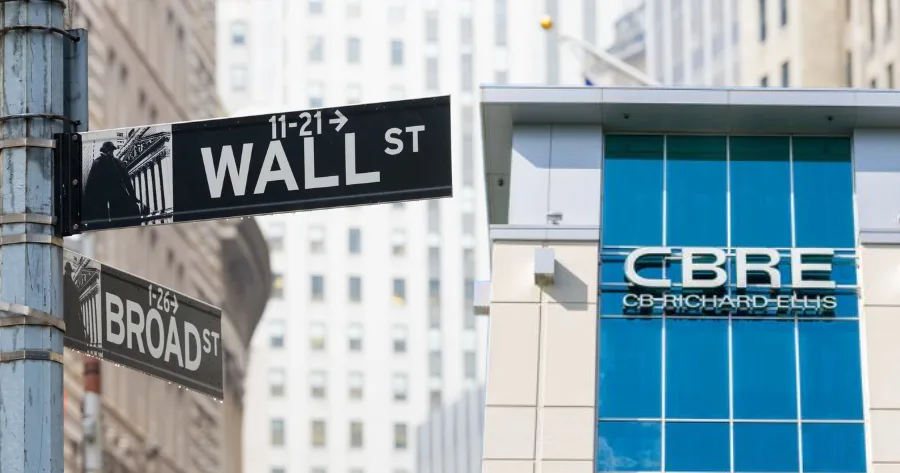
Shares of CBRE Group were hammered earlier this month as investors dumped office related real estate names on fears that artificial intelligence could permanently shrink demand for office space.
Now one major Wall Street bank is taking the other side of that trade.
UBS upgraded CBRE to Buy from Neutral and lifted its 12 month price target to $185 from $175. The new target implies roughly 21 percent upside from recent levels and suggests the stock could climb to fresh all time highs if the firm’s thesis plays out.
The call comes after a sharp selloff that erased billions in market value in just days.
Why CBRE Stock Sold Off So Hard
CBRE plunged roughly 20 percent over a two day stretch amid a broader market narrative that AI will replace enough white collar workers to reduce long term office demand.
The logic is straightforward. If generative AI tools eliminate jobs in consulting, legal services, finance, marketing, and tech, fewer employees would need desks. That could mean lower occupancy rates, weaker leasing activity, and downward pressure on office rents.
The result was a swift repricing of companies tied to commercial real estate, especially those with meaningful exposure to office brokerage and advisory services. CBRE shares fell nearly 14 percent for the month during the height of the AI panic.
But UBS analyst Alex Kramm believes that reaction overshot reality.
UBS: CBRE Is Built to Navigate AI Disruption
In a detailed research report, Kramm argued that while AI could affect office usage at the margin, CBRE’s business model is more resilient than the market is assuming.
“While AI could have some impact over time, we believe CBRE is actually positioned to benefit given its strong industry position and vast data assets,” he wrote.
He added that CBRE’s services are complex, localized, and relationship driven. Real estate advisory work often involves regulatory considerations, local market knowledge, structured finance, capital markets execution, and long term client relationships. These are not easily automated functions.
CBRE, formerly known as CB Richard Ellis and originally tied to the Coldwell Banker brand, has evolved into the world’s largest commercial real estate brokerage and advisory firm. Its scale gives it access to massive data sets on leasing trends, capital flows, tenant behavior, and property valuations. That data advantage could become more valuable in an AI driven world rather than less.
Strong Fundamentals May Be Getting Ignored
Beyond the AI debate, UBS pointed to solid underlying fundamentals.
In its most recent quarterly earnings report, CBRE issued strong forward guidance and said momentum from late 2025 carried into the first six weeks of 2026. Management signaled continued strength in capital markets activity, leasing pipelines, and property management services.
Kramm wrote:
“We are raising our [earnings and revenue] estimates significantly, supported by strong industry trends and company guidance, which points to 14-19% y/y growth in FY26.”
He added:
“We think the stock is pricing in only ~7% medium-term revenue growth, leaving room for upside.”
If UBS is right, investors may be anchoring to worst case AI scenarios while ignoring improving real estate transaction volumes and broader economic tailwinds.
The Bigger Real Estate Picture in 2026
Commercial real estate has already endured several structural shocks in recent years.
First came the pandemic, which accelerated remote work. Then came higher interest rates, which froze capital markets transactions and crushed valuations across office and multifamily assets. Now AI is being framed as the next existential threat.
Yet data across several major metro markets shows that office utilization has been stabilizing rather than collapsing. Hybrid work is clearly here to stay, but companies are also consolidating into higher quality space. That trend benefits large brokerage firms that advise on relocations, lease restructurings, and portfolio optimization.
At the same time, capital markets activity has been slowly recovering as investors adjust to a higher rate environment. If rates remain stable or drift lower, transaction volumes could accelerate further. Brokerage revenue is highly sensitive to deal flow.
CBRE also has diversified exposure beyond traditional office. The firm operates in industrial, data centers, healthcare real estate, life sciences, and alternative asset advisory. Industrial and logistics properties in particular have remained strong due to e commerce growth and supply chain reconfiguration.
Could AI Actually Help Real Estate Brokers?
There is another angle the market may be underestimating.
AI does not only replace labor. It also enhances productivity.
Firms like CBRE can use AI driven analytics to forecast demand, optimize property pricing, identify off market opportunities, and streamline due diligence. That could increase margins and improve client outcomes.
In that sense, AI could become a competitive advantage for firms with scale, capital, and proprietary data. Smaller regional players may struggle to invest at the same level.
If that dynamic plays out, industry consolidation could accelerate. Larger firms could capture incremental market share.
Risks Investors Should Watch
That said, this is not a risk free story.
If AI adoption accelerates faster than expected and companies dramatically shrink office footprints, leasing volumes could suffer. A recession would also hit transaction activity hard. Real estate remains cyclical.
In addition, higher for longer interest rates would continue to pressure valuations and refinancing activity across commercial property sectors.
Investors should also monitor occupancy trends in major gateway cities, corporate hiring data, and capital markets deal flow. Those metrics will ultimately determine whether UBS’s growth forecast proves realistic.
Why This Matters for Investors
For investors looking at CBRE today, the debate boils down to this question:
Is the market pricing in too much structural decline and not enough cyclical recovery?
UBS believes the answer is yes. With projected 14 to 19 percent year over year growth in fiscal 2026 and a stock valuation that reflects only about 7 percent medium term revenue growth, the firm sees a disconnect.
If earnings continue to surprise to the upside and capital markets activity strengthens, the stock could re rate higher.
On the other hand, if AI driven labor displacement materially reduces office demand over the next few years, today’s valuation may not be as cheap as it appears.
For long term investors, this may represent a classic fear driven setup. Panic around a new technology often leads to short term overreactions. The key is separating narrative from numbers.
Right now, UBS is betting that the numbers win.
Sources
- https://www.cnbc.com/2026/02/23/ubs-upgrades-cbre-rare-buying-opportunity-ai-fears.html
- https://www.cbre.com/investors
- https://www.ubs.com/global/en/investment-bank.html
About Author